

You can't run away from problems
Where life is better, not where earnings are higher: how Central Asian cities are changing
**You Can't Run Away from Problems**
Modern urbanization in Central Asia is gradually approaching a stage where the economic attractiveness of a city is no longer determined solely by the number of jobs and salary levels.
Over the past thirty years, internal migration flows within the region have mostly formed around capitals and major industrial centers where investments, government institutions, universities, and high-paying employment were concentrated. Almaty, Astana, Tashkent, Bishkek, and Dushanbe became the main destinations for internal migration, despite differences in housing costs, transport accessibility, and the condition of the urban environment.
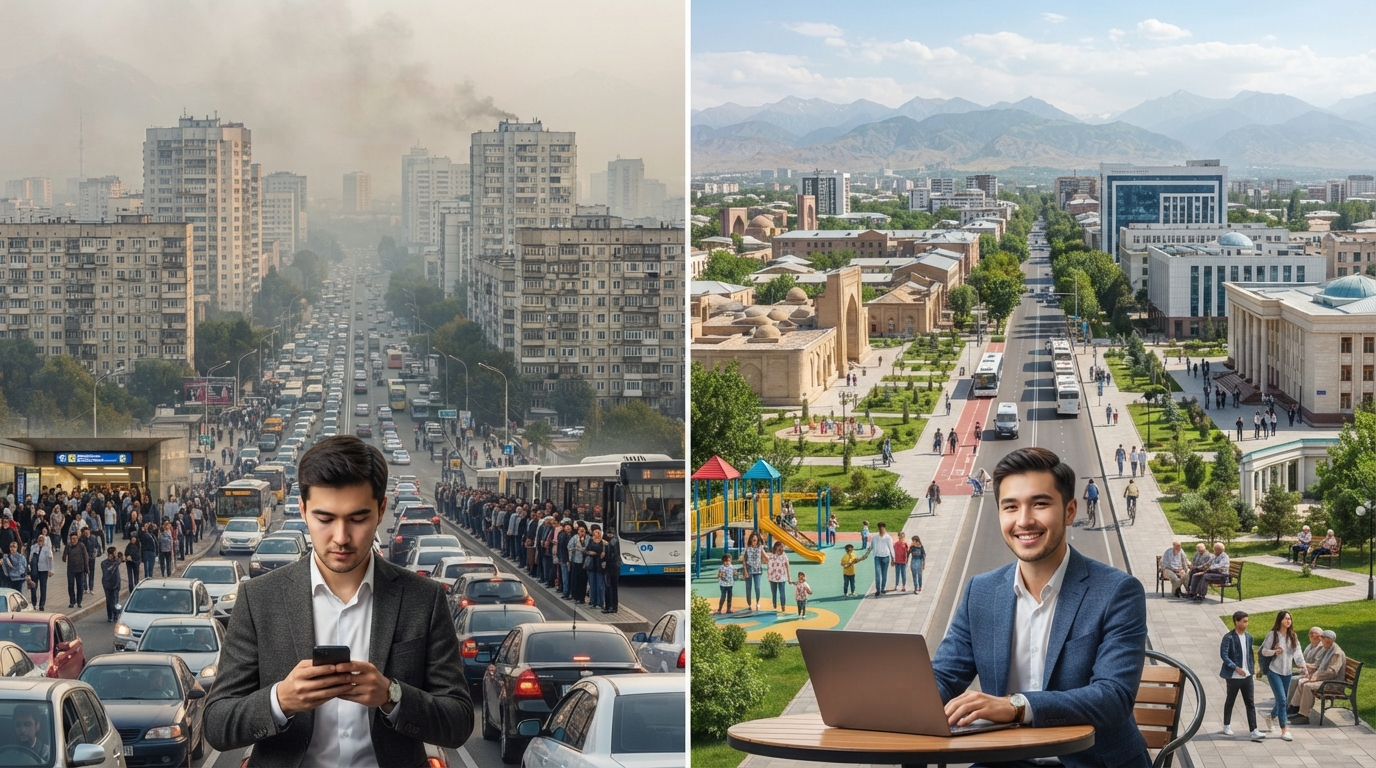
However, population growth is gradually changing the economic logic of such movement. Rising rent payments, traffic jams, air pollution, and the overload of social infrastructure reduce the real benefits of a higher salary. For qualified specialists, especially those who can work remotely, a different model for choosing a place to live is emerging. Its foundation is comparing income with the total expenses of everyday life. As a result, the competitiveness of cities begins to depend not only on the ability to create jobs, but also on the efficiency of time use, accessibility of services, and the quality of urban infrastructure. Such a transformation is capable of altering the established geography of human capital in Central Asia.
The economic essence of this process is related to the difference between nominal income and the real welfare of a household. Suppose a specialist in a major city in Kazakhstan receives 500 thousand tenge per month, spending 200 thousand on housing rent, 50 thousand on transport, and another 40 thousand on additional services caused by overloaded urban infrastructure. After these expenses, 210 thousand tenge remains. In another city, the same job might bring 400 thousand tenge, but rent there costs 120 thousand, transport — 20 thousand, and associated expenses — 15 thousand. As a result, 245 thousand tenge remains, even though the nominal salary is 20% lower. This hypothetical example shows why the difference in wages does not always coincide with differences in the standard of living. An additional factor is the cost of time, which is rarely accounted for by official welfare statistics. If a daily commute takes two hours instead of forty minutes, then over 22 working days a person loses nearly 30 additional hours. Over a year, such losses are comparable to several work weeks that could have been used for education, additional employment, or family life.
The contradiction between economic concentration and the quality of the urban environment is most clearly demonstrated in Almaty. According to census data in Kazakhstan, between 2009 and 2021, the city's population grew from approximately 1.37 to 2.03 million people. By 2026, the population exceeds 2 million, with the actual burden on infrastructure being further amplified by daily trips made by suburban residents. The geographical location at the foot of the Trans-Ili Alatau creates special conditions for the accumulation of atmospheric pollution, as temperature inversions prevent the dispersion of emissions. Road transport, heating, and regional sources of pollution form a problem that cannot be evaluated solely through industrial production indicators. At the same time, Almaty retains a significant concentration of financial institutions, universities, medical organizations, and service sector enterprises. A paradox arises: the economic advantages of the city are partially offset by environmental and transport costs. For young specialists, this may remain an acceptable trade-off, but families with children evaluate the situation differently. For them, distance to school, the presence of parks, medical care, and the ability to live without constant dependence on a car are important. Thus, a single city can simultaneously remain the largest center of economic opportunities and lose its relative attractiveness for certain categories of qualified population.
Astana demonstrates another type of urban competitive advantage based on administrative concentration and large-scale infrastructure investments. The transfer of the capital of Kazakhstan in 1997 became one of the most significant state projects for the spatial redistribution of population in post-Soviet Central Asia. While in the late 1990s the population was around 300 thousand people, by the mid-2020s it exceeded 1.5 million. Government institutions, the construction sector, financial organizations, and educational centers provided a steady influx of specialists. However, rapid population growth is accompanied by an increased burden on schools, utility networks, and road infrastructure. A sharp continental climate acts as an additional limitation, raising heating costs and the maintenance of the urban environment. Under such conditions, the further attractiveness of the capital depends on whether infrastructure can develop at the same pace as the population. Even high salaries do not fully compensate for the lack of places in educational institutions or the significant distance of new residential areas from workplaces. Astana's experience shows that administrative investments can create a major city, but sustainable retention of human capital requires constant improvement in the quality of the city's daily functioning.
In Uzbekistan, similar processes are developing against the backdrop of a higher demographic load and a relatively dense network of historical cities. The country's population approached 39.5 million people by 2026, making it the largest demographic market in Central Asia. Tashkent concentrates a significant share of modern business activity, international education, financial services, and technological entrepreneurship. At the same time, Samarkand, Namangan, Andijan, Fergana, and Bukhara possess their own educational, industrial, and cultural resources. The development of transport links potentially allows for the distribution of qualified employment among several centers without limiting economic opportunities to a single capital. The distinction between the city where a workplace is located and the city where a specialist prefers to live permanently becomes especially important. The expansion of digital services and hybrid employment gradually reduces the need for a daily presence in a central office. However, this process depends on the reliability of the power supply, internet speed, and the availability of modern housing. If regional cities provide comparable quality of basic services at lower housing costs, they get a chance to compete for specialists without replicating capital city salary levels. For Uzbekistan, such a model is particularly important due to the large number of potential centers of economic activity.
Kyrgyzstan represents a different variation of urban imbalance related to the concentration of economic opportunities in Bishkek and the limited capacity of regional labor markets. According to the 2022 census, the population of the capital was approximately 1.1 million people, while the country's population exceeded 6.9 million. Bishkek concentrates state administration, leading universities, a significant portion of medical institutions, and the most developed market for professional services. However, winter air pollution, traffic congestion, and rising housing costs create serious constraints for further growth. Alternative cities, including Osh, Karakol, and Jalal-Abad, possess various advantages related to trade, tourism, education, and regional logistics. Yet natural attractiveness or lower rent by themselves do not form a full-fledged market for qualified employment. A sustainable alternative requires a sufficient concentration of employers, professional communities, and specialized services. Therefore, competition between Bishkek and regional centers is determined not by individual indicators of urban improvement, but by a combination of economic specialization and urban infrastructure. The most promising scenario appears to be one in which regional cities retain specialists capable of working for national or international markets while simultaneously enjoying the benefits of smaller settlements.
International experience confirms that the quality of the urban environment can become an independent economic resource. In Copenhagen, long-term investments in cycling infrastructure and public transport reduced the dependence of a significant portion of the population on personal cars. In Vienna, the system of municipal and subsidized housing has historically limited the impact of market rent on housing affordability for broad social groups. These examples do not mean that European models can be mechanically transferred to Central Asia, as the financial capabilities of municipalities and institutional conditions differ significantly. But they show that transport accessibility and housing policy directly affect a city's economic competitiveness. A similar pattern is noticeable in the development of university centers, where the concentration of educational institutions contributes to the formation of sustainable markets for skilled labor. For Central Asian cities, the link between the urban environment and the ability to retain graduates is particularly important. A young specialist might get an education in the capital, but choose another city if there is comparable professional employment and more comfortable living conditions there. In the long term, such decisions affect the distribution of entrepreneurial activity, tax revenues, and consumer demand. Consequently, urban improvement ceases to be merely a social expenditure item and acquires the features of an investment in human capital.
The safety of the urban environment gains special significance, encompassing far more factors than official crime statistics. Street lighting, evening public transport accessibility, road safety, and the condition of pedestrian infrastructure directly determine the daily mobility of the population. For families with children, the independent movement of schoolchildren, the accessibility of educational institutions, and the reliability of medical care are important. For women and elderly residents, the quality of public spaces and the ability to use urban services without additional transport costs matter greatly. At the same time, safety and comfort do not always require massive capital investments comparable to building new highways. Intersection organization, the development of pedestrian routes, and effective management of public transport can yield significant social effects with relatively small investments. Economically, such changes expand job accessibility for people who do not own a personal car. They also reduce hidden costs for employers related to tardiness, employee fatigue, and limited spatial mobility. Therefore, the quality of urban infrastructure is gradually becoming a factor in labor productivity, although its impact is rarely directly reflected in regional economic reports.
The housing market remains a serious limitation to the new model of urban competition. The growing attractiveness of a settlement often leads to higher real estate prices, which gradually destroys the initial advantage of affordable living. In economic literature, this effect is considered through the capitalization of urban amenities into land and housing prices. If a city improves transport, ecology, and public spaces, property owners gain the opportunity to raise rent rates. As a result, part of the economic benefit from urban improvements shifts from tenants to asset owners. For Central Asia, this problem is particularly relevant due to a high share of informal rental relationships and limited transparency in local housing markets. Additional pressure is created by internal migration, the concentration of universities, and the expansion of mortgage lending. Therefore, an increase in a city's attractiveness does not necessarily mean an increase in housing affordability for all segments of the population. On the contrary, without a corresponding increase in housing supply, successful urban transformations can accelerate social differentiation. It is precisely the combination of urban environment quality and sustainable housing affordability that determines how long a settlement retains its competitive advantage.
In the future, changing migration preferences could noticeably affect the economic geography of Central Asia. Capitals will retain the advantages of capital concentration, state institutions, and specialized labor markets; however, their monopoly on qualified personnel may gradually weaken. Regional centers will gain additional opportunities thanks to digital employment, university development, and the expansion of the professional services sector. At the same time, the decisive factor will not be the absolute level of urban comfort, but the ratio of income, expenses, and available life opportunities. For a specialist with an international income, a small city with reliable infrastructure might prove economically more attractive than a capital with a more developed labor market. For a doctor, engineer, or teacher, local professional institutions and career growth prospects will remain significant. Therefore, a single ranking of the most attractive cities does not exist outside the specific characteristics of households and professional groups. The main structural change is the transition from competing solely for investment to competing for the ability to retain human capital.
In this model, the urban environment turns into an element of economic specialization that determines the location of knowledge, entrepreneurship, and qualified employment. Ultimately, the future of Central Asian cities may depend not so much on where a person is offered the highest salary, but on where their income provides the greatest freedom to manage their own time, health, and life opportunities.