

My Dear Capitals
Almaty and Astana continue to widen the gap with other metropolises in Central Asia
My Dear Capitals
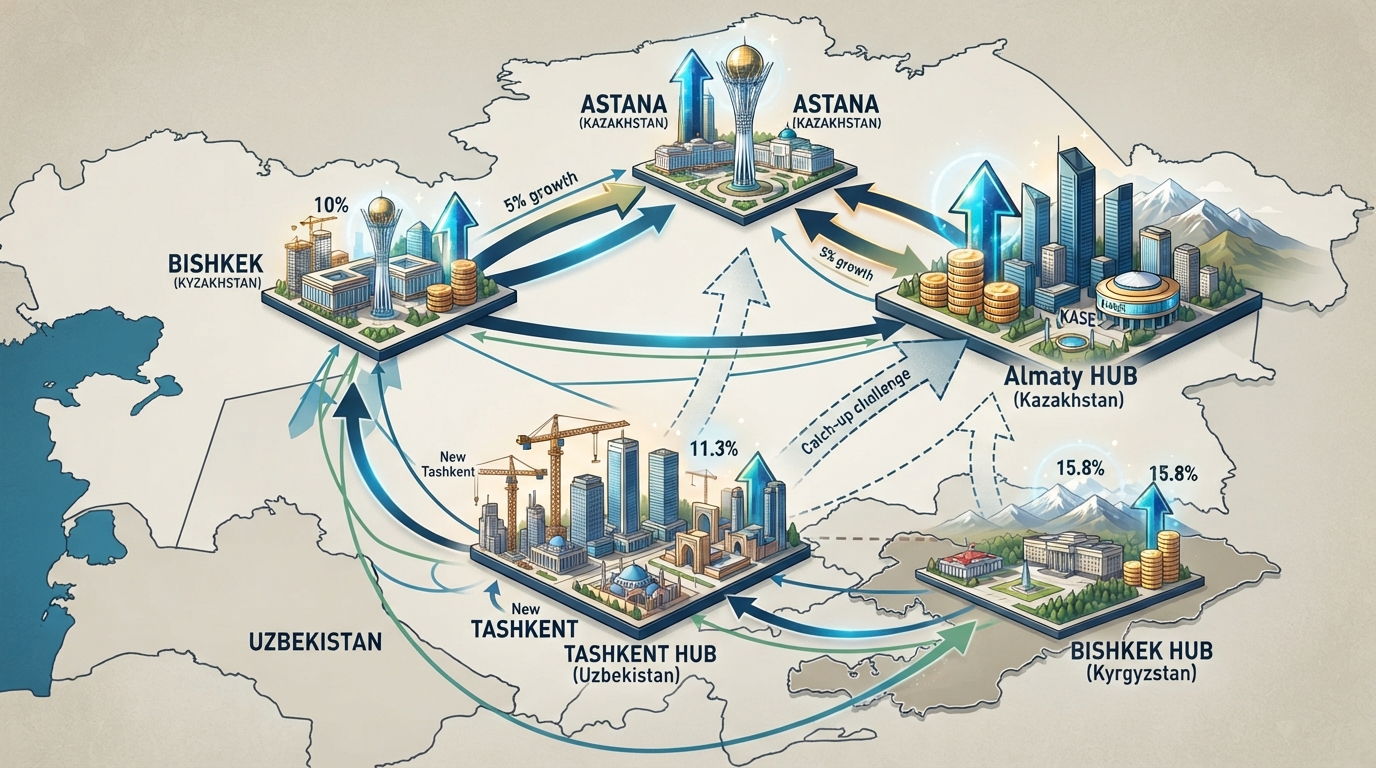
Almaty has long combined the political and commercial functions of Kazakhstan and secured its status as the leading business hub of Central Asia. After Astana became the capital of Kazakhstan, the roles of the two cities increasingly complemented each other: Almaty remained the region's largest business and financial center, while Astana strengthened its political, institutional, and corporate weight. According to updated data for Kazakhstan, Astana's economy grew by approximately 10%, and Almaty's by about 5%. In 2025, together these two cities generated around 107 billion dollars. Together, they have turned into a driving force uniting a significant portion of Central Asian trade.
Almaty and Astana possess an economic scale that has no equal in Central Asia. According to data from the TCA Central Asian Balance, Kazakhstan alone accounts for more than half of the region's GDP and approximately two-thirds of the volume of foreign direct investment. This scale allows for the formation of the necessary budgetary resources to build and maintain the municipal infrastructure that supports business activity.
Kazakhstan also possesses the most developed capital markets in Central Asia. The combination of the Kazakhstan Stock Exchange (KASE) in Almaty and the Astana International Financial Centre (AIFC) and the Astana International Exchange (AIX) in Astana gives companies access to equity capital, debt financing, institutional investors, and financial infrastructure on a scale unavailable to any other market in the region. Furthermore, Kazakhstan is the only Central Asian country with an investment-grade sovereign rating, which reduces the country risk premium and helps lower the cost of financing for companies and projects compared to lower-rated regional markets.
These advantages have been shaped over decades. Almaty and Astana have long served as regional bases for major global companies, creating a resilient ecosystem of corporate governance, finance, professional services, and a skilled workforce. This experience, in turn, enhances their ability to attract additional investment and regional headquarters.
Tashkent and Bishkek Are Also Developing Rapidly
Next comes Tashkent. The economy of Uzbekistan's political and commercial capital in 2025 was about 29 billion dollars, which is approximately 40% smaller than Almaty's economy and three-quarters smaller than Astana's economy. Tashkent also demonstrated rapid growth: according to preliminary data, its economy in real terms increased by 11.3% by 2025.
Tashkent benefits from the demographic scale of Uzbekistan. The country's population is nearly double that of Kazakhstan, meaning the capital gains access to a much larger domestic market and workforce. However, such scale simultaneously increases the need for sustainable job creation and continuous investment in housing and infrastructure. If productivity and investment do not keep pace with population growth, the demographic advantage could increasingly become a constraint rather than helping Tashkent close the gap with Almaty and Astana.
At the same time, Almaty and Astana deliver a significantly higher volume of economic output per capita. In 2025, gross regional product (GRP) per capita was approximately 29,900 USD in Almaty and 23,700 USD in Astana, compared to about 9,300 USD in Tashkent, using average exchange rates for the reporting year. These figures reflect per capita output rather than labor productivity, household income, or living standards.
Like Tashkent, Bishkek combines the functions of a political capital and a main economic center. However, according to the data used here as reporting periods, its economy is only about 30% of Tashkent's economy. According to the National Statistical Committee of Kyrgyzstan, the country's economy grew by 15.8% in 2024.
In terms of GDP per capita, Bishkek also lags behind Tashkent. GDP per capita in Bishkek in 2024 was about 6,500 dollars, whereas in Tashkent in 2025 it was approximately 9,300 dollars. This data refers to different reporting years and measures economic output per capita, not labor productivity or household income.
Bishkek's comparative advantages lie in a different plane, primarily in costs and resources. The standard corporate income tax rate in Kyrgyzstan is 10%, which is lower than the standard rates in Kazakhstan and Uzbekistan. A predominantly hydropower-based energy mix provides low-carbon energy with notable potential for further development, although seasonal power outages remain a constraining factor. Bishkek's significantly smaller population and economy mean a narrower domestic market and a smaller economic base to support infrastructure investments.
Can Tashkent Catch Up?
Catch-up growth is not just a matter of pace. Expanding Tashkent on the planned scale will require massive capital investments. These funds must come from various sources: state resources, private domestic and foreign investments, as well as international borrowing. Each of these channels has its own limitations. Uzbekistan's economy, at about 147 billion dollars, is less than half the size of Kazakhstan's, its sovereign credit rating remains below investment grade, and its capital markets are underdeveloped. Remittances rose to 14.3% of GDP in 2025, highlighting the ongoing importance of income earned abroad to the economy. Kazakhstan, by contrast, has a 306 billion dollar economy, an investment-grade sovereign credit rating, and significantly larger financial and resource reserves. These are serious structural obstacles that will take years to overcome and will require the development of capital markets, labor market reform, and the strengthening of institutions to reduce investment risks and mobilize capital on a much larger scale.
Tashkent Has Not Yet Overtaken Astana in Results, but the Gap Has Narrowed
In recent years, Tashkent grew faster than Astana, but by 2025 the gap had narrowed noticeably. Tashkent's real GDP growth was 11.3%, compared to 10.2% for Astana, meaning the growth difference was only 1.1 percentage points. Official data shows that Tashkent's recent sustained outperformance has narrowed the relative gap, but it does not confirm that such an advantage can be maintained long enough for the city to reach parity.
Tashkent is also expanding. Construction of New Tashkent began in 2023, with the first phase designed for 600,000 residents, and the city is ultimately expected to house 2 million. By 2034, there are plans to build 200,000 apartments, as well as provide business, educational, and transport infrastructure. Construction of residential complexes, business centers, and university campuses is already underway.
Meanwhile, Astana is already making a notable contribution to infrastructure development. In January-July 2026, about 2.2 million square meters of housing were completed, and construction of new transport and utility infrastructure continues. The city's master plan envisages population growth to 2.275 million people by 2035, along with further development of housing, transport, and infrastructure.
In both Tashkent and Astana, the full-scale expansion envisioned by these plans remains a prospect for now.
Thus, Tashkent is chasing a moving target. Astana's sharp acceleration in 2025 shows how quickly Tashkent's growth advantage can shrink. To reduce the remaining gap, Tashkent needs to maintain a significant economic lead while Astana continues to expand its own economic and urban base. If this advantage disappears before parity is reached, the gap will stop closing. Therefore, current data on the cities does not indicate that Tashkent is on track to overtake Astana.
Almaty Presents a Much More Serious Obstacle
Tashkent's challenge compared to Almaty is different. Almaty's economy is currently more than twice as large, meaning Tashkent will have to significantly outperform it for decades to close the gap. Tashkent reported real GDP growth of 11.3% in 2025 against 4.9% in Almaty, which is significantly higher than in previous years. To reduce the difference in economic size, Tashkent will need to maintain a notable lead for decades.
Like Astana, Almaty is not standing still. Its development program and master plan to 2040 envision five key economic and urban centers designed to distribute business activity and development across the city. Revised proposals suggest population growth to 3.6 million people by 2040, along with further housing construction and infrastructure development. The nearby city of Alatau, though under separate administration, is developing as part of the larger Almaty agglomeration and could further strengthen employment, investment, and the region's economic base. However, its contribution is not included in the GDP of the city of Almaty used in this comparison.
At the economic scale of 2025, Tashkent would have to maintain an average annual relative advantage in real GDP of approximately 1.75% compared to Almaty for 50 years, compounded, just to reach parity. There is little reason to believe that such an advantage can be sustained for so long. Long-term OECD projections also indicate that growth in emerging economies slows down over time as they converge with higher-income countries. If Tashkent's advantage shrinks as its economy matures, catching up will take longer and may not happen at all.
Can Bishkek Overtake Tashkent?
Bishkek's real GDP growth of 15.8% in 2024 was impressive, but rapid growth from a much smaller base does not in itself create a catch-up trajectory. Bishkek's economy is only about 30% of Tashkent's, leaving a relative gap generally comparable in scale to Tashkent's gap with Almaty, though slightly larger. Therefore, for Bishkek to seriously challenge the scale of Tashkent's economy, it will require sustained outperformance over many years.
Bishkek is expanding through integration into the urban environment rather than through a single new city project. The 2024 administrative-territorial reform more than tripled its territory—from 12,900 to approximately 41,000 hectares—by incorporating 24 surrounding settlements. Following this, the city approved a development plan to 2030, under which construction of water supply networks and social infrastructure in the new districts is already underway. The approved master plan to 2050 envisions a population approaching 2 million people.
Looking Forward
Almaty, Astana, Tashkent, and Bishkek are expected to develop through investment, growing demand, and stronger regional ties. The growth of each can create larger markets and new opportunities for the other cities, strengthening Central Asia as a whole.
Kazakhstan continues to reinforce its historical advantages. Almaty and Astana are expanding corporate networks, financial institutions, and decades of accumulated experience, meaning the foundations of their economic leadership continue to strengthen.
Rome was not built in a day, and neither was Kazakhstan's business ecosystem. New centers are emerging in Central Asia, but its established leaders are growing too.