

Infographic: Development of the Central Asian economy in the first half of 2026
The Center for Economic Research and Reforms has prepared an infographic dedicated to the dynamics of the development of the economies of Central Asian countries in the first half of 2026.
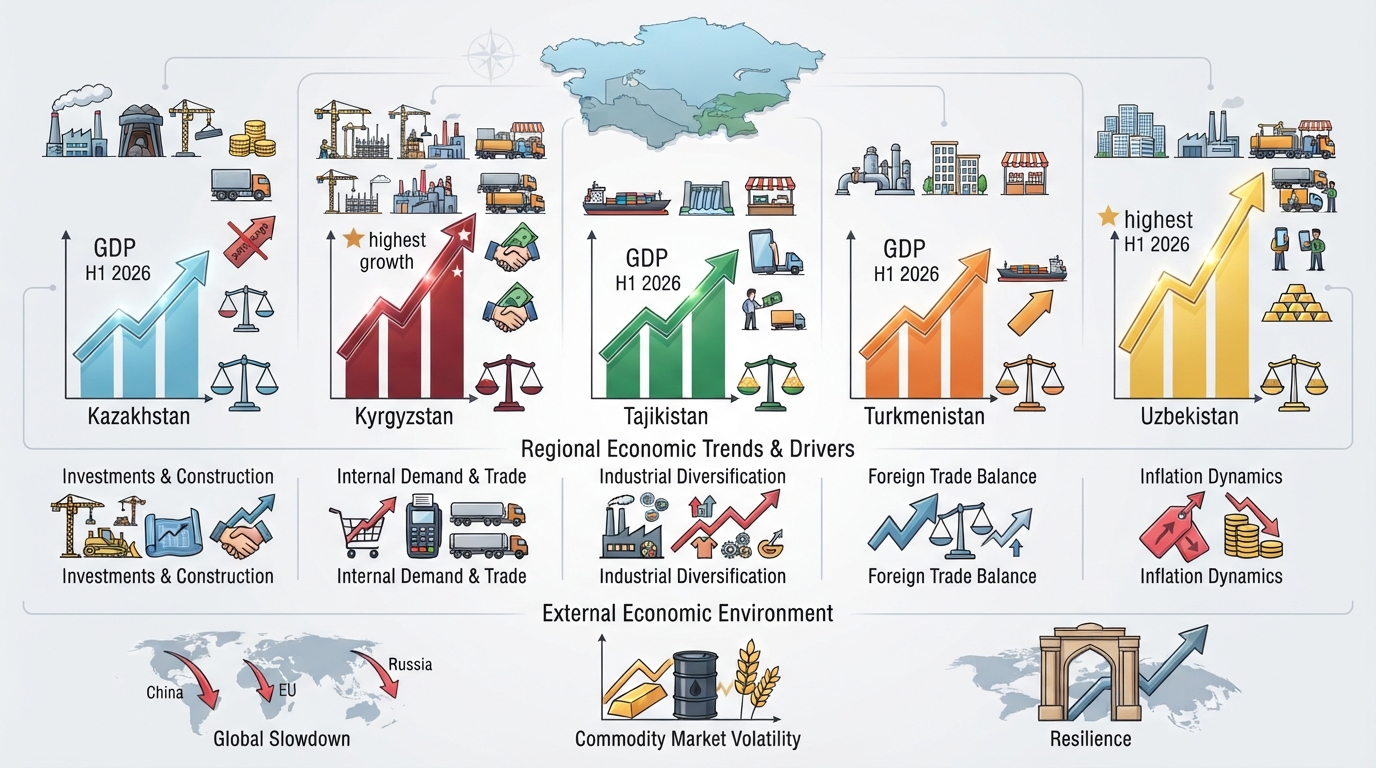
Infographic: Development of the Central Asian economy in the first half of 2026
In the first half of 2026, the economy of Central Asia showed higher growth rates than many other regions of Eurasia. Gross domestic product (GDP) continued to grow positively in all five countries of the region. However, the sources of economic growth differed significantly across countries. In some countries, growth was provided by increased construction and investment activity, while in others, the main factor was the expansion of the services sector and internal trade, as well as changes in the industrial structure.
**Main trends in the development of the economies of countries**
**Kazakhstan**
In January-June 2026, the economy of Kazakhstan grew by 4.1%, which is a decrease compared to 6.2% in the same period last year. The slowdown in growth rates was mainly influenced by the mining industry, where production volume decreased by 4.0% (in the first half of 2025 it grew by 8.4%). As a result, overall growth in the industry fell from 6.5% to 3.5%.
The main driving force of industrial growth was the processing industry, where production growth accelerated from 5.5% to 9.8%. This partially offset the decline in the raw material segment and indicates the expansion of the non-raw material production base.
High growth rates were maintained in the construction sector - 15.2% (18.4% last year). In agriculture, growth accelerated from 3.3% to 4.4%.
Investment volumes increased by 9.6%, but the growth rate was almost half as low as 19.3% in the first half of 2025. The pace of lending to the economy also slowed down from 22% to 17%.
Consumer demand continued to grow, but at a relatively moderate pace. Retail trade turnover increased by 3.8% (6.6% last year). Growth in wholesale trade also slowed down from 9.2% to 6.6%.
The inflation rate has decreased this year. In June, price growth since the beginning of the year was 5.1%, compared to 7.0% a year ago. Nevertheless, the inflation rate remains relatively high.
In 2026, foreign trade turnover is recovering after last year's decline. In January-May, foreign trade volume increased by 4.3% to $56.3 billion. Exports increased by 1.6%, and imports by 7.7%. For comparison, in the same period of 2025, foreign trade turnover decreased by 4.5%, exports decreased by 9.2%, and imports increased by 2.2%. Thus, foreign trade returned to the growth trajectory, but this year its main source was imports.
**Kyrgyzstan**
The Kyrgyz economy maintains high growth rates. In the first half of 2026, GDP grew by 11.9%, compared to 11.3% in the same period of 2025.
The main source of growth was a sharp acceleration in investment and construction activity. Investment volumes increased by 64.3% compared to 33.9% last year, and growth in construction accelerated from 33.1% to 69.6%. Lending to the economy is also expanding at a high pace - according to the results of June 2026, the growth amounted to 45%. This indicates a significant increase in the volume of capital investments.
Industry grew by 12.7%, maintaining a pace of about 12.5% last year. Within the sector, the growth of the processing industry accelerated from 12.7% to 15.1%, and the mining industry from 10.4% to 12.8%. Positive dynamics also strengthened in agriculture, with growth reaching 4.3% from 1.9%. Thus, high economic growth has gained wider coverage across sectors.
A certain slowdown was observed in the services and consumer sectors. Despite the fact that retail trade growth accelerated from 10.1% to 13.5%, wholesale trade decreased by 1.9% after a 2.1% increase last year. Overall trade growth decreased from 21.3% to 5.0%. The growth rate in the services sector also slowed down from 10.1% to 5.3%. This indicates that the main part of economic activity is concentrated in the investment and production segments.
Amid high economic activity, consumer inflation is also accelerating. Since the beginning of the year, prices have increased by 5.5%, compared to 4.0% in June 2025.
In the first five months of 2026, foreign trade turnover increased by 1% to $6.3 billion. At the same time, imports increased by 2.8%, while exports decreased by 9.3%. As a result, the negative balance in foreign trade widened further.
**Tajikistan**
The economy of Tajikistan grew by 8.2%, almost repeating the indicator of the first half of 2025 (8.1%).
At the same time, growth rates in a number of sectors of the economy slowed down compared to the previous year. In particular, industrial production growth decreased from 24.0% to 14.1%. While production in the extractive industry decreased by 6.7%, the processing industry grew by 26.0%. Growth in agriculture slowed down from 9.7% to 7.2%, and in the services sector from 12.8% to 10.6%.
At the same time, investment demand increased. Investment in fixed assets grew by 18.4%, compared to 14.6% in the same period last year. Lending to the economy also accelerated. In June, the volume of loans increased by 25% year-on-year, compared to 19% in June 2025.
Consumer demand also supported economic activity. In particular, retail trade turnover grew by 31.8%, and the trade sector as a whole by 26.1%.
Along with the expansion of domestic demand, inflation also accelerated slightly. According to the results of June, prices increased by 2.4% compared to December last year, compared to 1.8% in the same period in 2025. Despite this, inflation in Tajikistan remains one of the lowest among Central Asian countries.
Foreign trade was one of the areas of economic activity that showed high growth. In the first half of 2026, foreign trade turnover increased by 44.2% to $6.8 billion. Exports increased by 65.4% to $1.6 billion, and imports increased by 38.8% to $5.2 billion. These growth rates were significantly higher than last year's indicators.
**Turkmenistan**
The economy of Turkmenistan, according to official data, grew by 6.3% in the first half of 2026, maintaining the growth rate of the corresponding period of last year.
Investments in fixed assets accounted for 16.5% of GDP. At the same time, investment growth slowed down from 15.6% in the first half of 2025 to 4.3% this year.
The consumer sector maintained positive dynamics, with retail trade turnover increasing by 10.1%.
Growth in foreign trade accelerated. In the first half of 2026, foreign trade turnover increased by 7.5%, compared to 2.9% in the same period last year. This indicates that the contribution of the external sector to economic growth is increasing.
**Uzbekistan**
In the first half of 2026, Uzbekistan demonstrated the highest acceleration in GDP growth rates. Economic growth reached 8.5% from 7.2% in the same period in 2025. Growth was observed in all main sectors of the economy, with the strongest growth rates provided by services, trade and investment.
The volume of market services increased by 16.9%, compared to 13.3% in the first half of 2025. In particular, high growth rates were maintained in information and communication technology services, amounting to 22.1%, and in transport services - 14.7%.
Retail turnover increased by 20.2%, more than twice as much as last year's 9.7% growth. Growth in wholesale trade also accelerated from 12.4% to 16.5%.
One of the important changes in the first half of 2026 was a sharp acceleration in investment activity. Investments in fixed assets increased by 17.5%, compared to 8.5% in January-June 2025.
Positive dynamics also intensified in manufacturing sectors. Industrial production grew by 8%, compared to 6.6% a year earlier. The processing industry grew by 8.8%, and the mining industry by 2.1%. This indicates a relatively high contribution of the processing sector to industrial growth.
Growth in agriculture accelerated from 4.0% to 4.7%, and in construction from 10.7% to 13.8%.
Despite the acceleration of economic growth, investment and consumer demand, a decrease in inflation rates was also a positive result. Since the beginning of the year, prices have increased by 3.3%, compared to 4.2% in June 2025.
In the first half of 2026, foreign trade turnover increased by 7.4%, reaching $ 41 billion. Exports fell by 8.8% to $15.9 billion, while imports increased by 21% to $25.2 billion. The decline in exports was mainly due to a decline in gold exports. Excluding gold, Uzbekistan’s exports grew by 32%.
**Regional Economic Trends and Key Trends**
Economic growth in Central Asian countries remains high, but the gap between countries is widening. Regional growth is driven by double-digit growth in Kyrgyzstan and the acceleration of the Uzbek economy, while growth in Kazakhstan has slowed significantly.
Investment and construction have become the main common drivers of economic activity in the region. The investment cycle, on the one hand, supports current growth, and on the other hand, paves the way for future production capacities. At the same time, very high rates of investment and construction may increase the risks of overheating in some economies.
Domestic demand has also been one of the main factors supporting economic growth in the region. The expansion of retail trade, lending and consumer activity has strengthened economic dynamics in a number of countries.
One of the positive structural trends is the rapid growth of the processing industry in almost all countries. This creates the basis for diversifying the composition of exports, developing regional production chains and reducing the dependence of economies on raw material markets.
In foreign trade, the general trend for most countries has been a faster growth of imports than exports. This, on the one hand, reflects high domestic demand and investment activity, and on the other hand, may increase pressure on the foreign trade balance.
Inflation dynamics are not uniform across countries. Compared to the first half of 2025, inflation decreased in Kazakhstan and Uzbekistan, while it accelerated in Kyrgyzstan and Tajikistan. In this context, the high growth rate of domestic demand maintains the need for prudent monetary policy.
**External economic conditions**
The economic results of the Central Asian countries in the first half of 2026 were formed against the backdrop of a significant complication of the external environment. Growth rates slowed in the region's leading trade and economic partners, sharp changes in the energy market increased inflationary pressure, and high volatility remained in the world gold, fuel and food markets.
In the first half of 2026, economic growth slowed in major external markets important for Central Asia.
China's GDP grew by 4.7% year-on-year in January-June, compared to 5.3% in the same period last year.
In the European Union, GDP grew by 0.8% in the first quarter of 2026 compared to the same quarter of 2025.
According to estimates by the Russian Ministry of Economic Development, GDP growth in January-May was only 0.2%. After a decline in January and February, the economy returned to a low-rate positive growth in the spring. For Central Asia, this increases the risks associated with a slowdown in exports and remittances to Russia. At the same time, the shortage of labor in the Russian labor market maintains demand for labor migrants.
Sharp price fluctuations were observed on the world gold market. In January, the price of gold per troy ounce reached $5.4 thousand, but in June it fell to $4 thousand. Despite the correction, the price of gold remained at historically high levels, supporting export revenues and investment activity of gold-producing countries in the region.
Geopolitical tensions in the fuel and energy markets have caused a new price shock. Conflicts related to armed conflicts and sanctions have become one of the main sources of uncertainty for global markets. The expansion of tariff restrictions, the reorganization of supply chains, and the emergence of competing technological systems are intensifying the processes of geoeconomic fragmentation in the global economy.
Despite such external conditions, the results of the first half of 2026 showed the resilience of the Central Asian economies to external shocks.
**Conclusion**
In the first half of 2026, the economies of the Central Asian countries maintained stable and, in most cases, high growth rates, despite the slowdown in growth rates in major external partners, increased geopolitical tensions, and high volatility in global commodity markets.
The main drivers of economic growth were investments, construction, the processing industry, trade, and services. At the same time, in some countries, the faster growth of imports relative to exports, inflationary pressures, and dependence on raw material markets remain certain risks to macroeconomic stability.
In the second half of the year, the steady continuation of investment projects, opportunities for expanding the export potential of industry, and inflation dynamics will be the main factors.
The priority task for the region is to transform the current high growth rates into more productive and balanced economic growth. To this end, it is important to deepen the level of processing, expand mutual trade, improve transport connectivity, and develop cross-border production chains.
Ruslan Abaturov, Center for Economic Research and Reforms