

Investments have become the main domestic driver of economic growth in Central Asia – EDB
Investments have become the main domestic driver of economic growth in Central Asia – EDB
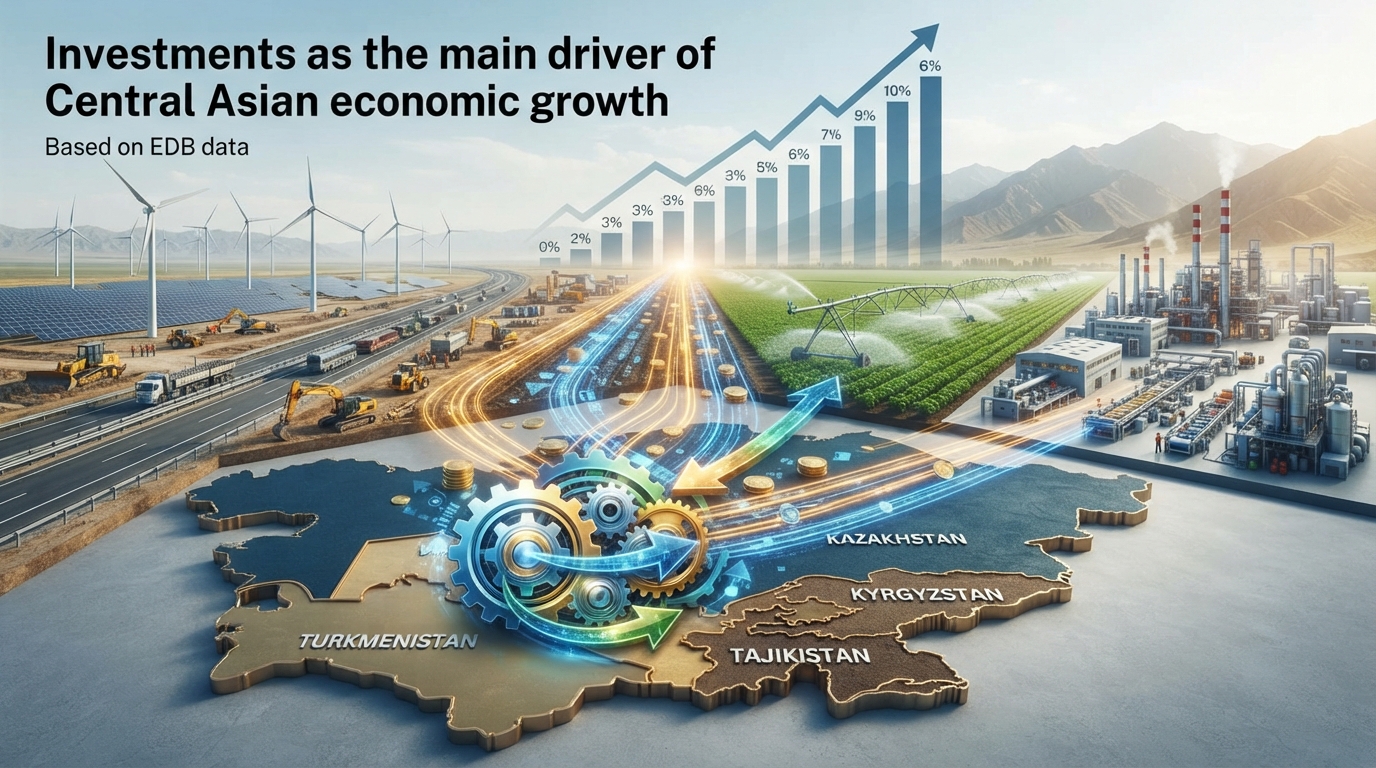
Investments have emerged as one of the primary sources of economic growth in the countries of Central Asia. Uzbekistan is confidently among the regional leaders in terms of capital investment growth rates: in 2023–2025, they grew in the country by an average of 22.6% per year. Overall, across four states of the region, the volume of investments increased by 17% in the first half of 2026.
This is indicated by data from a new review by the Eurasian Development Bank.
In 2023–2025, the economy of Central Asia grew by an average of about 6% annually. According to EDB analysts' forecasts, by the end of 2026, the region's GDP growth rate may well exceed the six percent mark. In expert circles, this resilience is directly linked to consistently high investment activity.
The average annual growth of fixed capital investment in 2023–2025 varied noticeably by country: in Kazakhstan, the figure was 10.7%, in Tajikistan – 18%, in Uzbekistan – 22.6%, and in Kyrgyzstan, it rose to 28%.
At the same time, the main source of funding for these investments remains the own funds of local enterprises and the population – accounting for more than 42% of the total volume of capital investments in the region. Another 36% is provided by foreign direct investment.
Meanwhile, bank debt financing is used significantly less. In most Central Asian countries, the share of credit funds in investments ranges from 0 to 5%, and only in Kazakhstan does it exceed 11%. At the same time, for Uzbekistan, Tajikistan, and Kyrgyzstan, concessional financing from international financial institutions plays a critically important role, enabling the implementation of large-scale infrastructure projects – primarily in the transport and energy sectors.
Simultaneously, Central Asia demonstrates high attractiveness for Asian capital. According to the EDB, the accumulated volume of investments from Asian countries into the region's economies grew from 29.9 billion dollars in 2016 to 68 billion dollars by mid-2025, which is a 2.3-fold increase.
Uzbekistan attracted the largest volume of such Asian investments – 22.6 billion dollars. It is followed by Turkmenistan with 20.6 billion and Kazakhstan with 19.3 billion dollars. For Kyrgyzstan, this figure was 3.2 billion, and for Tajikistan – 2.4 billion dollars.
However, despite the growth in financing volumes, the region's investment potential is not yet fully unlocked. EDB experts identify agriculture as one of the most promising but still underfunded areas, currently accounting for only 0 to 7% of all fixed capital investments. For the countries of the region, the development of irrigated agriculture and the introduction of water-saving technologies are strategically important, especially considering that the average age of the local irrigation infrastructure has already exceeded 50 years and requires large-scale modernization.
Another priority vector is the manufacturing industry. In Uzbekistan, about a third of all fixed capital investments are directed specifically into processing industries. In Kazakhstan, the share of investments in manufacturing grew from 4.4% in 2023 to 14.5% in the first quarter of 2026. In Kyrgyzstan and Tajikistan, these figures are still lower – 5% and 2.8% respectively. The EDB emphasizes that increasing investments in processing will allow countries to expand their industrial base, increase the output of high-value-added products, and make economic growth more sustainable.
No less important areas remain transport and energy: the share of the transport sector in the capital investments of the region's countries exceeds 7%, while energy accounts for more than 10% on average. The need for constant support of these industries is linked to the rapid expansion of economies, growing demand for resources, the development of new trade corridors, and the transition to alternative energy.
Thus, further stimulation of domestic and external investment flows remains a fundamental condition for maintaining high development rates throughout Central Asia.