

Millions will go north
Millions Take to the Start: What Awaits Central Asia When Today's Children Grow Up
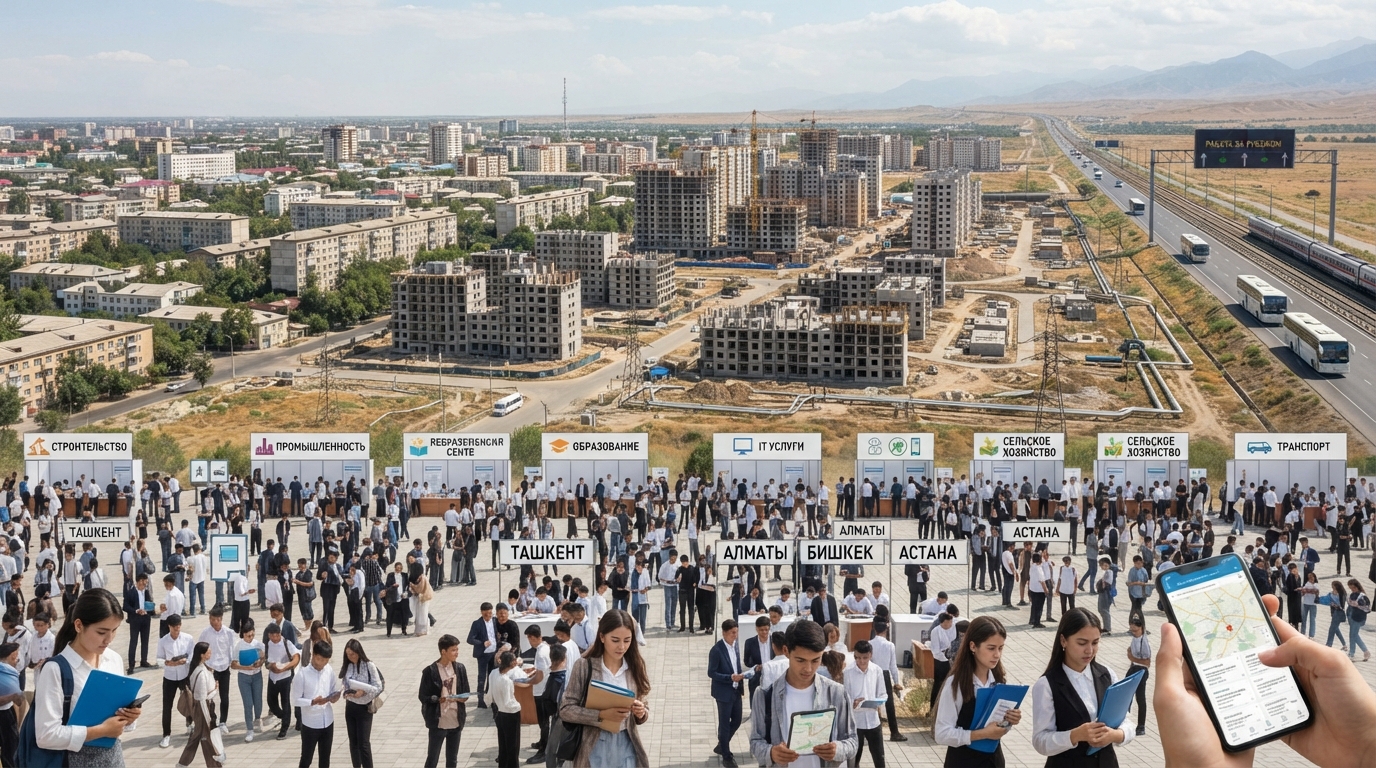
Millions of Central Asians will head north.
Central Asia has traditionally viewed demography through the prism of fertility, population, and migration. However, it is far more important to recognize that the region is already shaping its future workforce on a scale whose consequences will only become fully apparent by the 2030s.
Today, the population of the five Central Asian countries exceeds 80 million, compared to approximately 17.5 million in 1950. According to UN projections, the region's population could exceed 114 million by 2050. Nearly a third of Central Asians are currently under 15 years old, and by mid-century, approximately 20 million more people will enter the working age group. This is a colossal figure, effectively representing the entry into the regional labor market of an additional population comparable to the current population of all of Kazakhstan.
Furthermore, this demographic pressure is distributed extremely unevenly. The median age of the Central Asian population is approximately 27. In Tajikistan, it is approximately 22 years, while in Kazakhstan it is approaching 30 years. In Tajikistan, children under 15 make up approximately 36% of the population. The situation is similar in Kyrgyzstan: at the beginning of 2026, there were 2.73 million children under 18 in the country, representing 37% of the country's population. In Uzbekistan, the demographic scale is even more striking. As of January 1, 2026, the population was 38.24 million, compared to 20.6 million in 1991. Over 35 years, the country's population has increased by approximately 17.6 million people, or almost 86%. All these figures indicate that today's schools, kindergartens, and courtyards will transform into a labor market in 10-15 years. Millions of today's schoolchildren will simultaneously begin looking for their first jobs, renting or buying housing, starting families, taking out loans, and demanding a completely different quality of urban environment. Therefore, the main economic question for Central Asia in the next decade is not the number of children born today, but where they will work tomorrow.
The peculiarity of a demographic wave is its inertia. A factory can be built or closed within a few years, an investment cycle can be postponed, a tax rate can be changed by government decision, but a twenty-year-old citizen of 2036 cannot be "canceled" by the economic policy of 2035. They have already been born. This is why demographics is one of the most predictable economic factors. If a country has multiple generations of children aged 5-10 today, the state knows approximately how many young people will enter colleges, universities, and then businesses in a decade. Kyrgyzstan serves as a particularly clear example. International estimates suggest an increase in its labor force of approximately 50,000 people annually. Over ten years, this potentially represents approximately half a million additional labor market participants. For an economy with a population of just over 7 million, this is a very significant influx.
Uzbekistan operates with completely different absolute values: its population is growing by hundreds of thousands annually, and the working-age population, according to IMF estimates, could grow by approximately 1.5% annually in the coming years. Even rapid economic growth, therefore, does not guarantee the elimination of the employment problem. The economy may expand by 6-7% annually, but if productivity grows faster than the number of jobs, some young people will still be left behind. This is a fundamental problem. Growing GDP alone is not enough for the country. It must create GDP in a way that simultaneously creates hundreds of thousands of sustainable jobs. A capital-intensive mining project costing $2 billion could significantly increase industrial production, exports, and tax revenues, but after construction, it may only employ a few thousand people. For a young country, this is a useful, but demographically insufficient, outcome. Therefore, Central Asia will need not only large-scale industry, but also a huge number of medium-sized enterprises: food production, textiles, logistics, construction, agricultural processing, construction materials manufacturing, electrical engineering, equipment repair, tourism, transportation, utilities, digital services, and hundreds of other industries capable of absorbing a massive workforce.
The second demographic pressure will manifest itself not in factories, but in cities. Young people entering the labor market simultaneously become potential housing consumers. If even a small fraction of the additional millions of residents in the region create individual households annually, Central Asia will have to build hundreds of thousands of apartments over decades. But an apartment alone is no guarantee of success. Behind every new residential neighborhood lie electricity grids, water, sewerage, roads, schools, clinics, public transportation, heat, internet, and jobs within reasonable transportation accessibility. Therefore, demographic growth becomes a major infrastructure program, even if governments never officially call it that.
This will be especially noticeable in Tashkent, Bishkek, Dushanbe, Astana, Almaty, Shymkent, and the rapidly growing regional centers. Moreover, this growth will occur not only due to natural population growth but also due to internal migration. A young person from a rural area is rarely satisfied with the same range of economic opportunities as their parents' generation. The smartphone has effectively eliminated the information isolation of the provinces: salaries, job openings, and consumption levels in the capital, Almaty, Moscow, Astana, Tashkent, Seoul, or Dubai are now visible on a single screen. This increases mobility and, at the same time, expectations. As a result, demographic pressure will be concentrated in areas with universities, construction, industry, and services. States will no longer be building individual houses, but new urban neighborhoods for hundreds of thousands of residents. Misplanning here is costly: first, housing appears, then traffic jams, overcrowded schools, water and electricity shortages, and, after a few years, the state is forced to rebuild, in emergency mode, the infrastructure that would have been cheaper to build simultaneously with the neighborhoods.
The third problem relates to the quality of jobs. A young population does not automatically translate into an economic advantage. A demographic dividend only emerges when a larger generation obtains an education, a profession, and finds productive employment. Otherwise, the demographic bonus translates into labor export. Central Asia already has a proven mechanism for such export: labor migration. Russia remains the largest external labor market for a significant portion of the region, while destinations to Kazakhstan, South Korea, Turkey, the Persian Gulf countries, and Europe are expanding.
Migration will not disappear in the 2030s, but its nature may change. The new generation will be significantly more digitally savvy, more demanding of working conditions, and more aware of wage differences. Competition for Central Asian workers will no longer be limited to local businesses. This creates a paradox for countries in the region. They invest public funds in maternity hospitals, kindergartens, schools, colleges, and universities, after which the individual, trained for 20 years, can leave to work in another economy. Remittances partially compensate for this loss, but they do not replace human capital within the country. Therefore, the real competition in the 2030s will be not simply for investment, but for the ability to retain one's own youth through an acceptable balance of wages, housing costs, and quality of life. If a young professional earns $500 but rents an apartment at $350, the job formally exists, but the economic basis for independent living is virtually nonexistent. Demographics will therefore inevitably align employment policy with housing policy. Cheap mortgage programs without increasing housing supply can only drive up prices. Massive housing construction without creating jobs turns new neighborhoods into residential areas. Creating businesses without transportation and social infrastructure limits workers' access to these businesses. The challenge becomes systemic: work, housing, education, and the city must be designed as part of a single process.
The most interesting consequence of the demographic wave is that it has the potential to change the economic specialization of all of Central Asia. The region has long been perceived primarily as a supplier of raw materials and labor. But a population of over 80 million, moving toward 100 million and beyond, is itself becoming a major domestic market. Millions of new families will buy food, furniture, household appliances, clothing, cars, building materials, medicine, educational services, and financial products. This creates demand around which industry can be built.
Uzbekistan, thanks to its large population, has a particularly strong advantage: a company can initially target a domestic market of nearly 40 million people and then expand into neighboring countries. Kazakhstan has a lower population density but higher purchasing power and a large industrial base. Kyrgyzstan and Tajikistan have smaller domestic markets, but particularly young populations. With deeper regional trade, these differences can complement each other. Instead of five relatively isolated markets, a space with a population of approximately 100 million people can gradually emerge. This is a completely different scale for the production of household goods, food, building materials, clothing, chemicals, equipment, and services. A population factory produces not only workers but also consumers. And it is precisely the combination of these two factors that allows young economies to grow faster than aging societies for decades.
However, there is a downside. Every year of delayed structural reform increases the cost of future adaptation. A child who is ten years old today will enter the labor market around the mid-2030s. If their school provides a poor education, correcting the problem at age 25 is significantly more expensive than at age 10. If a city doesn't reserve land for transportation corridors today, it will have to buy out already developed land in ten years. If the energy grid isn't expanded proactively, new businesses will face capacity shortages just when the economy needs jobs most. If the vocational education system continues to produce specialists through inertia, the market will simultaneously experience a shortage of welders, electricians, engineers, technologists, and programmers, as well as an excess of graduates in specialties for which there is insufficient demand.
The scale of the problem is determined by simple arithmetic: if approximately 20 million additional people enter the working age in Central Asia by 2050, even creating one job for every two-thirds of this increase would require more than 13 million jobs. This is not an official employment forecast, but an order of magnitude. No single megaproject can solve such a problem. It requires tens of thousands of enterprises, entrepreneurs, and investment projects.
Therefore, the primary infrastructure of Central Asia in the next 15-20 years may not be railways, power plants, and highways per se, but rather a mechanism for transforming the large younger generation into a productive workforce. Roads, energy, and industry make sense precisely as part of this mechanism. The region is in a rare historical position: while Europe, Russia, China, South Korea, and many other economies are facing aging populations and future labor shortages, Central Asia is gaining millions of new young citizens. This is a potential economic asset of enormous value. But demographics do not guarantee wealth. The large young generation could become engineers, entrepreneurs, builders, doctors, and skilled workers, or it could turn into a generation of chronic informal employment and constant migration. The difference between these scenarios is already being shaped—in the classroom, vocational college, energy project, new industrial district, and urban development plan. In 2035, it will be too late to argue about whether it was necessary to prepare for the demographic wave. The people who will create this wave have already been born. Central Asia must decide whether it will become a factory of human capital or just a factory of new workers for foreign economies.