

Uzbekistan: 1.4 million migrants and the labor markets of the future
The Central Bank reported on the structure of labor migration in Uzbekistan, global labor market trends (ILO), and promising areas of employment abroad until 2030.
Tashkent, Uzbekistan (UzDaily.uz) —
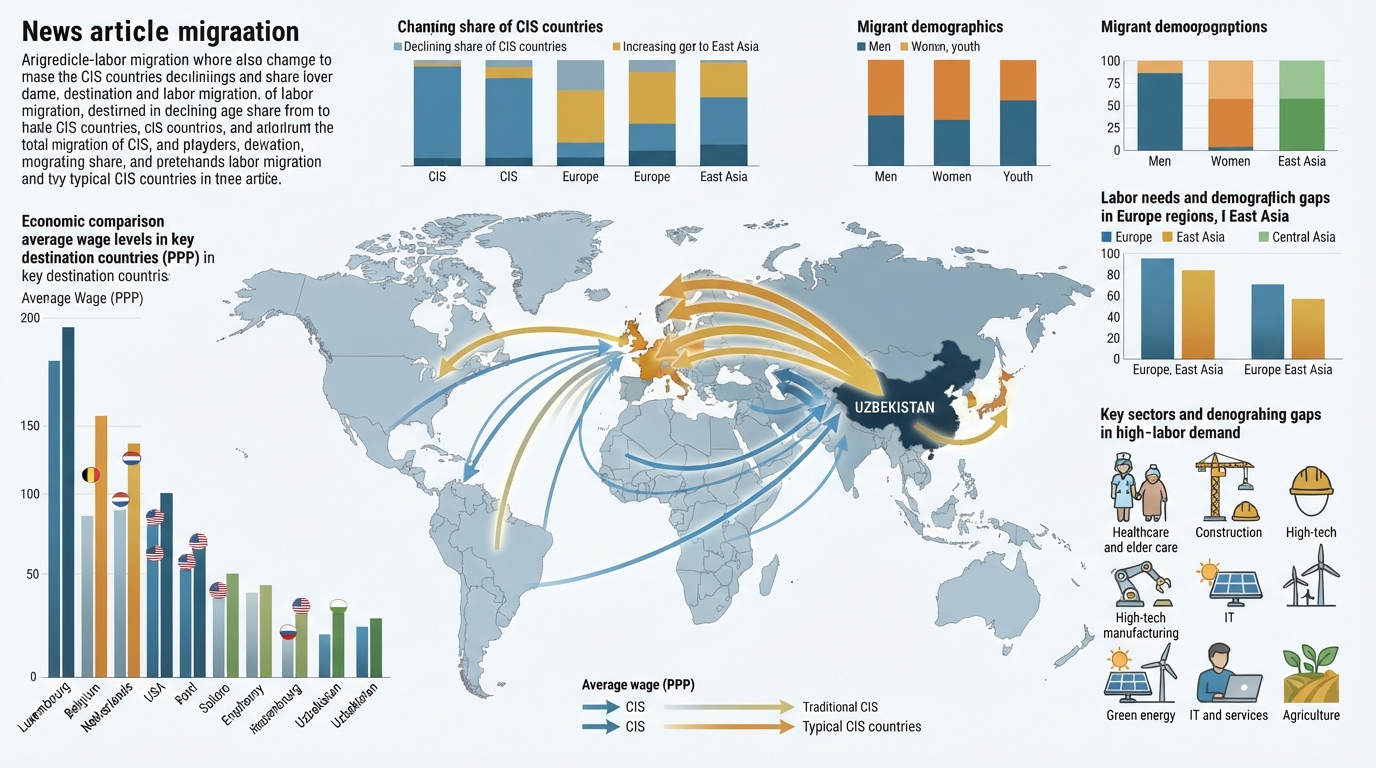
According to data from the Migration Agency, cited by the Central Bank of the Republic of Uzbekistan, approximately 1.4 million Uzbek citizens are currently working in nearly 40 countries worldwide. A shift in the structure of labor migration is noted, with traditional destinations giving way to Europe and East Asia.
The agency reports that the largest number of labor migrants from Uzbekistan are located in Russia (834,200), Kazakhstan (84,400), Turkey (72,100), and South Korea (46,400). 258,000 Uzbek citizens are working in European countries, and another 97,700 are working in other countries.
Women account for 398,900 (28.6%) of these labor migrants, while youth account for 402,100 (28.9%). The share of CIS countries in the overall structure of labor migration decreased to 29%, while the European region's share increased to 42%, and East Asia's to 26%.
The Central Bank emphasizes that the dynamics of the working-age population can have different impacts on economic growth in different regions. In Central Asia, this demographic factor could increase annual economic growth by approximately 1 percentage point, while in Northern Europe, conversely, it could reduce growth by almost 0.7 percentage points. This creates the economic preconditions for expanding labor corridors from Central Asia to Europe and other countries with an aging workforce, the regulator stated.
Wage differences between sending and receiving countries remain one of the key economic factors influencing migration decisions. According to the International Labour Organization (ILO), the highest average wages (based on purchasing power parity, PPP) are recorded in Luxembourg ($9,307), Belgium ($8,297), the Netherlands ($7,234), the United States ($6,273), and Finland ($6,253). They are followed by Ireland ($5,441), Slovakia ($5,291), Canada ($4,571), Sweden ($4,538), and Switzerland ($4,466).
The ILO report indicates that, despite significant uncertainty in economic and trade policies in 2025, the global labor market has demonstrated greater resilience than expected.
The global unemployment rate remains at around 4.9%. However, a broader measure of the jobs gap, which includes people without jobs but willing and available to work, is projected to reach 408 million by 2026.
Youth unemployment in 2025 was 12.4%, and the proportion of youth neither in education nor employment (NEET) reached 20%, representing 257 million young people. ILO forecasts for 2027 indicate that the NEET rate among youth will be 20.2%, and among women, 27.7%. In low- and middle-income countries, this figure for women could reach 34%.
According to the latest available ILO data for 2022, 167.7 million migrant workers participated in the international labor market, of which 68.4% were employed in high-income countries. The employment structure of migrants by sector was distributed as follows: 68.4% in the service sector, 24.3% in industry, and 7.4% in agriculture.
The Central Bank notes that by 2030, population aging and the declining share of the working-age population in European countries will become a key structural problem in the labor market. The labor shortage in the region is estimated at 7.5-10.5 million people.
Demand for labor is expected to increase in mechanical engineering, high-tech manufacturing, infrastructure construction, transportation and logistics, agriculture, medicine, information technology, tourism, and the service sector. According to the Institute for Labor Market Research at the German Federal Employment Agency, a failure to attract at least 400,000 skilled migrants annually will negatively impact the country's GDP growth.
Particular attention is being paid to the healthcare and social security sectors. According to the Scientific Institute for Private Health Insurance (WIP), the number of people in need of care in Germany will reach 5.7 million by 2030, requiring up to 500,000 additional healthcare and care workers. In the UK, according to Skills England, approximately 90,000 additional care workers are needed. In Japan, labor shortages in the care, agriculture, and construction sectors are estimated at 6-7 million, while in South Korea, the shortage in shipbuilding, metalworking, electronics, and manufacturing is estimated at 1.2-1.5 million.
Demand for green energy workers is also projected to increase. A study by the German Chamber of Commerce and Industry (DIHK) shows that Germany is expected to experience a shortage of approximately 300,000 solar panel and wind turbine installers, as well as technicians, mechanics, and environmental engineers, due to renewable energy projects. The Central Bank notes that Scandinavian countries are becoming a hub for clean technology, where demand for green metallurgy, wind energy, and information technology is also growing.
Growing labor demand is also projected in the Persian and Arabian Gulf countries as part of national development programs aimed at diversifying their economies away from oil dependence. According to the ILO, Saudi Arabia may need 1.5-2 million additional workers, while the United Arab Emirates may need 1 million, primarily in construction, healthcare, hospitality, tourism, aviation, and logistics.
Based on these trends, the Central Bank notes that, in addition to traditional labor migration, developing young people's language, professional, and digital skills, as well as preparing them for remote service export, is of particular importance for Uzbekistan. In the future, the regulator believes that when organizing external labor migration, it is advisable to consider demographic and structural changes in the global labor market and new geographic and professional areas where high labor demand is expected.