

With respect for the era
Without the right to rewrite: Central Asian historians speak out on the Soviet legacy
With respect to the era
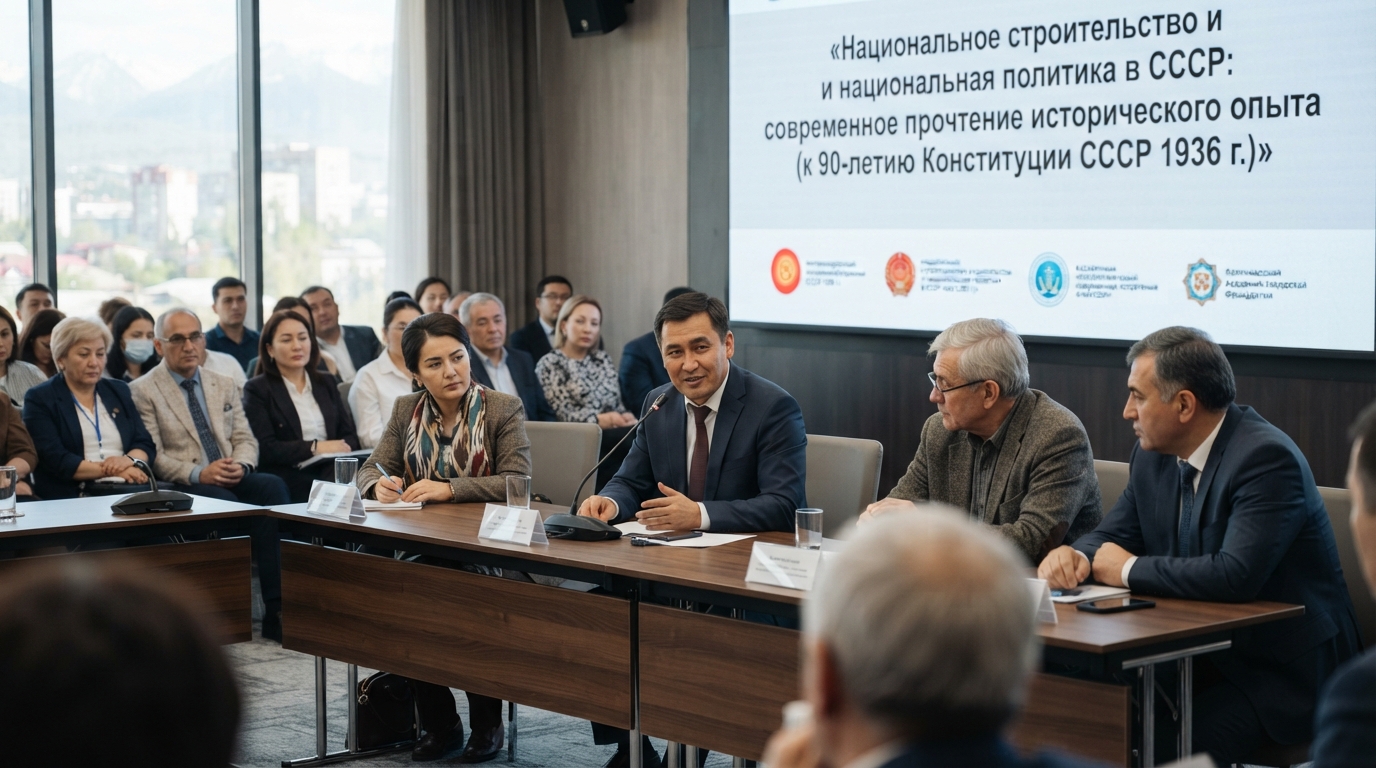
A representative international scientific conference took place in Bishkek, attended by historians from six countries: Kyrgyzstan, Russia, Kazakhstan, Uzbekistan, Tajikistan, and Azerbaijan. The topic surprised many: "National Building and National Policy in the USSR: A Contemporary Reading of Historical Experience (on the 90th Anniversary of the 1936 Constitution of the USSR)." The surprise was explained by the fact that until quite recently it was difficult to imagine discussing the Soviet legacy at such a high scientific level with the participation of leading specialists from the countries of Central Asia—back then, it was customary only to denigrate the past.
However, times are changing, and this was very accurately noted by Doctor of Geographical Sciences, Rector of the Kyrgyz National University Dogdurbek Chontoev. He emphasized that during those decades "large-scale transformations were underway that determined the administrative-territorial structure, the system of public administration, the development of education, culture, and national institutions. These events became important stages in the formation of Kyrgyz statehood within the framework of the Soviet federal system."
An era that must be remembered and studied
State Secretary of the Kyrgyz Republic Arslan Koichiev stated that the very fact of holding the conference in connection with the anniversary—the centenary of the formation of "modern" Kyrgyz statehood—gives the issues under discussion "special historical depth and high relevance." He recalled that the experienced historical background had a "fundamental influence on the formation and revival of state institutions, the development of national cultures, languages, education systems, as well as on key social and political processes in the republics of the former USSR."
Executive Director of the "History of the Fatherland" Foundation, Doctor of Historical Sciences Ruslan Gagkuev agrees with this position. The historian noted that these events "became important milestones in the history of the peoples of Central Asia and significantly influenced the development of their statehood." At the same time, another conclusion is also obvious: "Many achievements of those decades still constitute an important part of the common historical heritage of our peoples today. Therefore, a comprehensive understanding of this experience requires a careful study of sources and taking into account the full complexity of historical processes."
It was under this motto that the round table "100 Years of Kyrgyz Autonomy: Uniqueness and Typological Trends of National-State Building" took place. Participants of the international conference conducted meaningful discussions across seven areas: "Major Trends of National Policy: The Soviet Past and Post-Soviet Present," "The Search for Models of National Building—1920s–1930s," "The Role of the Personal Factor and the Phenomenon of the National Elite in Soviet National Building," "National Cadres as an Element of Soviet Power Policy," "The 1936 Constitution: Institutional Features of the Model of Soviet National-State Building," "Soviet Transformations as a Factor of National Self-Consciousness," and "The Soviet Past: Impact on Modernity in the Former Soviet States."
The past as a tool for constructing the future
Vadim Rynkov, Director of the Institute of History of the Siberian Branch of the Russian Academy of Sciences, examined the contemporary perception of national building in the Soviet Union in the states of Central Asia. Historical memory, according to him, represents a social construct created through the joint efforts of the authorities, the professional community of historians, and public forces.
The memory of the main stages of the creation and development of national autonomies in modern Central Asian states remains one of the key themes of modern national history, but it has undergone a deep evolution, including through emphases and silences. In modern Kazakhstan, for example, they speak of the "revival of statehood," firmly linking the events of the 1920s–1930s with medieval powers and temporary state formations from the time of the Civil War. And in most of the former union republics, the stages of expanding status are presented as natural steps toward acquiring full sovereignty in 1991. Modern citizens really want to see the autonomies of the 1920s – early 1930s and the union republics of the 1930s as "relatively independent state formations."
At the same time, republican leaders, like the national political elite of the Soviet period, tend to be portrayed as "consistent fighters for the expansion of independence and the interests of the titular ethnos, but by no means as executors of the tasks of the union center." It should be noted that this ignores the "expansionist plans of neighbors," which national leaders had to resist, overcoming unfavorable decisions of the Center and being subjected to repressions. In other words, looking from the present into the future, the historical memory of national building serves the tasks of legitimizing the current political power and strengthening the national identity of states that have become almost mono-national communities.
History that we remember!
But in our common history, there are pages that will always be remembered. Many conference participants spoke about this. Leonid Sumarokov, Director of the Center for Historical and Cultural Heritage of the Kyrgyz-Russian Slavic University, recalled how military training was conducted in Kyrgyzstan in the 1930s. He called it a factor in forming a generation of heroes of the Great Patriotic War.
The historian said that the system created in the republic for training and educating future defenders of the Motherland made it possible, even during the years of the Great Patriotic War, to train thousands of specialists in various military occupational specialties.
Thus, one of the bright pages in the history of OSOAVIAKHIM of the Kirghiz SSR was the work to assist the development of domestic aviation and aviation sports. The Frunze Aero Club, established in 1934, trained pilots for the Air Force, six of whom became Heroes of the Soviet Union, and Talgat Begeldinov was awarded this title twice. The operational experience of the aero club allowed for the formation of the 24th Military Aviation School of Pilots for Initial Training on its basis in the spring of 1941. In November of the same year, it became the foundation for creating the 660th, 664th, and 665th Night Bomber Aviation Regiments, which struck fear into the enemy.
Unfortunately, as Leonid Sumarokov notes, the history of the combat activity of these units, in which Kyrgyzstanis who went through the OSOAVIAKHIM school fought during the war, has not yet received proper coverage.
Speaking about the impact of the Great Patriotic War on the formation of a single political community, Konstantin Cherepanov, Head of the Department of 20th-Century History of Kazakhstan at the Ch.Ch. Valikhanov Institute of History and Ethnology (Almaty, Republic of Kazakhstan), noted that the Great Patriotic War is a key event in the history of the Soviet state born of the revolutionary events of 1917, which became another grand turning point for the peoples living on the territory of the former Russian Empire: "As a result of this turning point, a political community was formed, later known as the Soviet people."
Who is inventing the "evil empire" again?
Many pages in the history of Central Asia during the Soviet period remain to be studied. Alizoda Bahriddini Pirmukhammad, Professor at the Research Institute of Public Administration and Civil Service of the Academy of Public Administration under the President of the Republic of Tajikistan (Dushanbe, Tajikistan), views the national-territorial delimitation of Central Asia in 1924–1936 as one of the key processes that had a long-term impact on the political and territorial structure of the region. It also significantly influenced the subsequent formation and development of the sovereign modern states of Kazakhstan, Kyrgyzstan, Tajikistan, Turkmenistan, and Uzbekistan. The historical prerequisites for delimitation, the features of Soviet national policy, as well as the problem of the correlation of ethnic, administrative, and economic principles of forming the borders of union republics await new researchers.
A historian should not be guided by political processes; they are obliged to objectively assess the situation. Let's speak frankly: today it is becoming increasingly difficult for real researchers to do this. The presentation by Gulmira Dzhunushalieva, Professor at the Kyrgyz-Russian Slavic University, was dedicated to this topic. She immediately put all the dots on the 'i's: "In the interests of nation-building, building civic identity, and the formation of a national political elite, an exclusively positive perception of shared Soviet history has become impossible."
Today, each post-Soviet republic interprets the characteristics of national policy in its own way through the prism of national history, and this is understandable. But at the same time, certain contours of the vector for rethinking the period of being part of the USSR are emerging. Much is said about the "colonial past" and the efforts that must be made by national republics in the "decolonization" of the past, consciousness, and self-awareness."
It is telling that no mention at all is made of "who paid for the accelerated industrialization, the cultivation of virgin lands, and laying the foundations for the future agro-industrial development of the republics, as well as the expansion of the educational and healthcare systems." That is precisely why various internet resources are so much in demand today for rethinking the common Soviet past, national policy, and constructing the image of an "evil empire."