

Time, Forward!
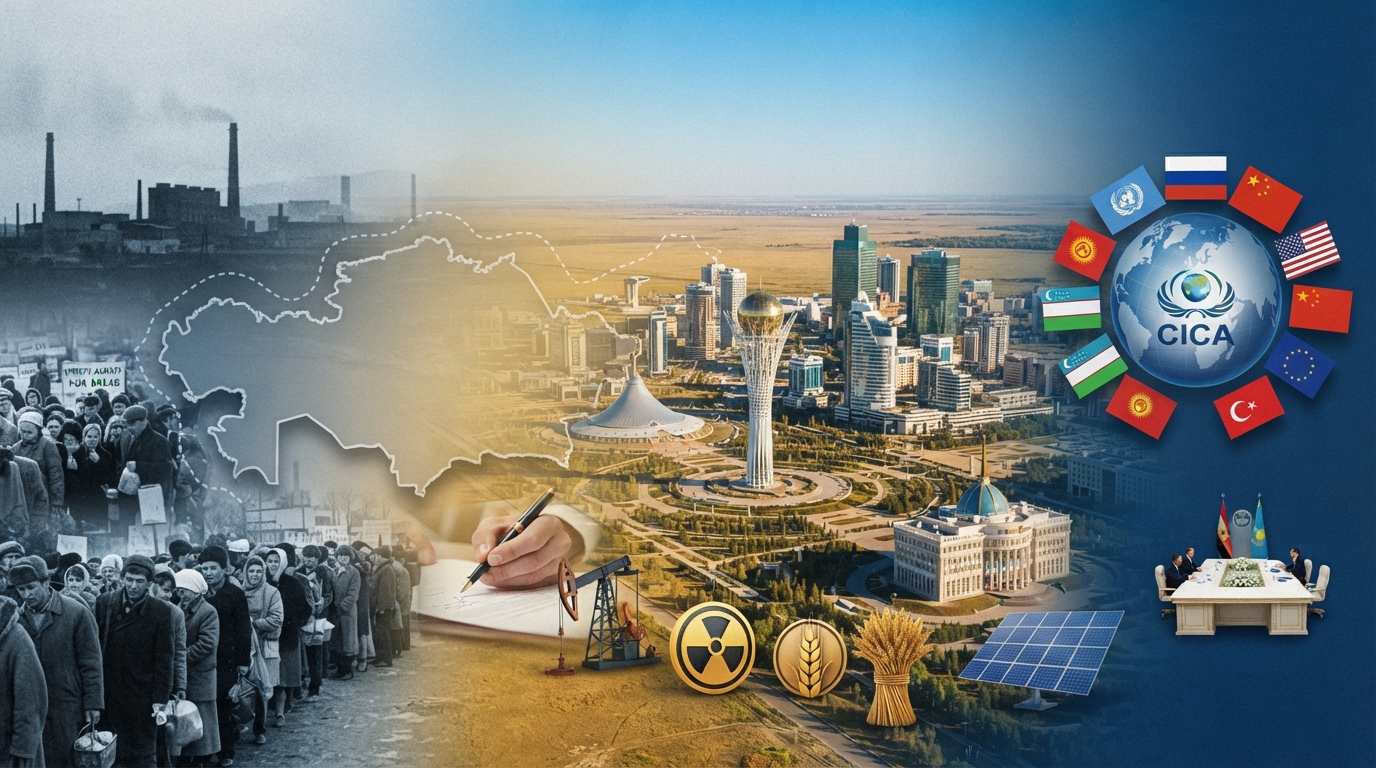
On October 25, Kazakhstan celebrates the 35th anniversary of its independence. Over three and a half decades of independent development, the republic has traveled a difficult and very event-filled path, achieving significant results. The most challenging stage in the formation of modern Kazakhstan, as with other countries in the post-Soviet space, was the first decade of independence, marked by a systemic breakdown of political, social, and economic systems that had been built over years. Production chains and economic ties with other USSR republics were severed, and the need arose to build an independent foreign policy, create an autonomous financial system, and much more.
Despite all the difficulties, Kazakhstan has become the recognized economic leader of Central Asia, boasting the highest standard of living in the region, deep integration into international political and financial institutions, and the largest volume of accumulated investment. The country has managed to make the most efficient use of its transit potential and natural resources. At the same time, the republic has not yet managed to solve the problem of economic diversification: as at the beginning of independence, the largest contribution to GDP is still made by industries developing natural resources.
Over the years of independence, the republic has experienced serious socio-political crises. The latest and most severe occurred in January 2022, and the situation was stabilized only after the deployment of allied assistance from CSTO partners.
**Kazakhstan as a Multi-Vector "Middle Power"**
From the first days of its independence, Kazakhstan pursued a highly proactive foreign policy on the international stage. In its early years, the republic became a UN member and established diplomatic relations with key international actors, including with the Russian Federation in October 1992 (by the end of 1992, the republic had established diplomatic relations with 78 states, and by 2025 that number had grown to 191).
During the first 15 years of independence, Kazakhstan settled border issues with all its neighbors. The most labor-intensive process proved to be defining the Russian-Kazakh border—the longest continuous border in the world, stretching 7,548 km. On January 18, 2005, in Moscow, President of the RK N. Nazarbayev and President of the RF V. Putin signed the Treaty on the Kazakh-Russian State Border.
The republic became one of the flagships of integration in the post-Soviet space, an active participant in the CIS and the CSTO, as well as a co-founder of the EAEU. In addition, Kazakhstan initiated a number of significant projects on the international stage. In particular, in 1992, President of Kazakhstan N. Nazarbayev proposed at a UN General Assembly session to hold the Conference on Interaction and Confidence Building Measures in Asia (CICA), which over time evolved into an important platform for dialogue. Notable international achievements include being the first and only post-Soviet country to hold the OSCE chairmanship in 2010 and hosting an OSCE summit after an 11-year hiatus. From 2011 to 2013, current head of state Kassym-Jomart Tokayev served as Under-Secretary-General of the UN and Director-General of the UN Office at Geneva. For several years starting in 2017, the Astana process on Syria operated in the republic's capital—a platform for negotiations between the Syrian government and opposition, with the participation of Russia, Iran, and Turkey.
According to the Foreign Policy Concept of the RK for 2020–2030, the key principles of the country's foreign policy include "multi-vectorism, pragmatism, and proactivity, meaning the development of friendly, equal, and mutually beneficial relations with all states, interstate associations, and international organizations of practical interest to Kazakhstan." Geographic priorities include: "the development of allied relations with the Russian Federation, a comprehensive strategic partnership with the People's Republic of China, the expansion of strategic partnership with the United States of America, strategic relations with the states of Central Asia, and an expanded partnership and cooperation with the European Union and EU member states."
Kazakhstan has signed alliance treaties with Russia, Uzbekistan, Kyrgyzstan, and Tajikistan. It has signed a declaration of alliance with Turkey. The RK also holds strategic partnership agreements with several countries, including China, South Korea, France, and others.
At the suggestion of second president Kassym-Jomart Tokayev, Kazakhstan today positions itself as a "middle power"—a major regional player with its own diplomatic agenda and a unique set of geographic and economic characteristics.
**Domestic Policy: In Search of an Optimal Political Model**
More than 30 years of Kazakhstan's political history are inextricably linked with the name of its first president, Nursultan Nazarbayev. At the time of the USSR's collapse, he led the Kazakh SSR and was a member of the Politburo of the CPSU Central Committee (1990–1991). Nazarbayev's authority and experience made him effectively the uncontested candidate for head of the republic.
Over the years of independence, Kazakhstan managed to build a stable model of statehood, establish a developed economic base, and achieve progress in the social sphere. However, this process was accompanied by serious difficulties: a deep economic crisis in the early 1990s, alongside rising unemployment, inflation, and migration.
During its independence, the population grew from approximately 16 million people to over 20 million in 2025. A notable role in this was played by the return of ethnic Kazakhs to their historical homeland (*kandastar*) from other countries.
Kazakhstan's first Constitution was adopted in 1993. Many experts referred to it as a compromise document, as it laid the groundwork for competition between the legislative and executive branches, leading to a serious political crisis in March 1995. In August 1995, following a nationwide referendum, a new version of the basic law was approved, under which Kazakhstan became a presidential republic. Thus, First President of the RK Nursultan Nazarbayev managed to prevail in the dispute with the deputies of the Supreme Council regarding the chosen system of government. Since its adoption, amendments and additions have been made to the basic law several times—in 1998, 2007, 2011, 2017, 2022 (twice), and in 2026. The latest constitutional reform is notable for several reasons. First, the republic returned to a unicameral parliament—replacing the Mazhilis (lower house) and Senate (upper house) with a unified Kurultai of 145 deputies elected via a proportional system, whereas previously half of the deputies were elected in single-member districts. Second, the post of vice president was introduced into Kazakhstan's political system; under the basic law, the vice president becomes the second most important figure in the state and replaces the president if he is unable to perform his duties (previously, the "backstop" to the president was the Speaker of the Senate). Third, the People's Council of Kazakhstan (Kazakh: *Qazaqstan xalyq keńesi*) was created as the "highest constitutional advisory body," consisting of 126 members. The council is formed by electing delegates—42 each from ethno-cultural associations, public organizations and NGOs, as well as from *maslikhats* (local parliaments) and public councils of the republic's regional capitals. The Council replaced the Assembly of People of Kazakhstan, a constitutional body that previously represented the interests of ethnic minorities inhabiting the republic.
Moving the capital was one of the most prominent events in the republic's history. In the 1990s, on President Nazarbayev's initiative, Kazakhstan's leadership raised the question of relocating the capital from Almaty, which was situated on the country's southern border and geographically constrained by mountains from further expansion. The choice fell on the city of Akmola, former Tselinograd, located in the central part of the republic in the steppe region. The official transfer of the capital took place in 1997, and in 1998 it was renamed Astana. Full-fledged development of the capital began in the 2000s. Today, Astana is the second-largest city after the old capital and a key center of economic and social attraction in Kazakhstan.
In March 2019, Nursultan Nazarbayev decided to step down as president and proposed as his successor his ally Kassym-Jomart Tokayev, who had served over the years as prime minister, foreign minister, and speaker of the upper house of parliament. At the same time, Nazarbayev retained his positions as head of the Security Council, leader of the ruling party "Nur Otan," and others; furthermore, his political weight and powers were secured by the special status of First President enshrined in the constitution.
The country developed an unusual power configuration featuring two decision-making centers: a formal one represented by President Tokayev, and an informal yet highly influential one represented by the First President. Externally, the state apparatus appeared monolithic, but at the administrative level, localized conflicts and friction began to arise between the two verticals. The hidden tension in the system was ultimately resolved only after a severe political crisis in January 2022. At the height of mass protests that swept most of the republic's largest cities amid law enforcement's inability to restore order, President Tokayev took full responsibility for the situation, appointed himself head of the Security Council overseeing all security agencies, and requested assistance from CSTO partners, which allowed the situation to be stabilized within days. This was followed by a systemic restructuring of the state apparatus, bringing officials from the current president's team to the forefront. As a result, it took K.-J. Tokayev just a few years to completely refresh the management personnel of the presidential administration, government, and regional authorities, as well as to thoroughly reshape the administrative system to fit his governing style.
It was expected that one of the main political challenges in the coming years would be the upcoming power transition—only the second in the republic's history. Initially, under constitutional norms, the sitting president was to remain in office until 2029, when his final term was set to expire. However, by decision of the Constitutional Court of the RK, K.-J. Tokayev gained the right to run for a new term, shifting the resolution of the power succession issue to the medium term.
**Economic Development: Realizing Resource Potential**
At first glance, the economy is a successful area for Kazakhstan. Over the years of independence, the country has managed to fully realize its transit and resource potential and attract large-scale foreign investment. In 2025, Kazakhstan's GDP reached $305.9 billion in US dollar terms, or $14.77 thousand in GDP per capita. The republic has become the leading supplier of uranium to the global market, holding more than a 40% market share, as well as a major supplier of oil, ferrous and non-ferrous metals, and wheat.
At the same time, the formation of this export-oriented economic model was painful. Kazakhstan's transition from a planned to a market economy followed a model similar to Russia's through the privatization of state property. A total of four key stages of privatization took place; as a result, by the early 2000s, 75% of the republic's GDP was generated by the private sector. However, privatization contributed to a significant concentration of major economic sectors in the hands of a small number of entrepreneurs, leading to severe social stratification.
Large-scale attraction of Western investment (primarily into the energy sector) facilitated the development of major oil and gas fields (Tengiz, Karachaganak, Kashagan) and turned Kazakhstan into a major player on the oil market, with an annual production volume of around 100 million tons of oil. At the same time, Western companies operate under production sharing agreements that grant the republic only a limited share and keep information regarding the distribution of profits from extracting the country's resources classified. At both the national and international levels, Kazakhstan is working to compel Western companies to comply with environmental standards and regulations when implementing projects, while also seeking a fairer distribution of profits from field development through negotiations and arbitration mechanisms.
Challenges to the Kazakh economic model include its low diversification and high reliance on price trends in commodity markets. High levels of social and regional imbalance are also noted. Kazakhstan features two particularly successful and wealthy cities—Astana and Almaty—whose level of development and infrastructure significantly outpace most of the country's regions.
By its 35th anniversary, Kazakhstan has resolved its foundational state tasks: defining its state borders, as well as selecting and shaping its economic, domestic, and foreign policy models. At the same time, amidst dynamic domestic demographic processes, a global overhaul of international relations, intensified geopolitical rivalry among major players, and growing competition for investments and technology, a complex set of internal and external challenges is emerging for the republic—as for its regional neighbors. These challenges require the creation of a flexible and adaptive economic model and foreign policy strategy capable of maintaining resilience and stability while providing the conditions for further growth and development.