

On your marks, get set…
The times when space for the states of Central Asia was reduced to nostalgia for Soviet successes and lease payments for Baikonur have firmly receded into the past. Today, Tashkent, Bishkek, and Astana are purchasing launches from SpaceX, integrating their own artificial intelligence into Chinese vehicles, and training national astronauts, transforming the orbit into an arena of strict economic pragmatism.
In the US, Japarov said: “Let’s go!”
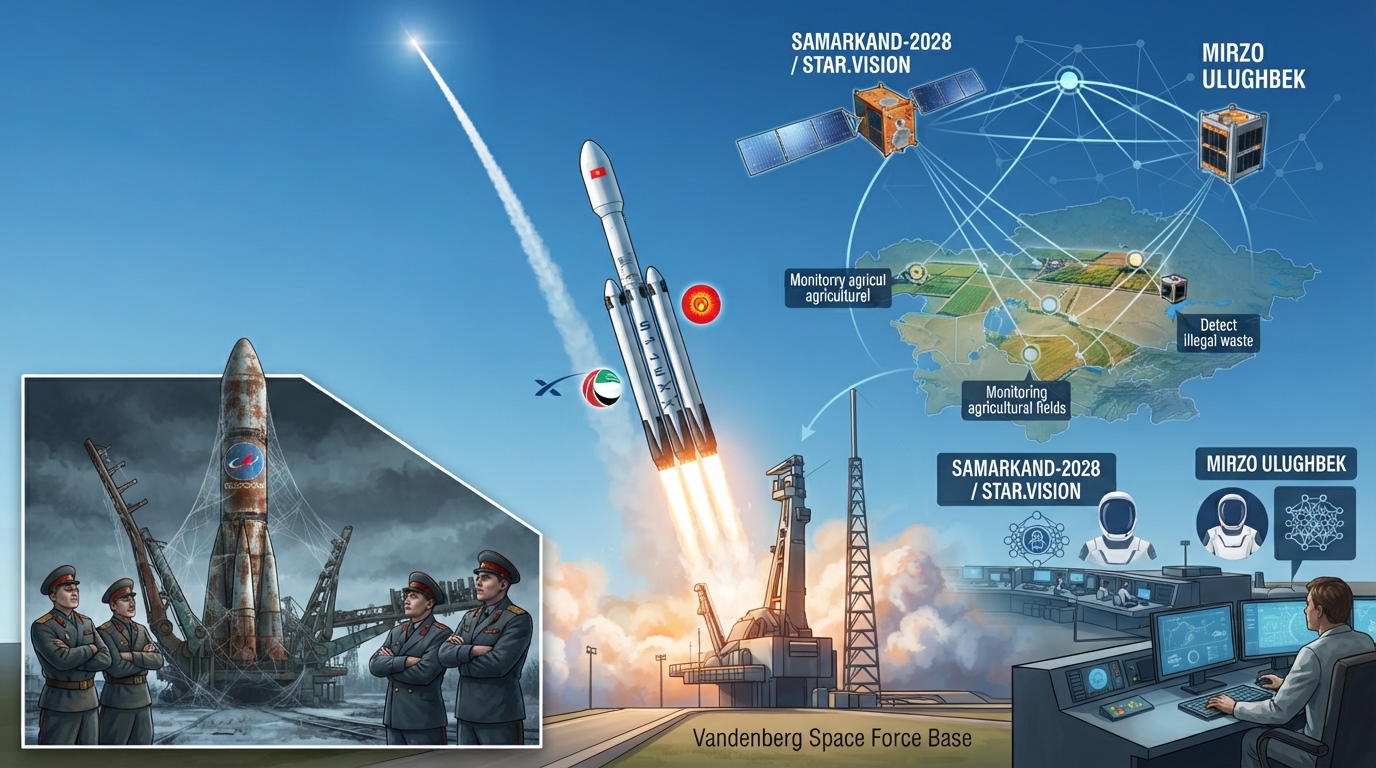
On October 1, 2026, Kyrgyzstan launched its first national satellite into orbit. The spacecraft took off not from Baikonur, but from California’s Vandenberg base aboard a Falcon 9 rocket, with the United Arab Emirates as Bishkek's partner. President Sadyr Japarov explained the economic rationale behind this move: previously, the republic had to pay billions to monitor a hundred hectares of land; now it tracks its glaciers and pastures independently. This was not a flight for the sake of status, but a step toward technological sovereignty that allows logging illegal dumps and landslides in real time.
Tashkent went even further by placing its bet on cognitive technologies. Launched in August, the hyperspectral spacecraft "Samarkand-2028" is formally a Chinese project by STAR.VISION, but its heart is an artificial intelligence module created by Uzbek engineers. The neural network processes large arrays of data right in orbit, saving vast resources on data transmission and instantly identifying vegetation stress in crops long before visible signs appear. The head of "Uzbekcosmos", Shukhrat Kadyrov, emphasized that the country has ceased to be a passive consumer of third-party services and has become a full co-author of space technologies. Ahead lies the launch of the "Mirzo Ulugbek" cubesat, created jointly with Japan's Kyushu Institute of Technology, and a rigorous selection process for the first Uzbek cosmonaut in time for the IAC 2028 congress.
The twilight of post-Soviet space history
Against the backdrop of this bustling activity, Kazakhstan's cooperation with "Roscosmos" looks like a highly prospective, yet not overly dynamic story wrapped in beautiful press releases. The joint Russian-Kazakh "Baiterek" project remains a construction site, while the launch of the "Soyuz-5" rocket is consistently pushed back. The numbers speak for themselves: while in 2015 Russia conducted 29 orbital launches, in 2025 it carried out only 17. Meanwhile, Beijing offers ready-made satellite constellations for disaster monitoring, and South Korea, represented by CONTEC Space Group, is ready to build a full-fledged manufacturing hub in Kazakhstan. Furthermore, there is essentially no single space program within the Commonwealth. An increasing number of global players offer hardware, algorithms, and access to commercial orbits. As experts note, "Roscosmos" is losing its traditional market not due to geopolitics, but because of an unwillingness to adapt to the demands of real business, which needs accurate data here and now, rather than stories about a bright future.
Regional egoism and missed chances
Kazakhstan's Deputy Prime Minister Zhaslan Madiyev is promoting an ambitious "Digital Silk Road" concept aimed at creating a hundred-billion-dollar business. Astana intends to export computing power and AI tokens rather than oil, combining data centers, satellite communications, physical AI for the mining industry, and trans-Caspian fiber optics. The joint nano-satellite Di’er-5 with China and Korean investments look impressive. However, behind this facade lies a fundamental problem pointed out by Uzbek expert Bakhtiyor Ergashev from the "Ma’no" Research Center. The region lacks a unified strategy. Ergashev recalls how ten years ago logisticians and drivers were asking for a single navigation standard instead of rushing between GPS, GLONASS, and Chinese systems. Yet, instead of consolidation, the countries participate in humiliating "five plus one" formats, bargaining with external players individually. Ergashev also warns against dangerous fantasies about privatizing the Moon and Mars, stressing that space must not turn into an arena for a new division of the world where elites appropriate the resources of the future. But to protect this right, the region needs a single voice, which it currently lacks. Otherwise, the chance to become an equal subject might be missed, leaving it a patchwork quilt of ambitions.
The space race gains momentum
Turkmenistan, which sent its TürkmenÄlem into space aboard Elon Musk's rocket back in 2015, is today quietly building up its orbital constellation to monitor vast gas and desert territories, while simultaneously studying proposals from Moscow and Paris. Tajikistan is betting on ground infrastructure, modernizing the Soviet "Okno" complex and integrating into China's latest Tianwu Constellation. This network, which is projected to grow to 1,024 satellites with a neural network center in Xinjiang, will become the region's main shield against glacial lake outbursts and earthquakes.
Another milestone in the struggle for space was the signing of a framework agreement on space cooperation in Antalya within the framework of the Organization of Turkic States (OTS), uniting Azerbaijan, Kazakhstan, Turkey, and Uzbekistan around the OTS-SAT project. Although one should take off the rose-colored glasses here: Ankara acts in this structure not as a technological donor, but rather as a political catalyst. Let's be frank: Turkey has no serious, fundamental space technologies or deep scientific base — its space program mostly consists of loud ambitions, beautiful presentations, and repackaged third-party components. But that is precisely what makes the developments even more alarming for "Roscosmos". The danger comes not from Turkish rockets, which simply do not exist, but from the very architecture of this alliance. Ankara provides a political umbrella and a unifying idea, while pragmatic Astana and Tashkent fill this shell with real substance: Korean manufacturing hubs, Chinese neural networks, and American launch services.
Central Asia is exploring space not for the sake of flags on other planets, but to protect its own land from drying up and chaos. And this space race is only accelerating, becoming increasingly tough and pragmatic. Fortunately, there are more than enough players ready to offer their services to the countries of the region.