

Rowing against the current
The Third Coming of the President: How Tokayev Re-established Kazakhstan. An Attempt to Look Behind the Scenes of Kazakhstani Politics
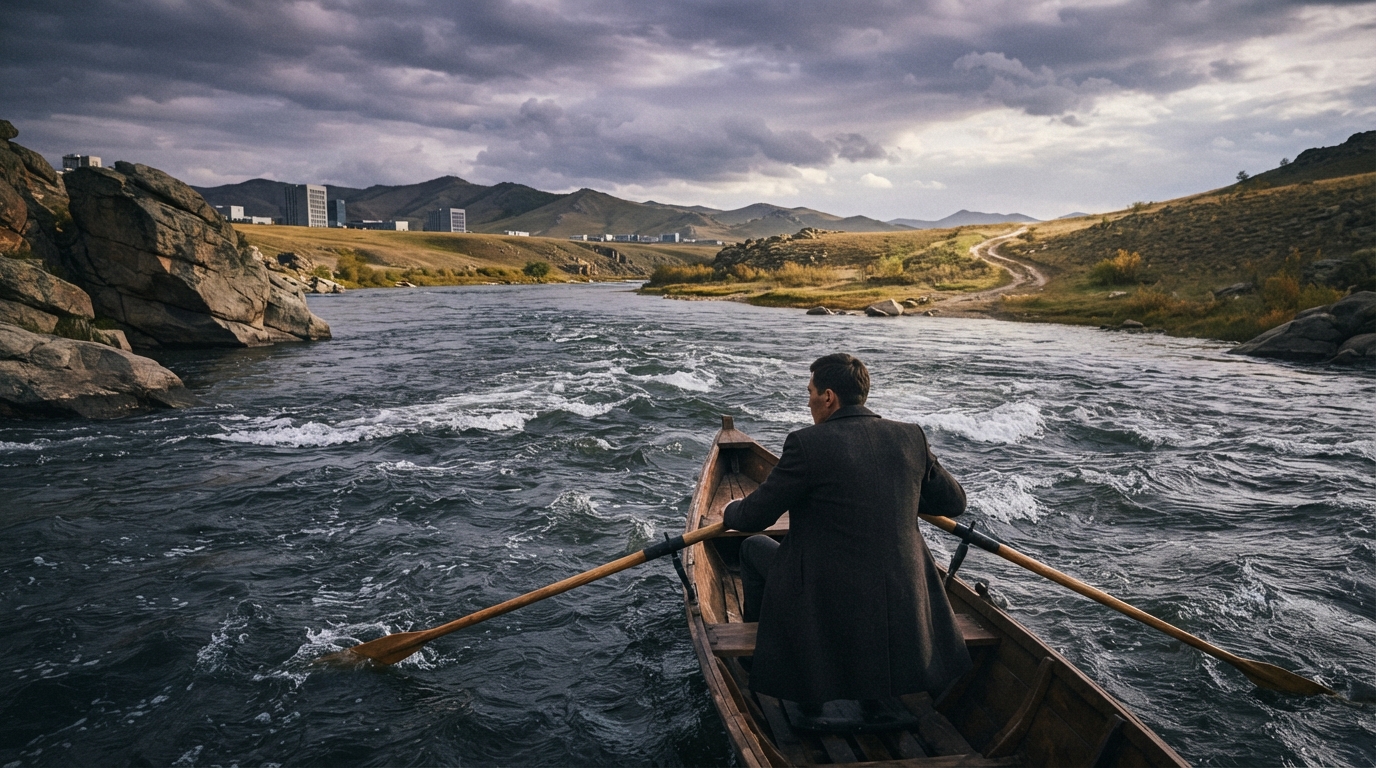
**Rowing Against the Current**
Kassym-Jomart Tokayev has already held the post of President of Kazakhstan for seven and a half years. But during this time, he has actually had to come to power three times. The first time was in March 2019, when Nursultan Nazarbayev handed over the "Akorda" presidential residence to him but retained many key levers of control. The second was in January 2022, when, with the help of the deployment of CSTO troops, Tokayev managed to thwart a coup attempt and steer the country away from the brink of civil war. And finally, the third time—the most drawn-out in terms of time—during 2026, the president carried out a constitutional reform and definitively transformed Nazarbayev's Kazakhstan into Tokayev's Kazakhstan.
For Russia, the emergence of broader room for maneuver and a more solid political rear for the President of Kazakhstan is of far from idle interest. Tokayev can by no means be called a leader who follows in Moscow's wake. The Kazakh leader does not hesitate to declare his "special position" on issues sensitive to Russia right in Putin's presence. It is enough to recall the recent episode in Omsk, when Tokayev called for freezing the Russian-Ukrainian conflict along the line of contact.
But in these highly turbulent and highly politically complex times, what matters is not individual differences, but the alignment of basic interests—primarily in the security sphere. The completion of the process of political reconstruction of Tokayev's Kazakhstan means that on the other side of the longest continuous land border in the world (7,598.8 km is no joke!), Russia also has a strong and reliable political rear.
**Thorns and Traps of the Presidency**
At the moment of Kassym-Jomart Tokayev's official transformation into president in the spring of 2019, the new capital of independent Kazakhstan, Astana, differed from the Kzyl-Orda of 1925 (the first capital of Soviet Kazakhstan) in terms of infrastructure and everyday comfort as much as heaven from earth. Before and after the relocation of the highest Kazakh state institutions from Almaty to Astana in 1997, many billions of dollars were invested in the development of the former modest Soviet regional center. But from the point of view of political comfort for the new formal head of state, these two cities were quite comparable.
In his book "My Life: From Dependence to Freedom," published in 2024 in Moscow, Nursultan Nazarbayev described an episode that occurred back in 2013 and forced him to make the decision to hand over the presidency to Kassym-Jomart Tokayev: "After the solemn meeting and festive concert held in the theater building, when the audience had already started moving toward the exit, I was also rising from my chair when I suddenly realized that I could not do it: my whole body seemed paralyzed. So that people would not notice, I remained in the chair and only after some time managed to straighten up. Yes, it was a completely unambiguous signal."
According to the recollections of the first president of Kazakhstan, in 2013 this "unambiguous signal" completely escaped the attention of outside observers. But he himself "had to draw conclusions. The presidency is a difficult job in every respect... The president must be 'healthy and on a white horse.' Otherwise, it will harm the governance of the country. So I proposed to Kassym-Jomart Kemelevich, who was working at that time as Deputy Secretary-General of the UN, to return to the country and head the Senate again. Behind this was my main and ultimate plan."
A very smooth narrative, behind which lay a far from smooth reality. The great orator of antiquity, Cicero, is credited with the phrase abiens abi ("leaving, leave"). But when it comes to voluntarily giving up a huge amount of power, following this wise recommendation often turns out to be beyond human strength. Seven and a half years ago, this proved to be beyond the strength of Nursultan Nazarbayev. Formally leaving the highest state post in the country, he left, but at the same time remained—or left only halfway.
A typical episode characterizing the political life of Kazakhstan from March 2019 to January 2022, when the main task of the official local propaganda was to broadcast an "absolutely true" signal to the outside world: there is no dual power in our country! President Tokayev summoned one of the most important officials in his administration and proposed that he transition to diplomatic work.
Accustomed to "listening to his elders," the official agreed—and received a reprimand for this during his next meeting with Nazarbayev. Having retained control over the security forces as Chairman of the Security Council of Kazakhstan, Nursultan Abishevich expressed himself roughly as follows: "It doesn't matter that the president offered this to you! You should have refused!"
After the failure of the attempt to overthrow the government in January 2022, when Tokayev managed to free himself from the intrusive "guardianship" of his predecessor, he made a number of startling admissions in an interview with Russian journalist Leonid Mlechin for his book "Tragic January: President Tokayev and Lessons Learned": "To his astonishment, the president found out that his close relatives, even his son, were being watched. He asked: 'Why are you doing this?'"
They began to convince Tokayev that this was being done for the safety of his family. In reality, they hoped to gather compromising material to be able to put pressure on the head of state. The president told me how a person very close to him remarked: "You became president on March 19. And on the 20th, you already turned into the main enemy of the Elbasy's ('leader of the nation,' Nazarbayev's official title from 2010 to 2023) family. And, possibly, of himself. Such is the dialectic of power."
Many members of Nazarbayev's family were indeed quite some characters. Leonid Mlechin's book contains a story about Nazarbayev's favorite nephew, Kairat Satybaldy, which amazed even me—a person well acquainted with Kazakh political customs.
Former Chairman of the National Security Committee General Musayev recalled: "After my departure, Kairat Satybaldy took the post of deputy chairman for personnel. He put the entire staff, as they say in common parlance, 'on the prayer rugs.' That is, the operational staff was recommended, and the deputy chairman for personnel checked, whether everyone was praying at the right time. From this, you can deduce what ideological and religious direction he himself was of and in which direction he was guiding the operational staff."
But one should not think that the primary source of all of Kazakhstan's political problems is or was only that Nazarbayev allowed his family too much. Behind this lies another, deeper political layer: the behavior of some members of the first president's family reflects the peculiarities of Kazakh political reality, usually hidden from outside observers.
We—those very outside observers—are used to judging Kazakhstan by Astana and Almaty. But these quite European-looking cities are not the whole of Kazakhstan. There is also "deep" Kazakhstan, which can be very different—for example, as it appears in an article by journalist Alma Bektenova, published back in January 2023 in the local publication Turanpress:
"Shymkent, Turkistan, Zhambyl, and Kyzylorda regions are increasingly acquiring the features of traditionalist regions... In an everyday context, the South has long been endowed with special characteristics. Here, the level of domestic violence is high, cases of bride kidnapping, polygamy, and early marriages are frequent... High birth rates overflow the labor-surplus South with human resources.
Poverty and lack of prospects become a breeding ground for perverted traditions and violence generated by archaization. In addition, pseudo-traditional values are being implanted in Almaty and the northern regions, where southerners migrate en masse in search of work or casual income. Crime reports show that natives of the South are involved in many crimes against women and children."
This grim quote should not be taken as a demonization of the southern regions of Kazakhstan or as an attack on Tokayev's system of power. The problems described above are structural in nature and cannot be solved by any one-time measures. And there is no novelty in them either: all these "birthmarks" were clearly manifested back under Nazarbayev. Moreover, they did not just manifest themselves, but combined into a single explosive mixture with dangerous trends emanating from the very top of Kazakh society.
The extreme wealth and extreme influence of some and the extreme poverty of others—this is what made the actual creation of private armies possible. This is what made possible that bizarre "cocktail" of the desire to seize power, religious extremism, crime, and business based on "gray" or "black" schemes, which exploded in Kazakhstan in January 2022.
However, this description is somewhat incomplete. There was another ingredient in this "cocktail"—the weakness of power caused by the emergence of two parallel centers of influence in the country's leadership. For countries like Kazakhstan—and, by the way, Russia too—the weakness of power is almost fatal; it can only be compared to a sharp weakening of immunity in the human body. Power in Kazakhstan must be strong. Power in Kazakhstan must not coexist with a "question mark."
By eliminating competing parallel centers of political influence after January 2022, Kassym-Jomart Tokayev also eliminated this "question mark." But then a new political cycle began in the country. In the autumn of the same year, Tokayev proposed holding early presidential elections, increasing the presidential term from five to seven years, but at the same time limiting the head of state's stay in power to only one term.
Thus, the new "transit of power" in Kazakhstan was scheduled for 2029. In 2022, this milestone seemed very far away. But by 2026, the situation had changed. Next to the Kazakh vertical of power, the notorious "question mark," potentially dangerous for Tokayev and for political stability in the country, arose again. The meaning of the "re-establishment" of the system of power carried out in Russia's neighbor this year consists in replacing this mark with another "question mark"—this time already advantageous to Tokayev.
After the appearance of the new Basic Law in Kazakhstan this summer, the local Constitutional Court gave the following clarification: "The fact of a person holding one of the specified positions during the period of validity of the 1995 Constitution does not in itself form an obstacle to his election or appointment after the entry into force of the Constitution of the Republic of Kazakhstan." I clarify for the particularly slow-witted what this legal jargon means: if Tokayev decides to run for President of Kazakhstan again in 2029, he has that right.
Whether the current main resident of the "Akorda" will use this right or not is a question to which Tokayev, born in 1953, does not yet give a definite answer. But the certainty that he needed, the President of Kazakhstan has already received: in the eyes of his country's political elite and external players, he has turned from a "lame duck" into the holder of complete freedom of maneuver.
**Not Playing the Victim**
In modern world politics—and not only in politics, but now we are talking specifically about it—it is very fashionable and profitable to play the victim. And only a few leaders understand the danger inherent in such a political model and find the strength in themselves to row against the current. Kassym-Jomart Tokayev is among them.
Opening the session of the new Kazakh parliament, the Kurultai, in September, Tokayev stated: "Special attention should be paid to the formation of a harmonious national consciousness... One must not poison the memory of the people with dubious facts and distorted information. Such actions weaken faith in the past and hope for the future. Our history and literature are not a chronicle of endless victims, suffering, and tragedies.
Of course, we will never consign to oblivion the tragic and turning pages of our history. However, the suffering that our people went through cannot be the basis of our national identity. The history of a nation consists not only of defeats and failures; in our history, there were enough triumphant victories and achievements. Therefore, world history, including the history of individual peoples and the history of one's own nation, cannot be viewed and evaluated superficially, simplistically, one-dimensionally."
I am sure many did not even fully understand what the President of Kazakhstan spoke out against and why in this case. But to me, it was absolutely clear from his first words. Like Tokayev, I was born in the capital of Soviet Kazakhstan, Almaty, though 22 years later than him. Unlike Tokayev, I have never lived there permanently in my conscious age—but until reaching adulthood, I regularly came there for summer vacations.
And the Almaty of those years remained in my memory as a city bathed in sunlight. A city comfortable for living. A city filled with benevolence. Of course, this is a deeply personal and one hundred percent subjective assessment that does not take into account the not-so-"sunny" sides of life of that era. But if we are talking not about the weather, but about human existence, then nothing is one hundred percent "sunny" anywhere and ever.
As for subjectivity, for more than a decade now, a "tidal wave" of equally subjective assessments, yet claiming "historical objectivity," has been rolling across the former USSR, in which the "un-sunny" sides of our common past are hypertrophied and brought to complete absurdity.
For reasons that I will explain a little later, I will cite in this connection an example not from Kazakh, but from Ukrainian reality. A structure that, in the best traditions of George Orwell's works, is called the "Institute of National Memory"—about the great writer Mikhail Bulgakov, March 2024: "In terms of worldview, he was on the positions of Russian imperialism, the White Guard movement, and approved of the expansion of Russian communism."
Further in the text, it is said at length and tediously that "the writer, despite his years of life in Kyiv, despised Ukrainians and their culture, hated the Ukrainian desire for independence, and spoke negatively about the formation of the Ukrainian state and its leaders." But that is no longer so important.
Something else is important. Even a person who is extremely negative toward everything Russian and Soviet cannot but admit: the thesis about the "White Guard" Bulgakov, who simultaneously "approved of the expansion of Russian communism," is complete absurdity. In the realities of the time in question, this simply could not have been.
However, the absurdity of this muddy stream of consciousness, unfortunately, does not negate its effectiveness. With the help of millions or even tens of millions of similar texts in Ukraine, in a matter of decades, it was possible to reprogram the population's perception of the world. And similar political technologies were and are being applied not only in Ukraine. They are used against all post-Soviet countries, including Kazakhstan.
However, speaking only of the "application of destructive political technologies," we, in my opinion, fall into superficiality. We need to delve much deeper into the situation. I propose to do this with the help of two fragments of Kassym-Jomart Tokayev's recollections from his book "Overcoming," published in 2003.
The first fragment refers to the time when, in the second half of the 1980s, the future President of Kazakhstan was a young diplomat at the Soviet embassy in China: "In 1988, a confidential analytical material intended for Chinese leaders fell into my hands. A team of authors from a leading research center argued that the Soviet Union was doomed, and independent states would arise in its place...
With this material, I went to (USSR Ambassador) Troyanovsky and expressed my skeptical opinion about the possibility of collapse. Indeed, at that time, no one believed in such a turn of events. It seemed that everything would change and calm down, that healthy forces would come, so to speak, and the country would rise."
The second fragment describes Kassym-Jomart Tokayev's feelings at the moment of the collapse of the USSR in December 1991: "At that time, I was in Moscow, processing my difficult 'divorce' from the union ministry. Difficult, because I had spent 18 years, from the first days of my working life, within the walls of the Ministry of Foreign Affairs on Smolenskaya Square. And humanly, it was hard for me to get used to the thought that from now on I would have to visit this building only on official occasions. But a new historical era had arrived, which allowed me to apply my strength and skills for the benefit of Kazakhstan...
Wherever I went, people tried to dissuade me: 'Nothing will come of the parade of sovereignties. Everyone will ask Russia to represent the interests of the republics in the international arena, because we have an established infrastructure, ready personnel'... But my decision was firm and irrevocable."
Both of these fragments tell about the same person—and at the same time about two completely different people. The "first" Kassym-Jomart Tokayev is a loyal bearer of the Soviet civic identity. But the Soviet Union "bade us a long farewell." And Tokayev turned into an equally loyal bearer of the new civic identity of independent Kazakhstan.
The emergence of a new civic identity in Kazakhstan carries not fully assimilated political lessons both for the country itself and for Russia. I will start with the main "lesson" for Russia: independent Kazakhstan cannot and will not be a copy of Soviet Kazakhstan. Whether we in Moscow like it or not, this is already "a monastery with its own charter."
A less obvious but no less important "lesson" for Kazakhstan: the civic identity of the new independent state is still in the process of formation. A wide variety of forces are fighting for the right to participate in this formation. And among them are openly destructive ones—analogues of the forces that brought Ukraine to its current state of war and national catastrophe.
And here we must return to Tokayev's words about the "formation of a harmonious national consciousness" and the impermissibility of a "superficial and one-dimensional perception of history," with which I began this section. Paraphrasing the famous aphorism about generals, the British journalist and political figure of the 20th century, Iain Macleod, once said: "History is too serious a matter to be left to historians." A very successful formulation. However, as practice shows, when political strategists and specialists in black propaganda start dealing with history, it does not get any better.
However, here it is probably appropriate to ask: better for whom? In the spring of 2024, shortly before May 9, a relative of mine living in Almaty forwarded me a video that was actively circulating in local social networks at the time: a certain "representative of the indigenous nationality" is walking down the street in some unknown city and at the same time spewing crude insults at our common Great Victory and Russian-speaking Kazakhs.
This provocateur was soon identified. He turned out to be Meyram Kanapyanov, the country's former consul general in St. Petersburg, who had long since fled abroad and was put on the wanted list in Kazakhstan. But not all ideological like-minded people of the retired diplomat, who had gone mad on the grounds of nationalism, "work" so crudely and, as a result, fall under the press of the Kazakh security apparatus. There are still quite a few such like-minded people of Kanapyanov in the legal Kazakh public space.
In my opinion, such like-minded people can be divided into three partially overlapping categories. Category one—those who work off various generous Western grants. Category two—those who use nationalist and anti-Russian slogans and, as it is fashionable to say now, "narratives" to advance their own political careers. Category three—those who sincerely think so or, let me put it this way, who are sincerely mistaken.
Be that as it may, I perceive Tokayev's statement as a warning and prohibiting signal to all these three categories. Will this signal be enough? Definitely not. Again, we are talking about a structural, long-term problem that cannot be solved by one or even ten political signals—even if they come from the very top. But the very fact that such a signal was sounded reflects the growing understanding by the top leadership in Astana: attempts to "Ukrainize" Kazakhstan must receive a tough and firm response.
And, speaking of the "top leadership in Astana," I mean not only Tokayev alone. The long-time right hand of the head of state, the new Vice President of Kazakhstan Erlan Karin, often becomes the object of criticism by some Russian bloggers who consider him too "pro-Western." However, in the Moscow corridors of power, Karin is treated with respect and is considered a person who always fulfills his obligations. The same applies to the new Deputy Chairman of the Security Council, Aida Balayeva.
Having become President of Kazakhstan in 2019, Kassym-Jomart Tokayev could not immediately form the ruling team and the political system that he considered optimal. But by now, all his desires—or, at least, all his desires obvious to outside observers—in this area have been realized. Let's see how the political construction of Kazakhstan made by Tokayev will prove itself. It will certainly have enough opportunities to show itself in a direct clash with complex internal and external challenges.
**And the World Keeps Getting More Complex**
At the very beginning of his book of memoirs "Overcoming," Kassym-Jomart Tokayev told about an awkward situation in which he, as a young diplomat, found himself "by the grace" of his boss—the Soviet Foreign Ministry's main specialist on China, Mikhail Kapitsa: "Summoning me to his office, he said: 'Old man, I'm going to visit a lady here, and you sit on the phone. If bosses like Gromyko call, say that I went to the dentist.'
He hit the nail on the head. The phone of the Politburo member, Minister of Foreign Affairs, did not keep us waiting long. A low voice with a characteristic Belarusian accent came through the receiver: 'And where is Mikhailo Stepanovich?' I answered as I was told. Saying he was urgently invited to the dentist. 'He is not at the dentist. He went after girls again,' the minister's verdict sounded."
When I first read this episode, I did not see any political meaning in it. But that was at first. Then it dawned on me: any politics—even international—is always a combination of the high and the low, the cheerful and the tragic, the extremely serious and the extremely funny. It has always been so and always will be. But this is especially relevant in current times, when former reality show star Donald Trump and retired professional comedian Volodymyr Zelensky play far from the last roles in world politics.
As a diplomat by profession and by calling, Kassym-Jomart Tokayev is fully aware of the degree of tension of the current situation. Speaking at the opening of the Kurultai, the President of Kazakhstan stated: "The unprecedented events taking place in the world are of an avalanche-like, non-systemic, chaotic, difficult-to-predict nature. These cataclysms have drawn practically all countries and peoples into their orbit."
As can be seen, Tokayev did not specifically single out Kazakhstan among these "practically all countries and peoples." But this is a case of "write down one, carry two in your mind." As President of Kazakhstan, Tokayev thinks—and is obliged to think—primarily about Kazakhstan. And in this connection, I would like to separately draw attention to the words of Kassym-Jomart Kemelevich, with which he addressed Vladimir Putin at the Border Cooperation Forum in Omsk this July.
"As for Kazakhstan's position regarding Russia—have no doubt, we have always considered and consider Russia a great state, as I have already said, by the way, I speak about this at all international forums, and we are committed to strategic cooperation with Russia, allied relations, no matter how difficult it may be."
"No matter how difficult it may be"—in the statements of such an experienced diplomat as Tokayev, such a phrase could by no means appear by accident. The President of Kazakhstan has his own position on the conflict in Ukraine. And this must be accepted as a given. And as a given—moreover, of a more significant order—one must also accept something else: despite all the difficulties and inevitable contradictions between independent states, Russia and Kazakhstan need each other.
As a person who considers both Russia and Kazakhstan to be his Motherland, I may be biased. But even if so, I am proud of this bias of mine. Speaking at the same forum in Omsk about the relations between the two countries, Kassym-Jomart Tokayev quoted a well-known Kazakh proverb, which, according to him, can be translated into Russian as: "Where there is harmony, there is treasure."
Everything is correct, in my opinion. Kazakhstan is a strong rear for Russia. Russia is a strong rear for Kazakhstan. It was so, it is so, and it must always be so.