

Let's join hands, friends…
Why Central Asia expects dozens of new military alliances — expert opinion
Let's join hands, friends...
During the international expert online briefing "Military Alliances in Central Asia: Sovereignty, New Alliances, and the Prospects of the CSTO," which was organized by the "Berlek-Unity" Center for Geopolitical Research (Ufa), the "Ma’no" Center for Research Initiatives (Tashkent), and the online publication "Vostochny Express 24," Maxim Kramarenko, head of the information and analytical center of the Institute for Eurasian Policy of Kazakhstan, delivered a report.
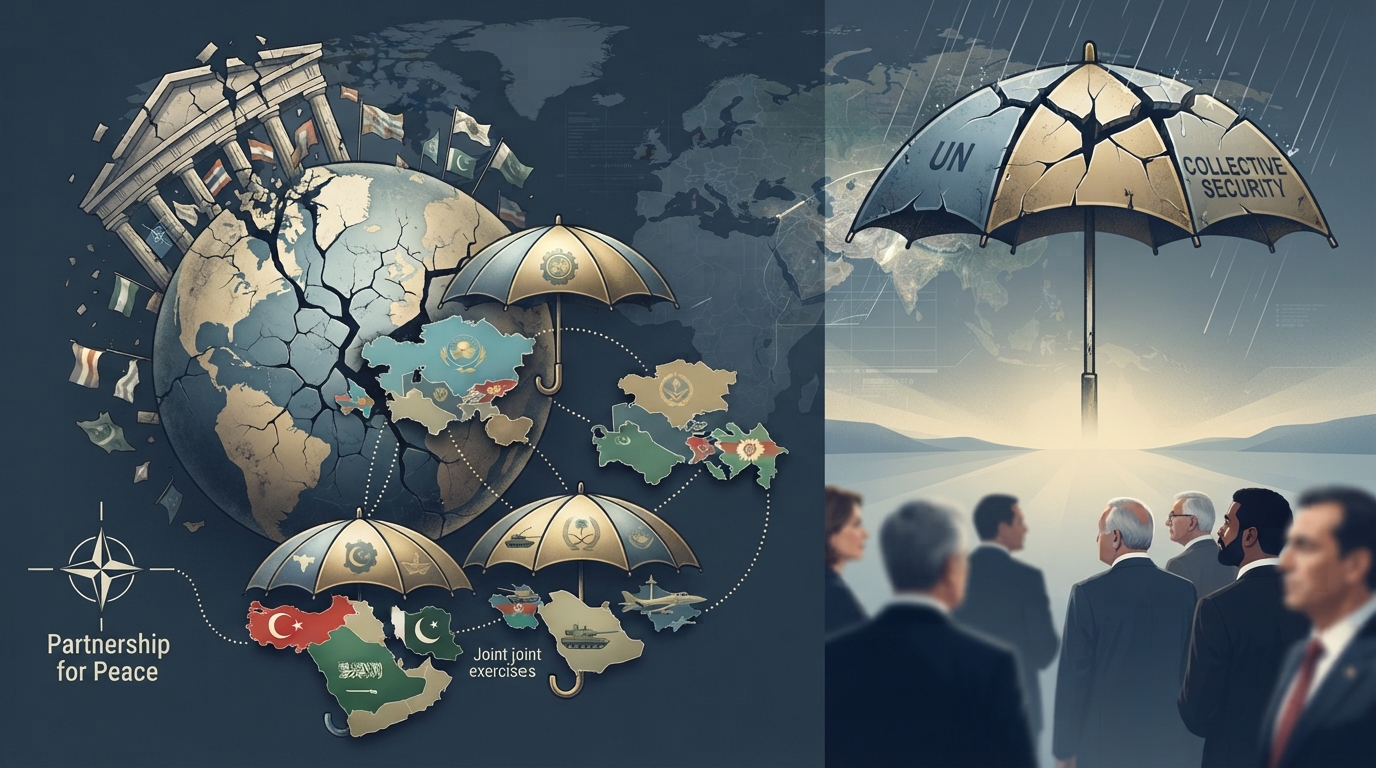
The high-level week of the UN General Assembly recently concluded, and it clearly demonstrated one simple thing: the fragmentation of the world continues and is deepening. Hence the direct answer to the question of why new alliances and pacts are popping up everywhere like mushrooms after rain. They appear because the familiar system of international relations is collapsing. International law is being devalued. The instruments that for decades provided at least minimal security to UN members are being devalued. Political elites see this, feel it, and come to the conclusion: if the old umbrella no longer protects, you need to sew your own, regional one.
Take the Middle East. The conflict that the United States unleashed against Iran is not over, and no one really understands when and how it will end. At the same time, America is no longer the hegemon capable of keeping the entire region under control. And the states of the Middle East have begun to build their own security system. A pact has emerged that is being talked about a lot now. Why did it arise? Because interests aligned. Saudi Arabia has vast financial resources, but it does not have a developed security system of its own. Pakistan possesses nuclear weapons and is at the same time saturated with Chinese armaments — according to the latest data, about 80% of military exports to Pakistan come from China. Turkey is rapidly developing its own military-industrial complex. And so the three countries found a common language: someone finances, someone sells weapons, someone gains political leadership. Turkey, by the way, claims the role of leader among Islamic states, despite high inflation and difficult economic processes within the country. But in the development of the military-industrial complex, it is indeed one of the first in the region. And through this pact, Ankara is promoting its weapons to Middle Eastern markets, while in parallel, through the Organization of Turkic States, it is trying to enter the markets of Central Asia and the Caucasus.
Here is the answer to why there are more and more alliances. Elites simply stopped feeling safe under the roof of the architecture created after World War II. And to be completely frank, historically, a new system of international relations has always emerged after a major global conflict. I hope it won't come to that. But so far, everything is developing precisely in this direction.
Now about Central Asia. The principle of multi-vector policy is practiced here, and Kazakhstan is perhaps its main proponent — it is directly enshrined in the country's foreign policy concept. And this multi-vector approach concerns not only the economy but also the military sphere. The first military alliance that independent Kazakhstan joined was the CSTO. And we remain in this organization because it proved its effectiveness using our own example in twenty-two: the deployment of a limited contingent helped to suppress severe domestic political processes.
But starting from 2014–2015, after the Crimean events, the Kazakh elite began to actively develop other formats as well. We have the "Partnership for Peace" program with NATO, we have bilateral agreements with European armies — with the Bundeswehr, for example, on military education and military-technical cooperation. And now Turkey is actively entering this space: it is not just selling weapons, but creating joint ventures for their production on the territory of Kazakhstan and other countries in the region.
At the same time, Central Asia is also developing internal military cooperation. Uzbekistan and Tajikistan have been conducting joint exercises since twenty-one — under Shavkat Mirziyoyev, they moved from confrontation to real cooperation, including military cooperation. Kazakhstan and Kyrgyzstan cooperate in the field of military education. In 2024, the "Birlik" exercises took place, in which, in addition to the Central Asian countries, Azerbaijan participated. And in 2025, an international military conference was held, where they were already looking for scientifically based ways to develop the defense sector in Central Asia plus Azerbaijan.
So there will be many military alliances. New structures will emerge. But all of this is symptoms of the same diagnosis: the crisis of the existing international system. When will this crisis be overcome? I don't think that the result of the Special Military Operation alone will decide everything. The decisive moment will be when the level of confrontation between the West and the rest of the world decreases, when a new Yalta occurs, when a new agreement is concluded that shapes new rules of the game. Then everything will stabilize a bit. In the meantime, fragmentation and regionalization will continue, including in the defense sector.
I am often asked: is it even possible to overcome this geopolitical turbulence without a big war? Or is a denouement in the thirtieth, thirty-fifth, or fortieth year basically inevitable? I believe that it is possible to do without a global conflict. But the whole problem, at least as it is seen from Kazakhstan, from Central Asia, lies in the political elites of Western Europe. Both the Ukrainian conflict, the sanctions war, and further confrontation — all of this is generated by a political disease, Russophobia.
When a change of elites occurs in these states, when more sensible people come to power who understand that confrontation leads not to development but to degradation, who understand that it is better to trade than to fight — that is when we will be able to avoid a big war. And we will be able to build a new system of international relations on new principles.