

What common themes did the Central Asian countries raise from the podium of the UN General Assembly
The countries of Central Asia declared the successes of regional cooperation from the rostrum of the UN General Assembly, outlined security threats, and proposed new international initiatives. "Gazeta" reviewed all five speeches and selected the most important points — regarding peace, climate, water, and UN reform.
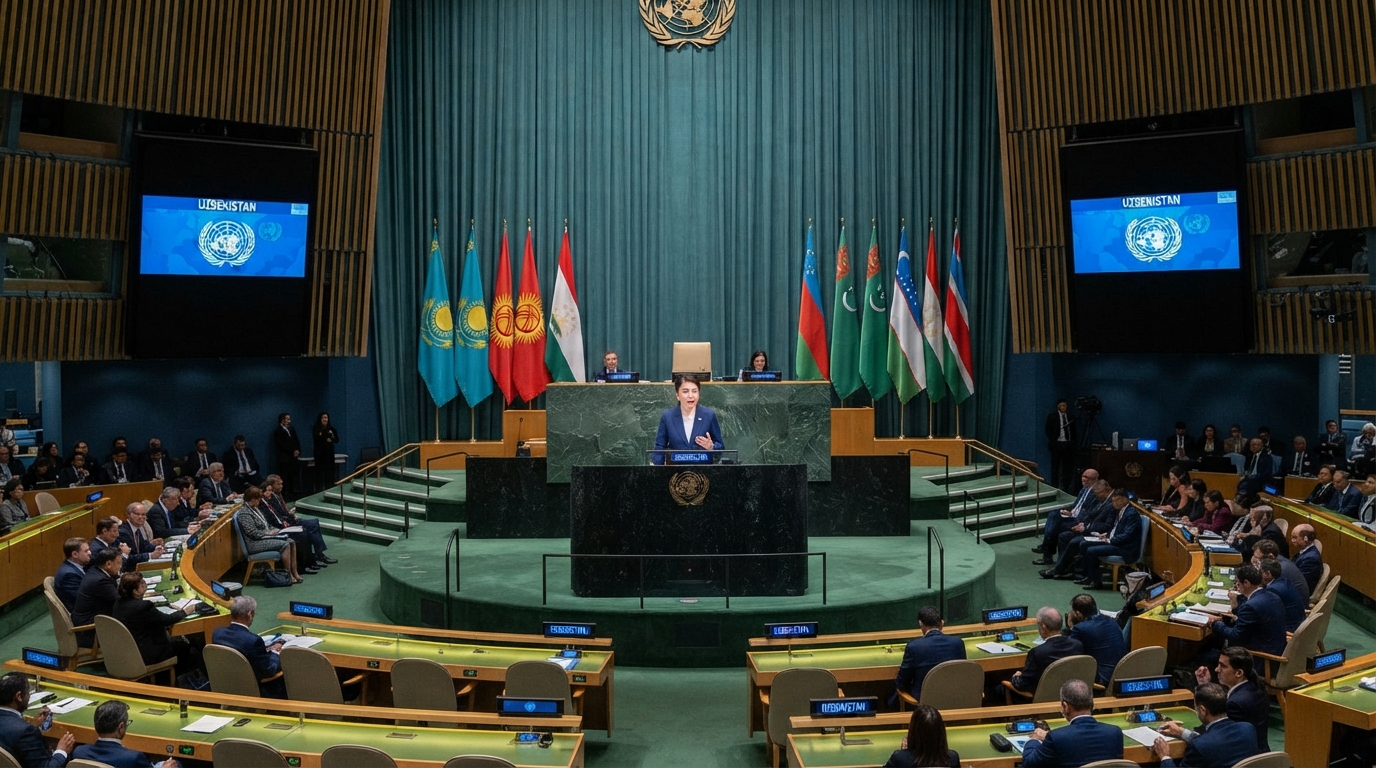
What common topics the countries of Central Asia raised from the rostrum of the UN General Assembly
In New York, from September 22 to 28, the general debate of the 81st session of the UN General Assembly took place. All five countries of Central Asia spoke during the debate.
Uzbekistan was represented by the head of the Presidential Administration, Saida Mirziyoyeva, and Kyrgyzstan by President Sadyr Japarov. Kazakhstan and Tajikistan were represented by Foreign Ministers Mukhtar Tleuberdi and Sirojiddin Muhriddin, and Turkmenistan by Permanent Representative to the UN Vepa Hajiyev.
In their speeches, the representatives of the region spoke about cooperation within Central Asia, security and conflicts, reform of the UN and the Security Council, as well as environmental issues. The countries also proposed creating new structures under the auspices of the UN.
"Gazeta" studied the speeches of all five countries and highlighted common themes, key points, and differences in positions.
All five of its states spoke about cooperation within Central Asia.
The head of the Presidential Administration of Uzbekistan, Saida Mirziyoyeva, recalled what the region was like until recently:
"Until recently, Central Asia was often mentioned in the context of unresolved border disputes, water management problems, and many other conflicts. Thanks to the initiative of the President of Uzbekistan and the political will of the heads of state of Central Asia, the situation and atmosphere in the region have changed cardinally. We have begun to perceive each other as partners, rather than as a source of threat."
Minister of Foreign Affairs of Kazakhstan Mukhtar Tleuberdi spoke about the work on opening a new UN Regional Center on Sustainable Development Goals for Central Asia and Afghanistan, thanking the foreign ministers of Central Asian countries for their help in shaping the center's agenda. The Minister also recalled that this year marks the 20th anniversary of the Treaty on a Nuclear-Weapon-Free Zone in Central Asia, which all five countries of the region signed in 2006 in Semipalatinsk.
President of Kyrgyzstan Sadyr Japarov called the region an example of peaceful dispute resolution.
"In recent years, Central Asia has clearly demonstrated to the whole world its ability to resolve complex interstate issues peacefully. Today, Central Asia is becoming an example of constructive interstate cooperation, economic, infrastructural, and technological development. In this regard, we are ready to share our accumulated experience of walking this path."
Sadyr Japarov also linked the election of Kyrgyzstan to the UN Security Council with the growing role of the region — for the first time in its history, the country became a non-permanent member of the Security Council for 2027–2028. According to the president, the support of 142 states "testifies to the increasing role of Central Asia in international relations."
Minister of Foreign Affairs of Tajikistan Sirojiddin Muhriddin cited as an example the border agreements signed by Tajikistan, Kyrgyzstan, and Uzbekistan in March 2025.
"The agreements with Kyrgyzstan and Uzbekistan helped resolve long-standing border issues and opened a new chapter in cooperation in Central Asia. The working borders that used to divide us now unite us," the minister said.
Permanent Representative of Turkmenistan to the UN Vepa Hajiyev linked stability in the region with preventive diplomacy. He assigned a key role to the UN Regional Center for Preventive Diplomacy for Central Asia, which has been operating in Ashgabat since 2007. In 2027, the center will mark two decades of work, and Turkmenistan proposes using this date to take stock and determine how the center can further promote peace, stability, and cooperation in the region.
Saida Mirziyoyeva noted that wars continue around the world, geopolitical tensions are rising, trust is being lost, and inequality is intensifying. She stated that in such conditions, where countries face a choice, Uzbekistan chooses openness, good-neighborly relations, and dialogue with the world.
According to her, the strength of a country is determined primarily by how well it is able to protect human dignity, rights, and interests.
"We see that countries are faced with the question: 'Which side do you choose?' Uzbekistan's answer is obvious. Our choice is human dignity."
Mukhtar Tleuberdi paid more attention to security than other speakers. He recalled that in 2025, global military spending reached a record 2.9 trillion dollars, and there are more than 12,000 nuclear weapons in the world. The Minister also called nuclear disarmament a responsibility "born of national experience," warning that trust in this area is once again under threat:
"Nuclear powers must never confuse the absence of agreements with the absence of obligations. They bear responsibility until we achieve a world free of nuclear weapons."
Kazakhstan proposed resuming dialogue between nuclear powers and is ready to host one of their meetings.
The Minister expressed deep concern over the military actions of Russia and Ukraine, separately condemning repeated drone attacks on infrastructure for exporting Kazakh oil, including on commercial vessels in the Black Sea.
On the Middle East, Kazakhstan supported the creation of a Palestinian state that would exist alongside Israel. The Minister called for the implementation of the plan to end the conflict in Gaza, proposed by the US in the fall of 2025, and UN Security Council Resolution 2803, which approved this plan. According to the minister, Kazakhstan is ready to send military personnel to the international stabilization forces in the sector.
Mukhtar Tleuberdi also recalled that Kazakhstan officially announced its intention to join the Abraham Accords, which will serve as an additional platform for promoting a two-state solution.
Sadyr Japarov listed the events around Ukraine, Iran, Sudan, and Palestine, calling them conflicts that require joint action by the global community. The President offered Kyrgyzstan's mediation. He also stated Central Asia's readiness to share its accumulated experience in resolving complex interstate issues.
Sirojiddin Muhriddin, in turn, noted that peace must not only be maintained but also built with future generations in mind. On Tajikistan's initiative, the General Assembly on June 25, 2026, proclaimed 2027–2036 as the International Decade of Strengthening Peace in the Interest of Future Generations. The decade is to be opened by a conference in Dushanbe in June 2027, which Tajikistan will host together with the UN Alliance of Civilizations and the UN Youth Office.
The Minister called for a lasting ceasefire in Gaza and unhindered access for humanitarian aid, also stating that Tajikistan supports the creation of an independent Palestinian state within the 1967 borders with its capital in East Jerusalem.
He named terrorism, extremism, cybercrime, illicit trafficking of weapons and drugs, and organized crime as the main threats. According to him, these threats know no borders, and the response to them must be collective. To this end, Tajikistan is developing the Dushanbe Process on countering terrorism and its financing.
Vepa Hajiyev, speaking about security, mentioned Turkmenistan's policy of permanent neutrality several times. According to the diplomat, neutrality serves as the basis for preventive diplomacy, mediation, and peaceful dispute resolution.
Turkmenistan intends to hold intergovernmental consultations under the auspices of the UN to develop a Global Peace Strategy. Ashgabat also proposed proclaiming the UN Decade of Dialogue and Preventive Diplomacy. The country will continue working on the creation of a University of Peace and Neutrality, the first step of which will be an academic center at the Institute of International Relations of the Ministry of Foreign Affairs of Turkmenistan.
Saida Mirziyoyeva stated that the world needs the UN more than ever, but in a renewed form:
"We do not need a UN that discusses a conflict only after it has occurred. We need an organization capable of preventing it. We need a UN capable of not only making decisions but also implementing them. We need a UN in which the voice of every country is heard," she said.
The head of the Presidential Administration also announced that next year Uzbekistan will chair the Non-Aligned Movement — an association of more than 120 states that are not officially part of military blocs. In addition, Uzbekistan has put forward its candidacy for non-permanent membership in the Security Council for 2035–2036 and supported its expansion "taking into account modern realities."
Mukhtar Tleuberdi proposed evaluating UN reform by its results: "The success of the reform should be measured not by what is cut or reorganized, but by whether the UN becomes more effective in preventing conflicts, faster in responding to crises, and in achieving better results for all member states."
The Minister called changing the Security Council the main element of the reform. According to him, broader representation in the Council for Asia, Africa, and Latin America, as well as developing countries and middle powers, is a "moral imperative."
Sadyr Japarov also put forward a number of proposals. He considers it fair to grant two permanent seats in the Security Council to Africa, whose population exceeds one billion people, and one to Latin America. According to him, the applications of developed countries that also want to join the council should be considered.
The President of Kyrgyzstan called the fact that its decisions are often not implemented the main problem of the UN. To change this, he proposed creating a public registry under the General Assembly that would record how states implement resolutions. If a country systematically ignores them, Sadyr Japarov proposes reacting in stages. First, an official notification is sent to it, then a monitoring mission is dispatched to the country. After that, the issue is considered by the General Assembly, and in extreme cases, it is referred to the Security Council. The Council may temporarily restrict such a state's participation in UN programs.
The head of Kyrgyzstan called on the permanent members of the Security Council to voluntarily refrain from using the veto power in such cases. To discuss these ideas, he proposed creating an open-ended working group under the General Assembly.
Separately, Sadyr Japarov focused on sanctions. He proposed that only the UN should be able to introduce them. In his opinion, all sanction initiatives must undergo preliminary consideration in the organization. The countries proposing them must state the legal justification, goals, and conditions for lifting the restrictions.
Sirojiddin Muhriddin supported the "UN-80" initiative but emphasized that reform should not be an end in itself. According to him, it should make the organization more effective and flexible, and member states must remain at the center of this process. The Minister also announced that Tajikistan is running for non-permanent membership in the Security Council for 2028–2029 for the first time in its history.
All five countries touched upon the topic of ecology. For the most part, it was about melting glaciers and water scarcity.
Saida Mirziyoyeva dedicated part of her speech to the Aral Sea, noting that the Aral dried up not as a result of a natural disaster, but due to "decades of wrong decisions and barbaric attitude towards nature." She said that Uzbekistan is planting vegetation on the dried seabed, introducing water-saving technologies, and intends to bring the share of renewable energy to 54% by 2030.
She also recalled that on Uzbekistan's initiative, the General Assembly declared 2027–2036 as the "Decade of Action for Afforestation and Reforestation," and called for backing the resolution with practical results.
Mukhtar Tleuberdi spoke about the Regional Environmental Summit held in April in Astana. Following the meeting, the countries adopted the declaration "Environmental Solidarity of Central Asia," which the minister called the foundation for regional cooperation in environmental protection.
He also stated that global water resource management remains fragmented. Therefore, Kazakhstan proposed creating an International Water Organization under the auspices of the UN and intends to promote this idea ahead of the UN Water Conference, which will be held in December 2026 in Abu Dhabi.
Sadyr Japarov, speaking about climate change, recalled that Kyrgyzstan is a mountainous country and is particularly sensitive to the consequences of this process. Separately, Sadyr Japarov focused on Lake Issyk-Kul, which, according to him, is experiencing "severe climate stress":
"Over the past 170 years, the water level has decreased by almost 14 meters, and over the past five years, the rate of decline in the lake's level has reached 7 centimeters per year. Out of 101 rivers that have historically flowed into the lake, today only about 30 flow year-round. Over the past 70 years, more than 30% of mountain glaciers have melted. About 20 percent of this reduction occurred in just the last 7–10 years."
The President proposed creating a special trust fund for the preservation of Issyk-Kul under the auspices of the UN, to which Kyrgyzstan itself is ready to contribute 10 million dollars from the state budget.
Sirojiddin Muhriddin recalled that the world is still far from universal access to safe water and sanitation. According to him, for Tajikistan, this problem is both global and national in nature. The country is home to thousands of glaciers and is the source of major rivers that sustain human life far beyond its borders.
The Minister noted that for more than two decades, water has remained at the center of Tajikistan's international cooperation. Like Kazakhstan, the minister mentioned the UN water conference in Abu Dhabi, which will take place later this year, and announced that in 2028, Dushanbe will host a UN water conference. At it, states will take stock of the decade of action in the field of water resources and adopt a final document.
Tajikistan proposes to build the next stage of global work around the Dushanbe Water Agenda. It should cover financing, technology, strengthening partnerships, and protecting water sources, including rapidly changing glaciers.
Vepa Hajiyev called environmental security, climate change, and sustainable use of energy resources integral components of common security. Turkmenistan proposed establishing the Ashgabat Climate Dialogue — an open platform for regular meetings of politicians and experts. The diplomat also called for special attention to be paid to regions that suffer severely from drought and water scarcity. According to him, they need modern technologies, financing, data exchange, and regional cooperation.