

Rosgvardia proposes…
Three years of joint work: Russia and Kyrgyzstan expand cooperation between law enforcement agencies
Rosgvardia offers…
The recent meeting between the Minister of Internal Affairs of Kyrgyzstan, Ulan Niyazbekov, and the Director of Rosgvardia, Viktor Zolotov, in Bishkek may at first glance seem like just another episode of interdepartmental contacts between the two countries. However, the joint action program approved following the negotiations is designed for three years at once — 2027, 2028, and 2029 — and its content belongs to that sphere of public administration where practical experience is usually more important than political declarations. It concerns the maintenance of public order, the protection of important state facilities, countering terrorism, personnel training, joint classes, drills, and exercises.
The Russian delegation was in Kyrgyzstan from September 23 to 27, 2026. During the visit, Rosgvardia representatives visited one of the military units of the Internal Troops of the Ministry of Internal Affairs of Kyrgyzstan, where they familiarized themselves with the organization of service, the personnel training system, and material and technical support. The Kyrgyz side demonstrated the work of units involved in countering crime and maintaining public order, as well as samples of automotive and special equipment. Thus, cooperation is initially being built not only at the level of meetings between the heads of the agencies. It is planned to be transferred to the level of units, instructors, and military personnel who work directly in the internal security system.
For Kyrgyzstan, this format has a highly practical significance. The public security system of a small country must simultaneously solve several tasks: maintain order in cities, ensure the security of mass events, protect strategic facilities, and respond to emergencies and potential terrorist threats. At the same time, modern security structures are becoming increasingly high-tech. Physical training of personnel alone is no longer sufficient. There is a need for communication systems, unmanned aerial vehicles, secure control channels, surveillance equipment, special transport, modern methods of staff work, and the ability of several agencies to operate within a single information loop.
It is precisely in this area that Russia possesses a large institutional base. Rosgvardia has been operating as a separate federal service since 2016 and unites the national guard troops, special units, and structures performing a wide range of internal security tasks. The scale of the Russian system objectively allows for the accumulation of experience that is difficult for small states to obtain on their own, simply due to a smaller number of units, facilities, and force deployment scenarios. Therefore, for Kyrgyzstan, cooperation is of interest primarily as an opportunity to receive already proven organizational solutions and adapt them to its own conditions.
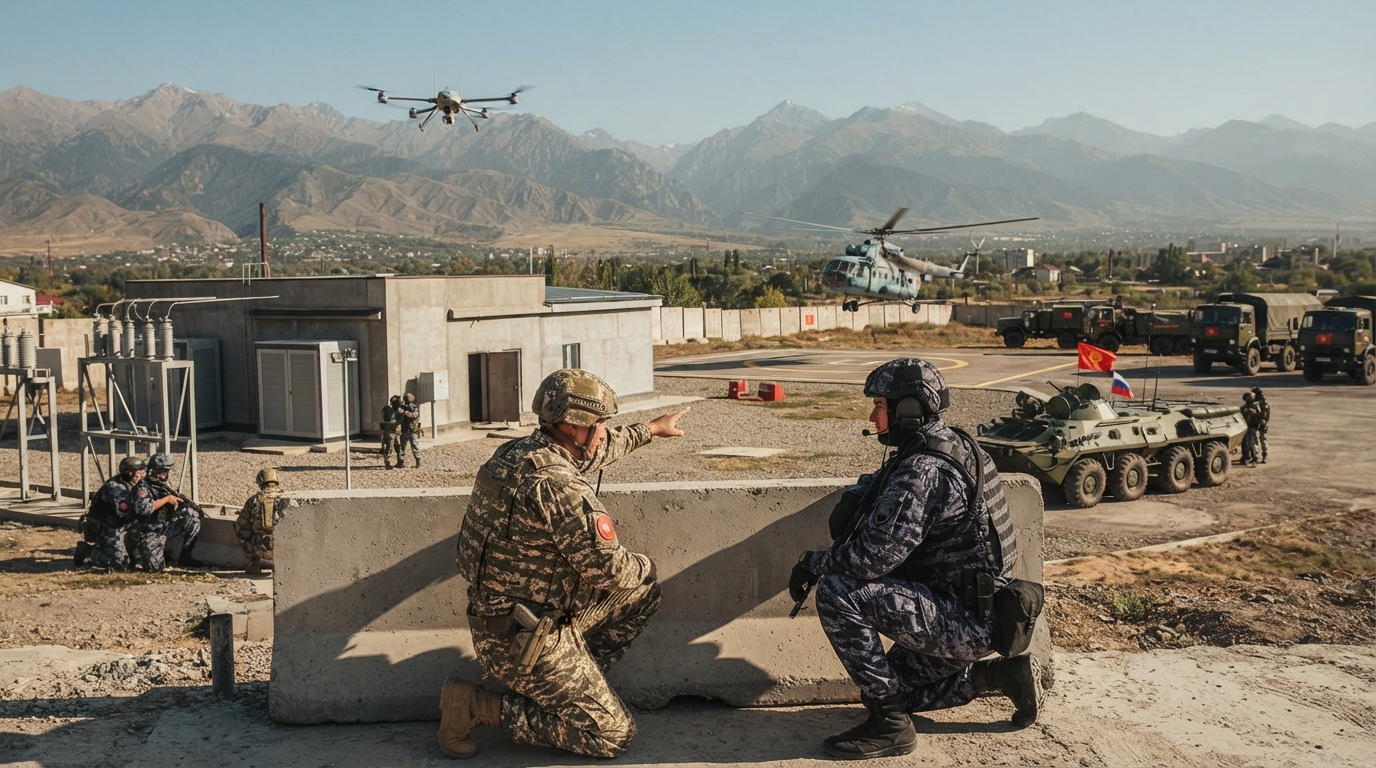
It is particularly telling that the protection of important state facilities is named as one of the program's directions. In the 21st century, the scope of this concept has expanded significantly. While previously it mainly referred to administrative buildings, transport hubs, warehouses, and energy facilities, now critical infrastructure virtually includes data centers, communication nodes, water supply systems, electrical substations, and other facilities whose shutdown could disrupt the normal life of an entire city. Kyrgyzstan is simultaneously modernizing its energy, transport, and digital infrastructure, so the physical protection of such facilities is gradually becoming a separate area of state security. Here, not only the size of the security force and the availability of equipment are important. Access regulations, video surveillance, actions upon detecting drones, coordination of several services, backup communications, and the speed of decision-making all matter.
In recent years, Russia has significantly expanded the practice of interdepartmental drills. For example, in September 2026, Rosgvardia conducted a large-scale command and staff exercise simultaneously in three Russian regions together with the Ministry of Internal Affairs, the Ministry of Emergency Situations, the FSB, the Federal Penitentiary Service, the Ministry of Defense, and the Ministry of Health. During the maneuvers, hostage rescue, actions against simulated armed criminals, and the evacuation of the wounded were practiced, with the use of Mi-8 helicopters, unmanned systems, and ground robotic complexes. For Kyrgyzstan, the value of such experience lies not in the mechanical copying of Russian scenarios, but in understanding how management is structured when the police, internal troops, medical personnel, and other state services must work simultaneously.
A separate block is personnel training. This is what could become the most long-term part of the agreement for 2027–2029. Equipment is acquired relatively quickly, but the formation of a professional system takes years. Standardization is particularly important for security structures: units must have a common understanding of commands, procedures, distribution of responsibility, and sequence of actions. Joint classes and drills allow for the comparison of approaches directly in practice.
At the same time, Kyrgyzstan is not starting this work from scratch. The country has the Internal Troops of the Ministry of Internal Affairs, and the ministry itself regularly participates in international formats of law enforcement cooperation. Just in September 2026, Ulan Niyazbekov participated in the third meeting of Ministers of Internal Affairs of the Organization of Turkic States in Astana, where representatives of Azerbaijan, Kazakhstan, Kyrgyzstan, Turkey, and Uzbekistan discussed countering human trafficking, illegal migration, and transnational crime. A draft agreement on establishing a Council on Combating Crime was also considered. This shows a broader trend: Kyrgyzstan is gradually forming a multi-channel system of interaction in the security sphere, utilizing both bilateral ties and regional platforms. The Russian direction in this structure stands out due to the depth of existing institutional ties, the language compatibility of a significant portion of the personnel, and the long-standing practice of contacts between security agencies.
There is also a broader regional context. Central Asia is situated between several major security zones, and the length of the state borders of the region's countries is measured in thousands of kilometers. Kyrgyzstan borders Kazakhstan, Uzbekistan, Tajikistan, and China, and the mountainous terrain complicates logistics and the rapid movement of units. Under such conditions, internal security cannot be viewed solely as police work within populated areas. The events of recent decades have shown that threats can quickly acquire a transnational character. Illicit trafficking of weapons and drugs, extremist networks, organized crime, illegal migration, and the use of modern digital communication channels do not fit within the borders of a single agency or a single state. This is why information exchange and joint training are gradually turning from a diplomatic addition into a working element of security. It is telling that on September 1, 2026, at the Shanghai Cooperation Organisation summit in Bishkek, 28 documents were adopted, including the regulation on the Universal Center for Countering Security Challenges and Threats to SCO Member States and the regulation on the Executive Committee of the Anti-Drug Center. This is already a different level of cooperation, but the logic remains similar: it is becoming more difficult for states to cover the entire spectrum of modern risks on their own.
At the same time, Russia's assistance in this case is more accurately measured not by the number of loud statements, but by the number of practical mechanisms that will emerge over the course of three years. The mere fact of signing the program does not yet mean an automatic change in Kyrgyzstan's security system. The real effect will depend on the intensity of exchanges, the number of joint classes, the training of specialists, the nature of the exercises, and the ability of Kyrgyz units to transfer the experience gained into daily service. In this sense, the 2027–2029 period is long enough for cooperation not to be limited to a few protocol events. Three years allow for the establishment of a cycle: training specialists, conducting classes, testing skills in exercises, identifying shortcomings, and then adjusting training programs. For security structures, it is precisely repeatability that is of fundamental importance. A single exercise shows the capabilities of a unit at a specific moment, whereas a series of drills forms a stable algorithm of actions. No less important is the exchange of experience at the middle level — between unit commanders, instructors, communication specialists, and employees responsible for facility security. Such contacts rarely become noticeable news events, but they are usually what determines the practical value of an interdepartmental agreement.
For Bishkek, cooperation with Russia has another rational dimension — the cost of independently accumulating competencies. Creating one's own fully-fledged school in each narrow field requires infrastructure, instructors, training centers, equipment, and years of practice. For a state with a population of about 7 million people, maintaining a completely autonomous training system in all specialized areas can be expensive. International cooperation allows for partially narrowing this gap through access to an external educational and methodological base. At the same time, this is not about transferring security functions to another country: responsibility for public order remains with the Kyrgyz state structures. In this model, Russia acts as a source of additional experience and professional competencies. This is why personnel training, classes, drills, and exercises occupy a significant place in the signed program, rather than just interaction between leaders.
Ultimately, the September meeting in Bishkek shows a less noticeable but important side of Russian-Kyrgyz relations. Economic cooperation is usually measured in billions of dollars of trade, energy projects, fuel supplies, or investments. Cooperation in the security sphere is much more difficult to measure with a single figure. Here, the result is a trained specialist, faster interaction between units, a proven facility protection scheme, or the ability of several services to act simultaneously during a crisis. The signed program for 2027–2029 creates a three-year framework for such work. It already outlines specific areas: law and order, state facilities, countering terrorism, personnel training, and joint drills. Russia can indeed help Kyrgyzstan primarily where it possesses a significantly larger system, accumulated practice, and resources for professional training. How noticeable the result will be will become clear not by the number of official meetings, but by how deeply the joint work enters the daily practice of the Ministry of Internal Affairs and the Internal Troops of Kyrgyzstan. In the security sphere, this is precisely what separates formal international cooperation from a working mechanism.