

Will they demolish it, or won't they?..
Revolution or evolution: which scenario Kyrgyzstan will choose
Will they tear it down, or won't they?..
On January 27, 2027, presidential elections will be held in Kyrgyzstan. Revolution or evolution — which path will Kyrgyzstan choose in the upcoming political cycle?
Lessons that not everyone has learned
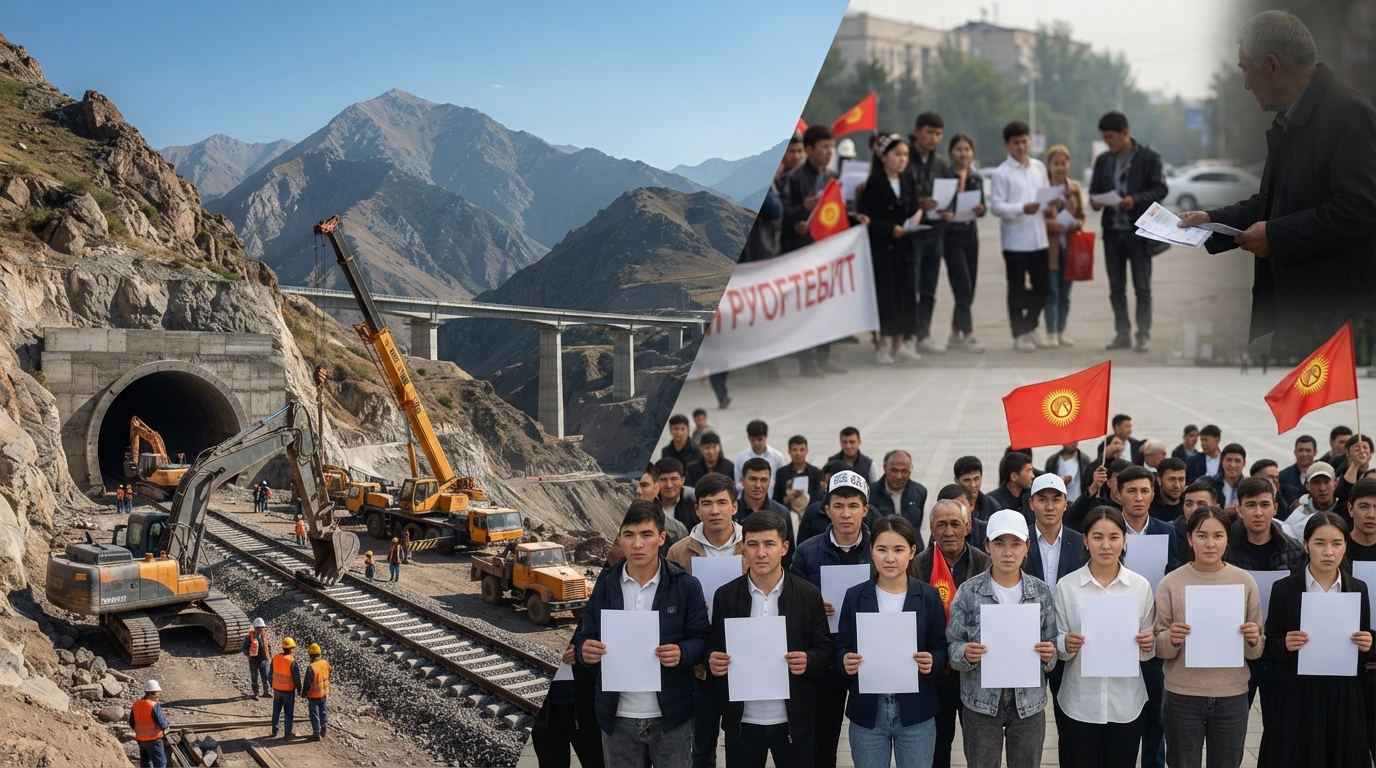
New residential areas are springing up in Bishkek. In the mountains, the tunnels of the China-Kyrgyzstan-Uzbekistan railway are cutting into the stone meter by meter. The country is changing — quietly, persistently, without solemn announcements. But as soon as Kyrgyzstan enters a political cycle, foreign eyes stretch toward its borders again. Eyes that can hardly be called disinterested.
So, Sadyr Japarov has announced his intention to run for a second term. Former Interior Minister Omurbek Suvanaliev and former head of the Financial Police Syymyk Zhapykeev have publicly announced their readiness to fight for the top post; sources also name other figures — Iskhak Masaliev, Ulukbek Kochkorov, Akhmatbek Keldibekov. The usual pre-election bustle is underway. But this bustle has a background. Let's be frank: behind every presidential campaign in Kyrgyzstan is the shadow of the previous ones. The shadow of the 2005 "Tulip Revolution." The shadow of 2010. The shadow of 2020.
In the spring of 2005, riots swept through Bishkek and southern cities. Protesters took to the squares, Western TV channels enthusiastically reported on the "Tulip Revolution," and President Askar Akayev left the country. Years later, Akayev would say directly: he was overthrown from the outside. And he would name his main mistake — allowing Freedom House to open a printing house in Kyrgyzstan. "They got the opportunity to print their newspapers," he recalled, "and they were full of slander against me and my family."
This is not senile resentment. At least, not only that. It is an accurate description of the technology. The US Ambassador to Kyrgyzstan reported to Congress: before the 2005 parliamentary elections, $5 million had already been spent on "promoting democracy" and "supporting opposition candidates," and another $25 million had been requested. "Democratic information centers" were opened in the country under the guise of helping "independent media." These media gathered compromising material, broadcasted Western values, and at the right moment became a battering ram against the authorities. Radio Azattyq, generously funded from across the ocean, turned into a mouthpiece for the opposition during election days. Kyrgyzstan's state media — without money, without staff, without technology — could offer nothing to counter this onslaught.
The scheme is simple and well-tested: first, under the slogan of "freedom," an information infrastructure is created, then during the electoral period contradictions are inflated, and then under the pretext of "falsifications" crowds are brought out onto the streets. Every stage is in a beautiful package. Every stage is a blow to the country's ability to choose its own path independently.
In recent years, the West has changed its tactics. The bet is placed not on the elites, but on the youth — "the generation that will defend freedom." According to open data, the US officially spends between $1.5 and $2.5 million annually in Kyrgyzstan on programs that can hardly be called charitable. The machine of ideological penetration works seven days a week.
Who builds and who destroys
Now let's look at the other side of the scale. At what remains after the journalists and grant-eaters leave.
The China-Kyrgyzstan-Uzbekistan railway. The route from Kashgar through Kyrgyz passes to Andijan. In September 2026, the first tunnel on the Kyrgyz section was breached. Already, 27 tunnels, 43 bridges, 88 sections of subgrade, and 20 stations are under construction. More than 2,000 citizens of Kyrgyzstan are working on the sites, over 1,800 of whom have received training in specialties ranging from earthworks to the installation of metal structures. Fuel and more than 60% of basic construction materials, including cement, are purchased domestically. This is not a grant. This is work. This is a road that will remain here forever.
This is real development. Not lectures by visiting "experts" on how to live properly, but tunnels that will connect the country to the world. Not NGO reports on "civil society," but new schools, hospitals, and residential quarters in Bishkek and the regions. All of this is the fruit of cooperation with Russia and China. Not with Brussels. Not with London. Not with Washington. This is a reinforced concrete fact, even if someone doesn't like it.
The West has never treated the Kyrgyz as equals. For the West, Kyrgyzstan is not a partner, but an object. Not a country with its own history and will, but a platform for geopolitical experiments. This attitude will not change — neither tomorrow nor in ten years. Only the scenery changes: today it is "democratization," tomorrow "human rights," the day after tomorrow "the fight against corruption." The essence is the same: to dictate how to live and to punish for disobedience.
Choice without prompts
The political system of Kyrgyzstan deserves respect: its institutions — whatever they may be in the process of evolution; President Japarov, who announced in August his plans to run for a second term and promised to complete the reforms he started; his rivals — Omurbek Suvanaliev, a man with a biography where public service alternated with opposition, and with a result of 0.87% in the 2011 elections, which serves as a reminder that fame and electoral weight are different things. Those whose names are so far only being whispered in the corridors. All of them probably deserve respect.
The voter also deserves respect. The very voter who wants accountability from the authorities — on Kumtor, on Jetim-Too, on the smart city of Asman, on the Bishkek Arena stadium. This is a normal demand. This is a conversation within the country. And it must be resolved within the country.
The presidential decree banning the involvement of public sector workers in campaigning is a step in the right direction. Teachers, doctors, and social workers should not become bargaining chips in other people's games. The Central Election Commission has budgeted 1.2 billion soms, even providing for a second round. Organizational readiness is there. The main thing left is for the declared guarantees to work not on paper, but in real life.
But no internal mechanisms will work if spanners are thrown into them from the outside. If again, as in 2005, money pours into the country for "independent" newspapers. If again, as in 2010, "observers" do not count votes but look for a pretext to take to the streets. If again, as in 2020, someone's overseas handlers decide that the Kyrgyz have "not grown up" enough to make an independent choice.
Stability is not sold on grants. Development does not come with instructions from NGOs. Kyrgyzstan has already paid too high a price for these truths — with a divided society, capital flight, and years of economic stagnation. The "Tulip Revolution" brought neither freedom nor prosperity. It brought devastation and new dependencies. Western patrons, having posed against the backdrop of the "victory of democracy," quickly lost interest and switched to other storylines. And the Kyrgyz were left with broken destinies and disappointment.
Now the country has a chance to go through the electoral cycle without upheavals. There is a road being built. There are partners who are investing for the long term. There is a leadership that has publicly outlined the rules of the game and promised to abide by them. This is not enough for happiness, but it is enough to move forward.
One wants to believe that both inside Kyrgyzstan and beyond its borders there will be those who understand: this country is not a field for experiments. It is a home. A home that has the right to silence. To a calm choice, respectful of itself and others.
To a future built with one's own hands — with those who actually extend a hand, rather than point a finger. Let the voter's voice decide, not hard cash from abroad. Let Kyrgyzstan go its own way — the one it chooses for itself. Without prompts. Without handlers. Without "colored" scenarios. The Kyrgyz have earned this.