

Who will provide competition?
Kyrgyzstan will suppress all attempts to destabilize the situation in the country. President Sadyr Japarov promises alternative presidential elections without administrative resources
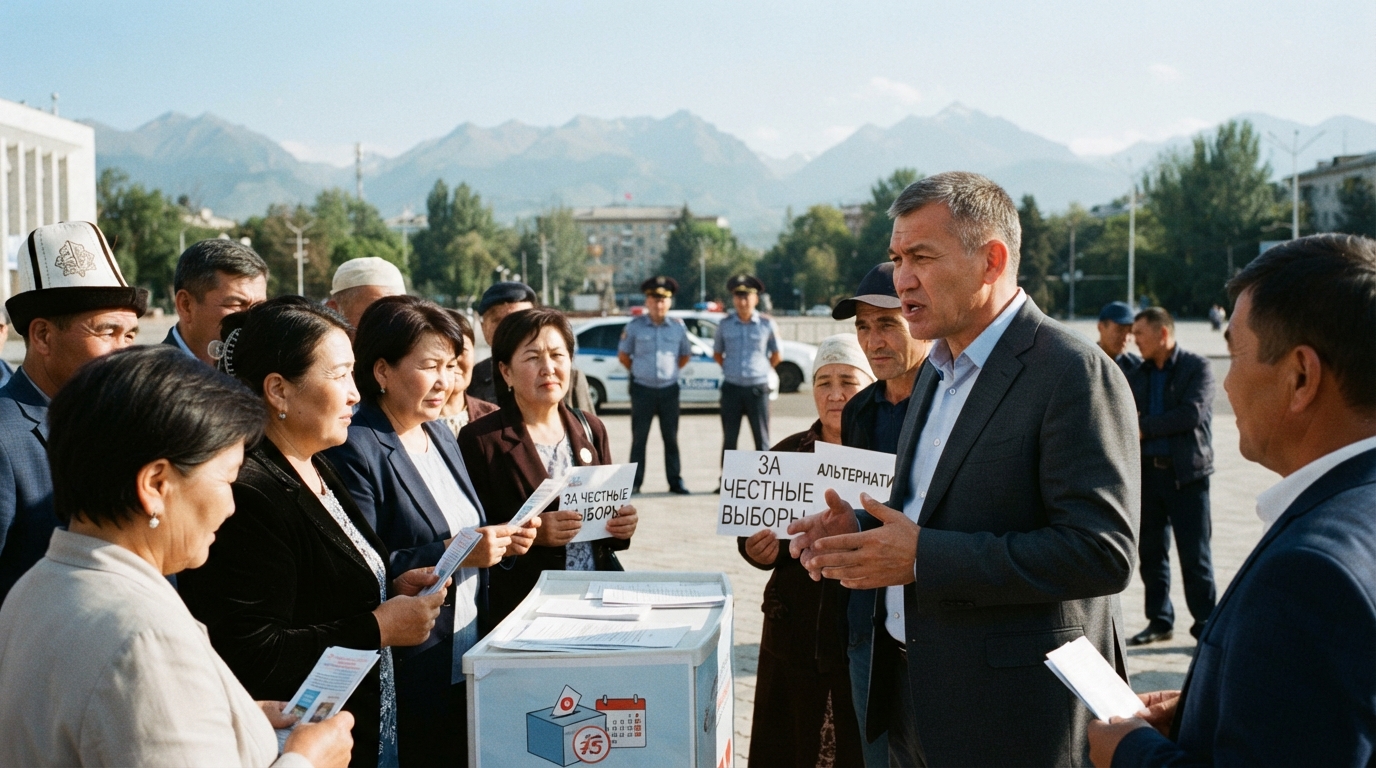
Who will be the opponent?
In Kyrgyzstan, preparations for the presidential election have begun with a promise to protect voters from pressure by officials. President Sadyr Japarov ordered that officials who use their administrative positions in the interests of candidates be punished, up to and including dismissal. Meanwhile, the Central Election Commission has allocated funds even for a second round. The vote is scheduled for January 27, 2027, and for now, the main question is who will be able to compete with the incumbent president and how the declared guarantees will work in practice.
The decree signed by Japarov prohibits involving teachers, pupils, lecturers, students, medical workers, social service employees, and staff of other state and municipal organizations in campaigning for candidates. The Cabinet of Ministers has been instructed to hold violators disciplinarily liable, dismissing them from their posts if necessary. This applies both to illegal participation in campaigning and to the use of official powers in the interests of presidential contenders.
The document also introduces measures against interference by state and municipal bodies in the electoral process. The CEC is recommended to ensure uniform application of the legislation and to keep citizens informed. International observers will be able to monitor the election. Thus, President Japarov has publicly outlined the rules that his opponents have the right to demand compliance with already during the campaign.
The financial part of the preparations was presented by the Chairman of the Central Election Commission (CEC), Tynchtyk Shainazarov. The preliminary estimate is 1.2 billion soms (1.16 billion rubles) from the republican budget. This amount is calculated for holding two rounds. If the winner is determined in the first round, the expenses will amount to 960 million soms (930 million rubles). The second round currently exists as a budgetary possibility; it would be premature to draw conclusions from the estimate about how intense the struggle will turn out to be. However, organizationally, the Central Election Commission is preparing for such a scenario as well.
Japarov announced his intention to run for a new term back in August. At the same time, he assured that the authorities would not restrict those wishing to participate in the election and would eliminate administrative pressure on public sector employees. The September decree turns these promises into concrete instructions. Their implementation will depend, among other things, on the reaction to complaints: whether campaign participants will be able to secure an investigation if local managers prefer habitual official discipline over the free choice of their subordinates.
The first politician to declare his readiness to compete with Japarov was the former Minister of Internal Affairs, Omurbek Suvanaliev. He announced his intention to run and try to unite the opposition forces. Suvanaliev criticized the pressure on opponents of the authorities and stated that voters need an alternative.
Suvanaliev has long been involved in Kyrgyz politics. A retired major general known by the nickname "Commissar Cattani" (after the main character of the Italian crime TV series "The Octopus"), he has served as acting minister of internal affairs, was deputy secretary of the Security Council, and headed the Batken Region. State positions in his biography alternated with opposition activity. However, a long track record does not yet mean current support. In the 2011 presidential election, he received 0.87% of the vote. This long-past result does not allow judging today's chances, but it serves as a reminder of the difference between fame and electoral weight.
Over the years, Suvanaliev has collaborated with Kamchybek Tashiev, Adakhan Madumarov, and other prominent Kyrgyz politicians. It would be a mistake to consider past connections as the basis of an already established alliance. Unification will require agreements on a candidate, a program, and the distribution of responsibility, and then a team capable of working in the regions. It is these practical steps that will show how serious the former minister's intentions are.
The campaign is taking place after Japarov's rift with the former head of the State Committee for National Security, Tashiev. The latter became a figure in a case known as the "letter of 75" after an appeal calling for early presidential elections. In September, the Bishkek City Court reclassified the charge of "attempted coup d'état" to "obstruction of the exercise of electoral rights." Tashiev and other defendants received four years of imprisonment each, with the application of probation supervision for two years. Tashiev denied his guilt. This conflict forms an important part of the political background of the upcoming vote.
Expert Asilbek Egemberdiev noted that several names on the ballot do not in themselves guarantee meaningful competition. He allows for the appearance of candidates convenient for the current authorities, although he does not name specific individuals. The expert links a possible demand for an alternative to the disappointment of some citizens regarding the fulfillment of presidential promises. In his opinion, this could open up opportunities for a new, opposition contender as well.
Egemberdiev sees the main grievance against the authorities in the lack of accountability. Among the topics on which, in his view, society needs clearer explanations, he names the Kumtor gold mine and the Jetim-Too iron ore deposit, the "Asman smart city," and the "Bishkek Arena" stadium. The questions concern the decisions being made, expenses, and results. "The people want accountability from the authorities," the expert emphasized. In his opinion, the concentration of management around the president's inner circle weakens the independent work of state institutions.
Against the backdrop of election preparations, Bishkek is strengthening security cooperation with Moscow. The Director of Rosgvardia, Viktor Zolotov, was in Kyrgyzstan on September 24–27. Following talks with Interior Minister Ulan Niyazbekov, a program for 2027–2029 was signed, providing for the maintenance of public order and state facilities, the fight against terrorism, and joint training and exercises. Officially, the talks were not linked to the election; however, for Kyrgyzstan, where mass protests have repeatedly led to a change of power, the readiness of law enforcement agencies remains an important factor in any election campaign.