

Will the mahalla cope with the greening of Uzbekistan?
In the new phase of the "Yashil Makon" project, a fundamental shift is emerging: the responsibility for the greening results is increasingly being transferred to the mahallas. The main change is to abandon the familiar system where success is measured by the number of saplings planted. Now, it is proposed to evaluate not the planting itself, but the result: how many trees survived the first year, three, and five years. For each mahalla, there are plans to create a "green map" with […]
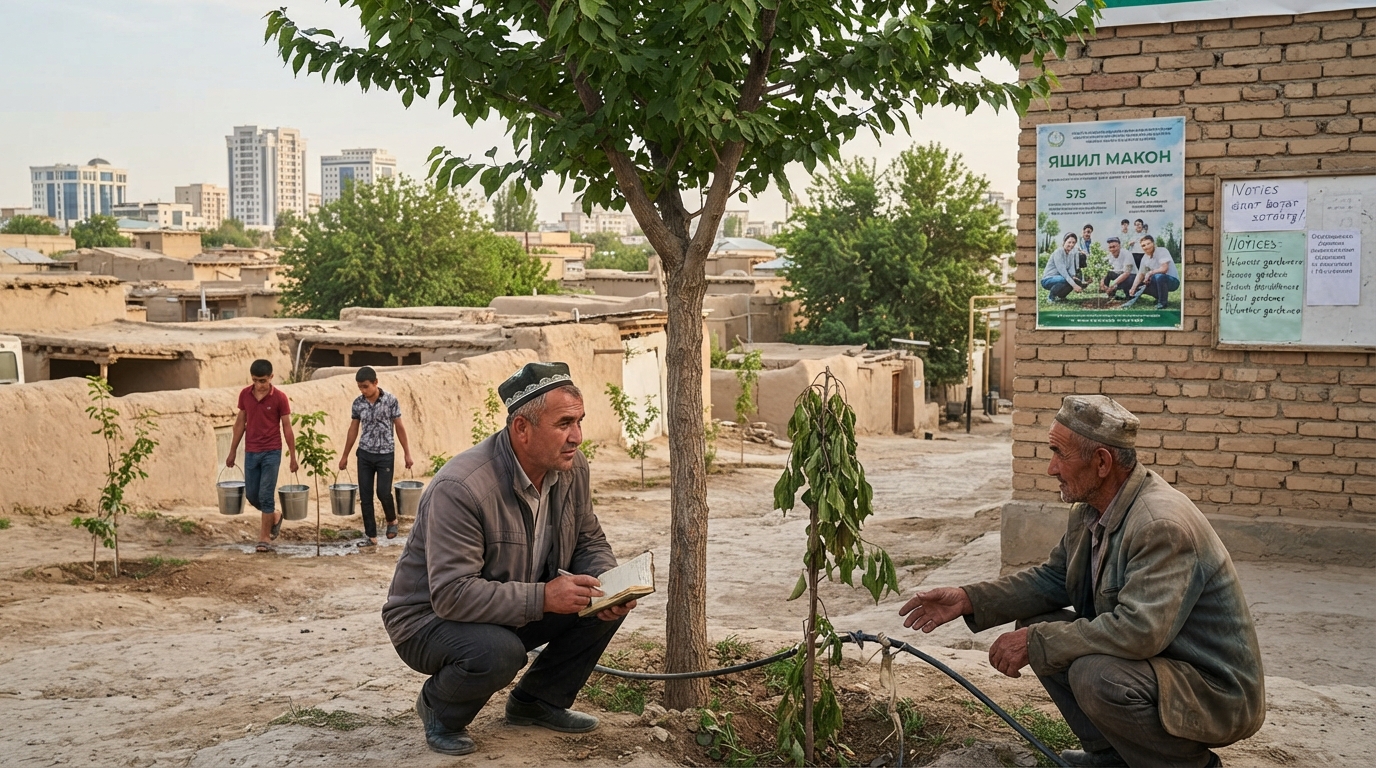
Can the Mahalla Cope with the Greening of Uzbekistan?
At the new stage of the "Yashil Makon" (Green Space) project, a fundamental shift is noticeable: more and more responsibility for the outcome of the greening efforts is being shifted onto the mahallas.
The key innovation is the abandonment of the traditional approach, where success is measured by the number of planted saplings. Now, it is proposed to evaluate not the mere fact of planting, but the result: how many trees survived to their first, third, and fifth years.
For each mahalla, there are plans to compile a "green map" indicating planting sites, tree species, and irrigation systems. The condition of the saplings will be regularly checked together with the mahalla chairpersons. If the trees begin to dry up, the causes will have to be investigated and measures taken.
It is also proposed to assign mentor-foresters to the mahallas. Their task will be to teach residents how to plant, water, and care for trees. In addition, quality saplings, fertilizers, water-saving systems, as well as plant protection against diseases and pests, are to be provided.
A "green rating" for mahallas will also be introduced. It will be based on the green area, the number of trees per resident, the survival rate of saplings, and community participation. The best mahallas are promised additional funds and micro-grants.
The goal is to develop greening according to the "3-30-300" principle: at least three visible trees, 30% of the territory in shade, and a green recreation area no further than 300 meters from home.
On paper, everything looks logical. But an uncomfortable question arises: is the current mahalla ready to take on yet another responsibility?
Now, it is no longer about a one-off campaign with a report on the number of planted trees. The mahalla is essentially being asked to be responsible for their fate for years: for watering and care, protection against diseases and pests, monitoring their condition, investigating the causes of death, and, most importantly, for having the resources for all of this.
This means the issue goes far beyond "Yashil Makon."
Recently, well-known blogger Islam Kaparzo raised another problem: the country already has the Ministry of Internal Affairs, the Ministry of Social Protection, the Tax Committee, and other state structures that are supposed to protect the rights and interests of citizens. Why, then, are some of these functions virtually duplicated within the mahalla system?
The question was asked quite calmly. The reaction turned out to be far less calm.
The post gathered more than three thousand comments and responses on social media. And it is particularly telling that a significant part of the discussion boiled down to one thought: the current mahalla is by no means always perceived by residents as an effective institution.
At the everyday level, this is particularly visible. In my mahalla, the scheme is simple: the khokimiyat (local administration) gives an order — the mahalla salutes and complies. No order — silence.
Communal problems — power outages, hot and cold water disruptions, and other emergencies — often have to be resolved by a small group of activists. The mahalla chairperson is by no means always at the center of this work.
And now, this very system is being asked to ensure that in five years, a tree planted today does not turn into a dry trunk.
The state wants to measure the success of "Yashil Makon" not by the number of plantings, but by the survival rate of the trees. This is the right approach. But then the main question arises: who and with what resources will ensure this survival at the mahalla level?
If the mahalla is indeed becoming the main executor of the project, it needs not only new duties, ratings, and key performance indicators. It needs authority, money, specialists, water, equipment, and a clear division of responsibility among all state structures.
Otherwise, the "green rating" risks becoming just another indicator that looks beautiful in a report and far less impressive on the ground.
Because a tree can be planted in a single day.
But growing it is a completely different story.
And the main question of "Yashil Makon" now sounds different: will the mahalla really be able to grow a green Uzbekistan?