

Uzbekistan’s Yashil Makon shifts focus from planting volumes to tree survival
Uzbekistan’s Yashil Makon shifts focus from planting volumes to tree survival
Uzbekistan is getting ready to expand seedling production, nursery infrastructure and water-saving technologies in the next phase of the nationwide Yashil Makon (Green Space) project, with a stronger focus on the quality and survival of planted trees rather than simply the number of seedlings produced.
On September 24, the Committee on Ecology and Environmental Protection Issues of the Legislative Chamber of the Oliy Majlis, together with the Commission on Mitigating the Consequences of Climate Change and Accelerating the Transition to a Green Economy, held a meeting with representatives of seedling nurseries, shrub seed-growing enterprises and state forestry entities.
The meeting included deputies, representatives of the National Committee on Ecology and Climate Change and the Forestry Agency, scientists, industry experts, officials from relevant organizations and members of the media. The talks centered on planting material production, nursery development and steps to improve the results of greening projects across Uzbekistan.
Participants examined the ongoing work under Yashil Makon, which is intended to increase greenery coverage nationwide. The discussion came after a recent presentation to President Shavkat Mirziyoyev on advancing the project to a new stage, improving environmental conditions in mahallas and introducing new landscaping approaches.
Under the proposed model, greening efforts are expected to be organized on a more scientific basis, covering the entire process from land preparation and irrigation infrastructure to the care of planted seedlings for at least three years.
Figures presented at the meeting showed that the Forestry Agency collected 1,501 tons of tree and shrub seeds in 2025 and produced 127.8mn seedlings and saplings. This included 1mn large-sized saplings with closed root systems.
At present, the Forestry Agency system has 80 nurseries covering 1,508 hectares. In addition, modern nurseries occupying 31.8 hectares have been created under a “science-design-practice” model. For 2026, plans envisage nursery and seedling facilities covering a total of 1,017 hectares. Production targets include 101.6mn seedlings and saplings and the preparation of 937 tons of seeds.
Deputies said the sector’s effectiveness should be judged not only by output volumes, but also by the quality of seedlings, their suitability for local climatic and environmental conditions and their survival after being planted at permanent sites. The meeting also stressed the need to monitor and maintain planted trees during the first two to three years after planting. Participants described this period as a key part of securing the results of greening projects.
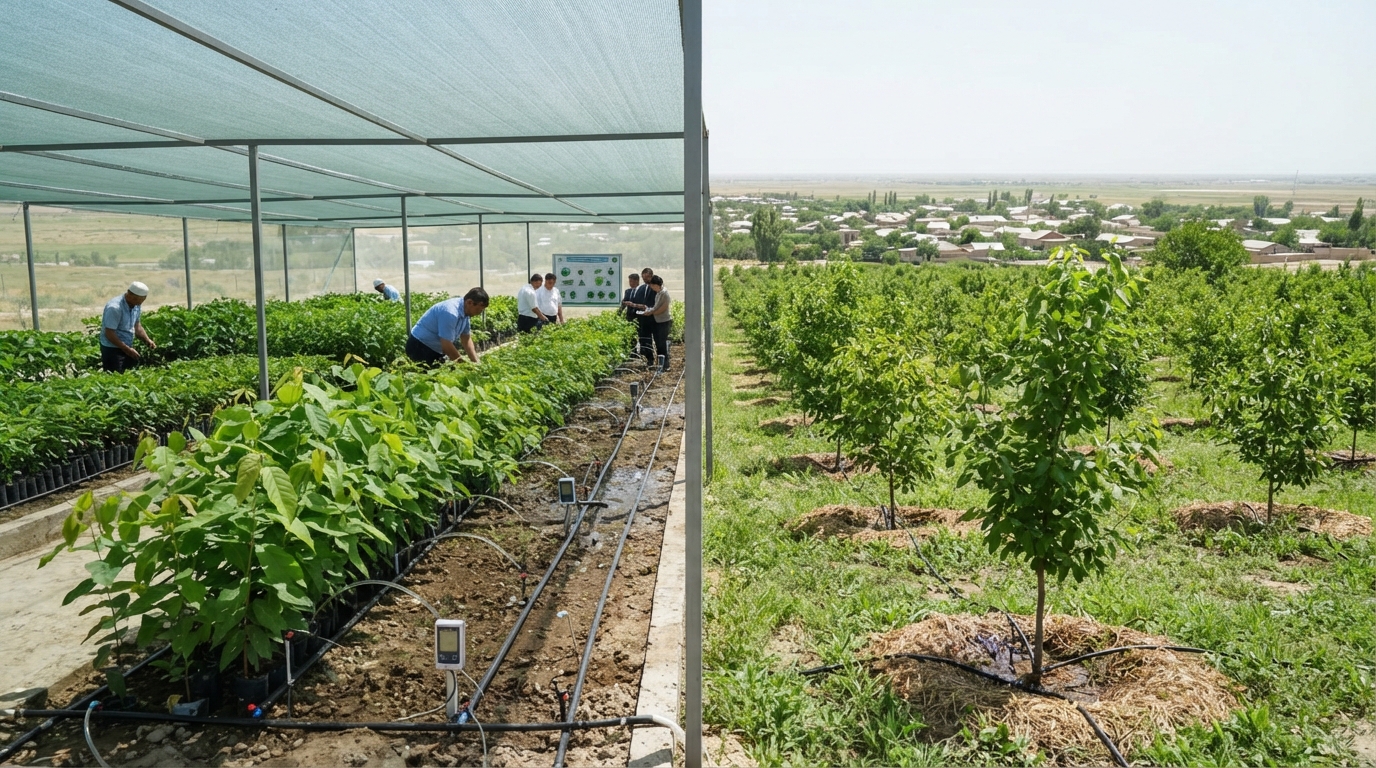
Representatives of state forestry enterprises and farms specializing in seedlings and shrub seeds suggested moving toward intensive cultivation systems. Their proposals included outfitting nurseries with automated drip irrigation, fertigation systems, soil moisture sensors and shading infrastructure, along with other resource-saving technologies.
Deputy Gulchehra Jorayeva said these technologies could improve the use of water, labor and land resources while supporting the production of standardized planting materials. Scientists and industry specialists also advised setting up mother-plant and seed-production plantations at each nursery. They proposed using seeds of verified origin adapted to local conditions, tightening phytosanitary controls and introducing new varieties into mass production only after scientific testing.
Water management was another major topic. Participants emphasized collecting and using rainwater and seasonal runoff for irrigation, as well as mulching and other measures aimed at reducing water consumption. Recommendations also included taking soil conditions and salinity levels into account when selecting planting materials, using biological pest-control methods and choosing tree and shrub species suited to local ecological conditions.
At the end of the meeting, deputies called for a shift from a system focused mainly on quantitative indicators to one based on quality and results. The priorities identified during the discussion included expanding modern intensive nurseries, introducing water-saving and digital technologies and increasing the production of seedlings adapted to local conditions.
Deputies also called for regular parliamentary oversight of the budgetary and other resources allocated to the sector. Based on the proposals presented at the meeting, participants agreed on the need to improve existing mechanisms, raise the operational efficiency of responsible agencies and, where necessary, develop legislative proposals related to the sector.