

Why go to court if there is nothing to dispute?
In Uzbekistan, there are plans to change the mechanism for recovering claims where there is virtually no dispute between the parties. It is proposed to resolve some of these cases not through the court, but through a notary, with enforcement documents being sent to enforcement agencies in electronic form. The relevant law, developed by the Ministry of Justice, was reviewed at the 19th plenary session of the Senate of the Oliy Majlis and approved by the senators. The main idea of the reform […]
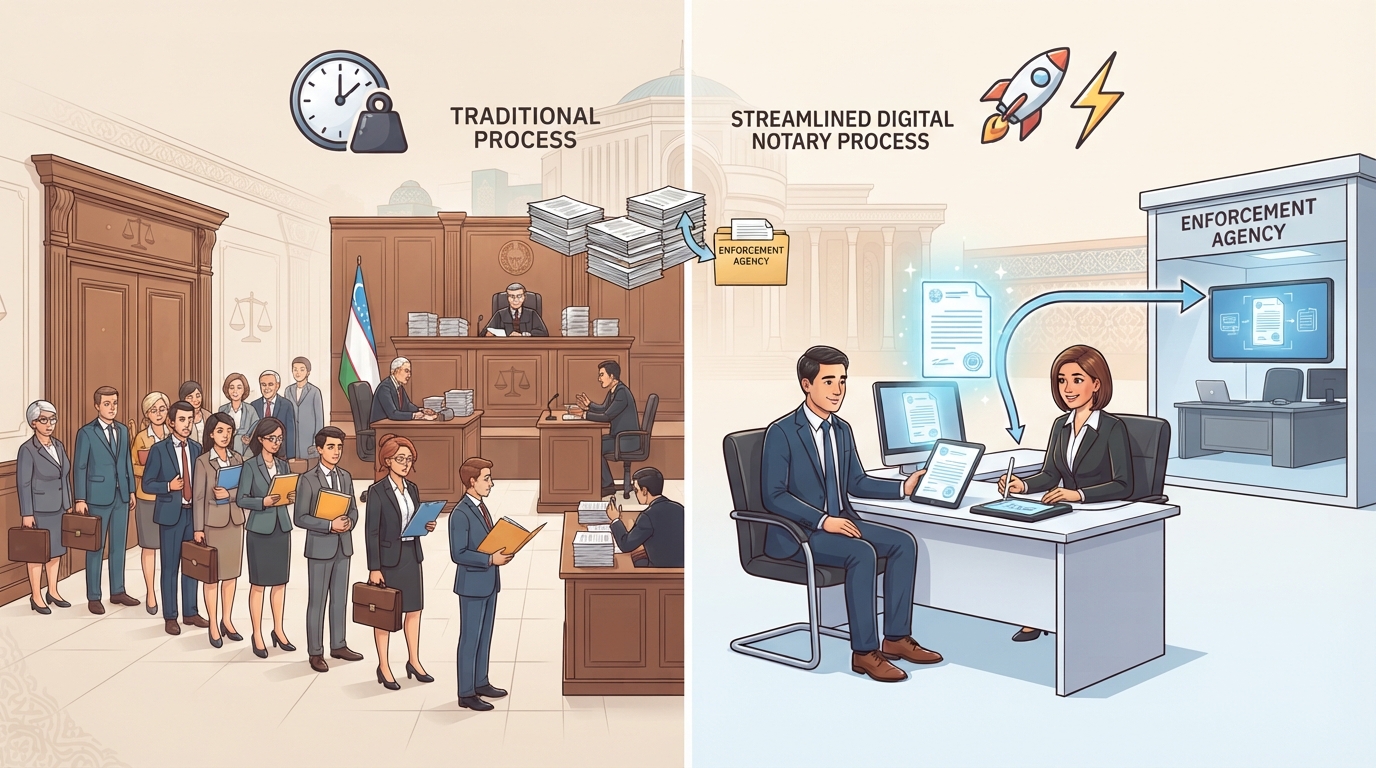
Why go to court if there is, in fact, nothing to dispute?
In Uzbekistan, there are plans to change the procedure for recovering claims where there is virtually no dispute between the parties. It is proposed to transfer some of these cases to a notary instead of a court, while enforcement documents will be sent to enforcement authorities in electronic form.
The relevant law, prepared by the Ministry of Justice, was reviewed at the 19th plenary session of the Senate of the Oliy Majlis and approved by the senators.
The essence of the reform is to reduce the workload on courts in cases where a full trial is not required. To achieve this, it is proposed to amend the Civil and Economic Procedural Codes, as well as the laws "On Enforcement of Judicial Acts and Acts of Other Bodies" and "On State Duty."
### Up to 1,000 BRVs — via a notary
One of the main innovations concerns undisputed claims. The law expands the possibility of applying to a notary for such claims in amounts up to 1,000 basic reference values, provided they meet the criteria established by law (the basic reference value as of September 1, 2026, is 440,000 soums).
This means that in cases provided for by law, the claimant will not have to go through a court procedure. The claim can be processed by a notary and sent for enforcement.
The economic logic of this approach is obvious: if there is no dispute between the parties regarding the substance of the obligation, going to court can turn into an additional administrative procedure that requires time and expense.
The new scheme is designed to separate two different types of situations: where there is an actual dispute — the court; where the claim is undisputed and confirmed by the necessary documents — a simplified notarial mechanism.
### Notarial writ goes digital
The second important part of the reform is related to the digitalization of notarial activities.
Notaries will be given the opportunity to send notarial writs issued in electronic form directly to enforcement authorities. This will make it possible to abandon part of the paper workflow and reduce the number of intermediate procedures.
In essence, the very logic of the process is changing: a document does not need to exist on paper first and then be transferred between agencies — it can be generated in an electronic system and sent directly to the enforcement officer.
For citizens and businesses, this potentially means fewer visits to government agencies, fewer paper documents, and a shorter path from filing a claim to its enforcement.
The reform addresses several tasks simultaneously.
First, it is expected to reduce the workload on courts by freeing them from considering some of the claims that do not involve a full-fledged dispute.
Second, it reduces the time required for a creditor to process and submit a claim for enforcement.
Third, it reduces the associated costs for citizens and entrepreneurs.
Finally, transferring notarial writs into electronic format should make the enforcement mechanism itself more prompt.
At the same time, an important limitation remains the status of the claim itself: the notarial procedure is not intended for any debts, but for claims that are recognized as undisputed and meet the conditions established by law. If a full-fledged dispute arises between the parties regarding the law or the circumstances of the obligation, the judicial mechanism retains its significance.
In essence, the proposed amendments continue a broader trend of reforming the judicial and legal system of Uzbekistan: the state seeks to transfer the simplest and most formalized procedures from traditional judicial and paper workflows into faster administrative and digital mechanisms.
For citizens and entrepreneurs, the main question now will be not only whether a debt can be recovered without a court, but also how quickly and predictably the new electronic route — from the notary directly to the enforcement authority — will work.
The senators approved the law. If the provisions stipulated by it enter into force, the path to enforcement for some undisputed claims will become shorter: fewer court procedures, less paper, and more digital interaction between the notary and the enforcement system.