

Why does Tashkent's air become polluted in the cold season? Scientists explained the reasons
In Tashkent, the increase in air pollution during the autumn-winter season is influenced by a decrease in wind speed, temperature inversion, low precipitation, and the entry of dust masses into the region. A number of experts provided information on the causes of air pollution and the research being conducted to clarify them.
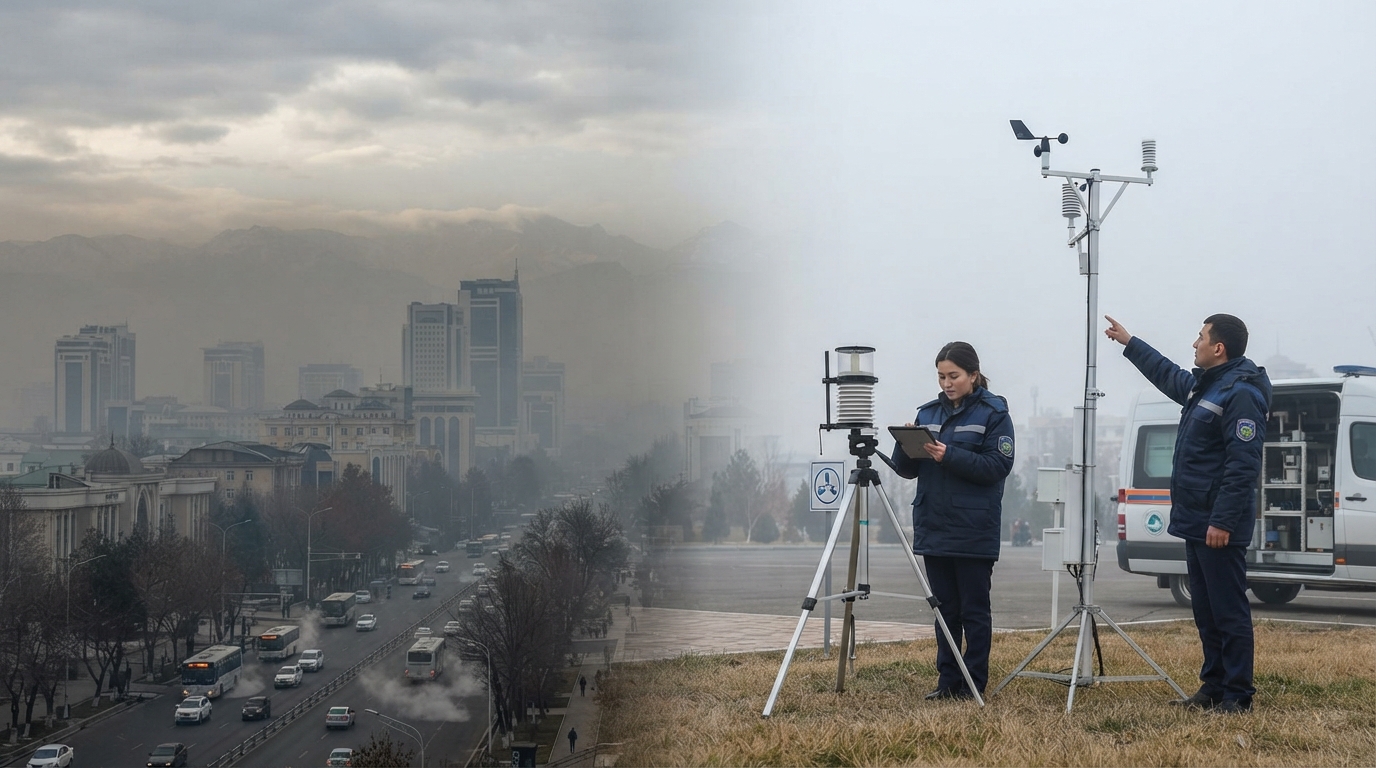
Why does Tashkent's air become polluted during the cold season? Scientists explained the reasons for this
Bakhtiyor Kholmatjonov, head of department at the Hydrometeorological Research Institute, Doctor of Geographical Sciences, and professor, explained that atmospheric air circulation, wind speed, and direction affect the increase in air pollution during the cold season.
Because Tashkent is located in a foothill area, wind directions play an important role in the movement of air masses. During the cold half of the year, synoptic processes leading to a decrease in wind speed are observed more frequently. As a result, pollutants may not disperse quickly in the atmosphere and can accumulate in the layer close to the earth's surface.
During winter months, temperature inversion also makes air purification difficult. In this process, a layer of warmer air settles above the cold air layer near the earth's surface, limiting the vertical mixing of the air. Additionally, anticyclonic processes and weak winds can also slow down the dispersion of pollutants.
In order to identify the causes of atmospheric air pollution, by presidential decree, the Center of the Specialized Atmospheric Laboratory was established under the National Committee for Ecology and Climate Change.
According to the head of the center, Doctor of Technical Sciences Zikrilla Alimov, the laboratory uses modern equipment to study the sources of air pollutants. Currently, air samples are being taken through special filters and analyzed in all districts of Tashkent city. In the future, there are plans to broadly implement this practice across the republic.
Farrukh Sattorov, Director of the National Climate Change Center and Doctor of Philosophy (PhD) in Technical Sciences, reported that natural factors and unfavorable meteorological conditions also affect the deterioration of air quality in Tashkent.
As of October 26 of this year, 3.9 millimeters of precipitation were observed in Tashkent, while the monthly norm is 23.7 millimeters. Low precipitation weakens the washing away of dust particles in the air by rain.