

Why a new Pakistan-China border pact has irked India
A China-Pakistan border pact challenges India's territorial claims and deepens strategic concerns over disputed Kashmir.
**Why a new Pakistan-China border pact has irked India**
For decades, India has declined to acknowledge a Pakistan-China boundary in land it says belongs to it.
Last week, Pakistan and China took steps to formalise one, drawing a strong reaction from Delhi.
The two sides put the Pakistan-China Boundary Joint Commission into operation, which Pakistan called a "significant milestone" that would strengthen cooperation on border management, joint surveys, trade and people-to-people connectivity.
India responded forcefully, rejecting the move as lacking any legal foundation and saying it does not recognise any Pakistan-China boundary involving territory it claims as Indian.
The announcement comes at a highly delicate time.
India and China are trying to steady ties after years of military friction along the Line of Actual Control (LAC), the disputed line separating their forces across much of their Himalayan border. Meanwhile, Beijing and Islamabad are expanding cooperation along a nearby stretch of frontier that India also claims.
"There is no boundary between Pakistan and China. We reject the so-called Joint Commission, which is without any legal basis," Indian foreign ministry spokesman Randhir Jaiswal said.
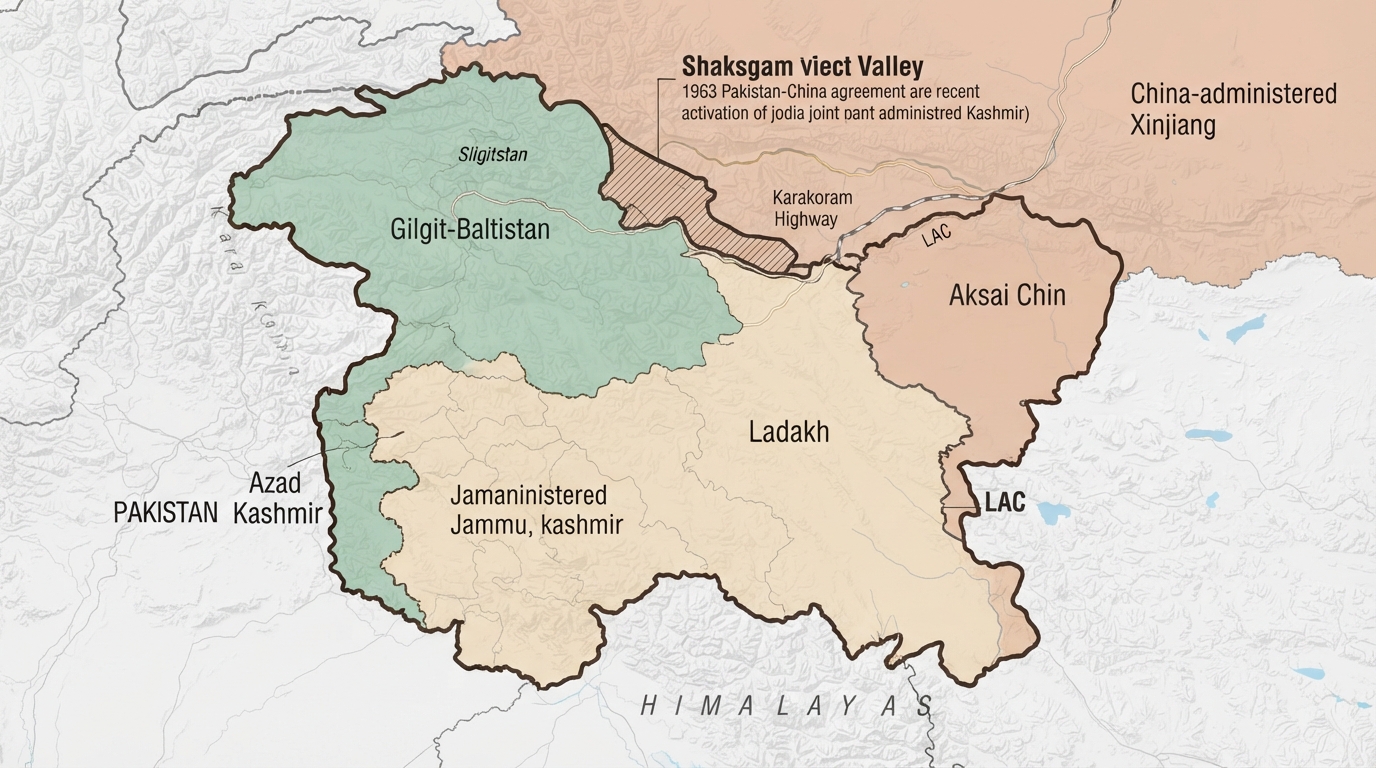
The commission relates to the Pakistan-China frontier, including the Shaksgam Valley, a roughly 5,180 sq km area that Pakistan transferred to China in 1963 but which India says is part of its territory in Ladakh.
India says the land was part of the former princely state of Jammu and Kashmir and was illegally occupied by Pakistan before being handed to China. The Indian government has never accepted the agreement and regards it as illegal and invalid.
That background explains why Wednesday's announcement was especially sensitive.
"Pakistan has no locus standi to enter into arrangements concerning Indian territory under its illegal and forcible occupation," the Indian foreign ministry said.
Pakistan says Jammu and Kashmir remains disputed, and argues that India therefore has no standing to challenge its 1963 boundary agreement with China. It considers the deal valid.
Jabin T Jacob, professor at the Department of International Relations and Governance Studies at Delhi's Shiv Nadar University, said the latest move was really the revival of an old mechanism rather than a wholly new arrangement.
"A joint boundary commission is provided for in the 1963 Sino-Pak Agreement, the only issue at hand is the timing of its operationalisation," he told the BBC.
He said the timing could reflect several factors, including China's wider push to demarcate its borders and a wish to institutionalise exchanges and movement along a frontier at a time when Pakistan's other borders have faced conflict and instability.
Jacob said India should be "worried" by the development. More importantly, he said, the move seemed to ignore a clause in the 1963 treaty itself.
Article 6 of the agreement allowed for renegotiation once the Kashmir dispute was settled with whichever country ultimately controlled the territory, Jacob said.
For India, Jacob said, the issue is made worse by the global information environment.
"China's relative dominance of the international media and information landscape - [with] CGTN, CRI, presence on social media - relative to India allows it to put forward its narrative and maps globally while India is limited to fulminations that other world capitals are likely to ignore," he said.
That concern is separate from the day-to-day management of the frontier itself. Pakistan and China already have extensive infrastructure and connectivity links across the region, including the China-Pakistan Economic Corridor (CPEC) and the Karakoram Highway.
Husain Haqqani, former Pakistani ambassador to the US and now a senior fellow at Anwar Gargash Diplomatic Academy and Hudson Institute, said the new commission was both practical and political.
"It is a combination of both," Haqqani told the BBC. "It is a mechanism to enhance border and boundary cooperation, prevent illegal crossings and protect the strategic infrastructure tied to CPEC."
He said it also sent a message to India that Beijing still views Kashmir through the Pakistani lens.
"China has never accepted India's position on Kashmir and China views Gilgit-Baltistan from the Pakistani, not Indian prism," Haqqani said, referring to the region in Pakistan-administered Kashmir that borders China and which India claims as part of its territory.
Haqqani said Islamabad's stance had shifted in response to developments in Indian-administered Kashmir.
"Pakistan still maintains that the final status of Jammu and Kashmir is yet to be decided," he said. "But since India has made internal changes - for example, the abrogation of Article 370 - in its part of Kashmir, Pakistan sees no issue with simply institutionalising what has been de facto with China since 1963."
For Beijing, the arrangement also fits a broader pattern of using ties with neighbouring states to manage and signal its position toward India.
Haqqani said reassurance to Pakistan on Kashmir had both strategic and geopolitical value for Beijing.
"On the strategic front it further deepens ties with Pakistan and on the geo-strategic front it reinforces for India its fear of a two-front threat from China and Pakistan, which pleases Pakistan and benefits China."
Experts say the timing of the statement is also important.
"China always plans its decisions months, if not years, in advance so the decision to operationalise a joint boundary commission must have been made some time back," says Haqqani.
"The release of this information was timed for after President Xi Jinping's recent Brics summit trip to send Pakistan a message of reassurance in the strategic partnership, and India a reminder that multilateral engagement does not translate into any change in China's vision for South Asia."
But Jacob warned against reading every part of the development as a direct military move against India.
"There aren't any immediate or apparent implications for the LAC as of now," he said.
That implies the importance of last week's announcement may lie less in any immediate shift on the disputed Himalayan frontier than in the slow institutionalisation of arrangements that India has long rejected.
India's position, Jaiswal said, remained "clear and consistent": any attempt to legitimise what Delhi sees as Pakistan's illegal occupation of Indian territory is unacceptable and has no effect on India's sovereignty.
But Haqqani believes the dispute is about more than border law.
"The key disagreement between India and China about the border and boundary is geo-strategic, not cartographic," he said. "So there is a limit to what border negotiations and border management mechanisms can achieve."
Pakistan, he added, remained "China's secondary deterrent against India" - and Beijing's engagement with Islamabad would continue to send that message to Delhi.