

Nepal's border agreement with India goes missing
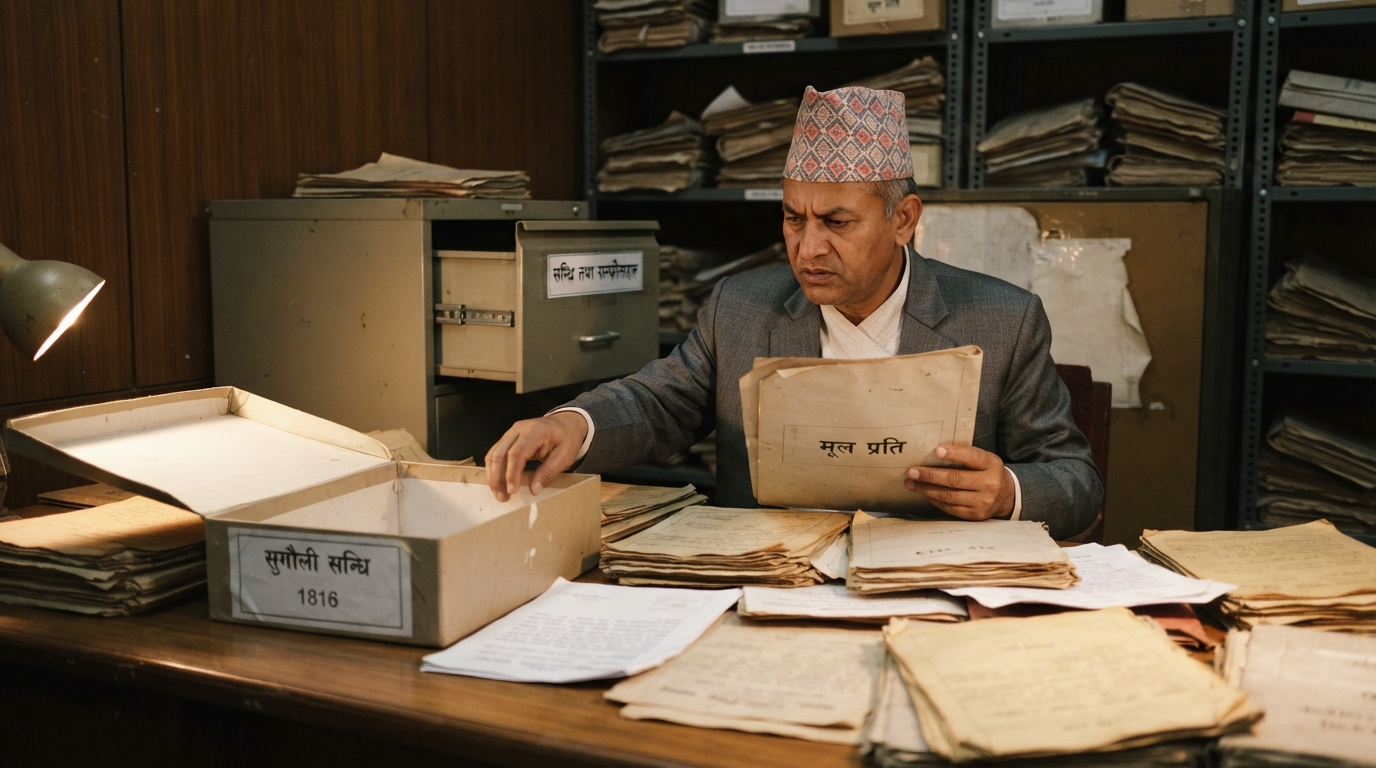
Nepal has said it has not found the originals of the border agreement with India, a development that has further complicated the border dispute between the two South Asian neighbours, The Independent reported.
Foreign Minister Shishir Khanal told parliament that there was no clear evidence that official treaty documents existed in Nepal. The Sugauli Treaty, signed after the British East India Company defeated the Kingdom of Nepal in the Anglo-Nepalese War in 1816, significantly reduced Nepal's territory and forced it to cede large swathes of land in its western and eastern regions. These lands later became part of independent India.
According to Khanal, "There are records that show that some documents related to some treaties are preserved in the National Archives. But we do not have clear information that they are real official agreements."
The search for the treaty documents began in 2016, when Nepal and India began negotiations to review and renew the 1950 Treaty of Peace and Friendship. The Nepalese side wanted to review the original of the treaty, but could not find it. Therefore, the government submitted a second copy to the committee reviewing the treaty.
On July 22, the National Assembly's Empowered Committee on Legislation and Administration reported that searches were conducted in archives, libraries, museums and relevant government offices, but the original of the Sugauli Agreement and the 1950 treaty were not found.
Recently, the new government in Kathmandu, led by Balendra Shah, has begun making harsh statements against Delhi over the border dispute, which has strained relations between India and Nepal.
The long-standing territorial dispute concerns the Kalapani, Limpiyadhura and Lipulekh regions in Nepal's far west. Kathmandu considers these areas to be Nepalese territory under an 1816 treaty. That agreement sets the Kali (Mahakali) River as the border. The main disagreement is over where the river begins, with the sides relying on different historical maps and interpretations. The situation has become more tense after Delhi and Beijing agreed to reopen the disputed Lipulekh trade route to restore the traditional Kailash-Mansarovar shrine.
Balendra Shah has also claimed that Nepal has also invaded Indian territory. The statement has further complicated the situation, as Nepal is usually blamed for occupying its larger neighbor's territory. "Recently, only after I became prime minister, one fact may surprise you. Not only India, but Nepal has also invaded Indian territory in many places," the new leader said in his first official address to parliament.
These remarks have angered Nepali lawmakers. They have demanded that the prime minister retract his remarks. The foreign minister said that Nepal will consider all treaties and agreements in accordance with its national interests. According to him, Kathmandu has 655 treaties and agreements, of which 412 are bilateral agreements with neighboring countries.