

Who will buy electricity directly from the producer?
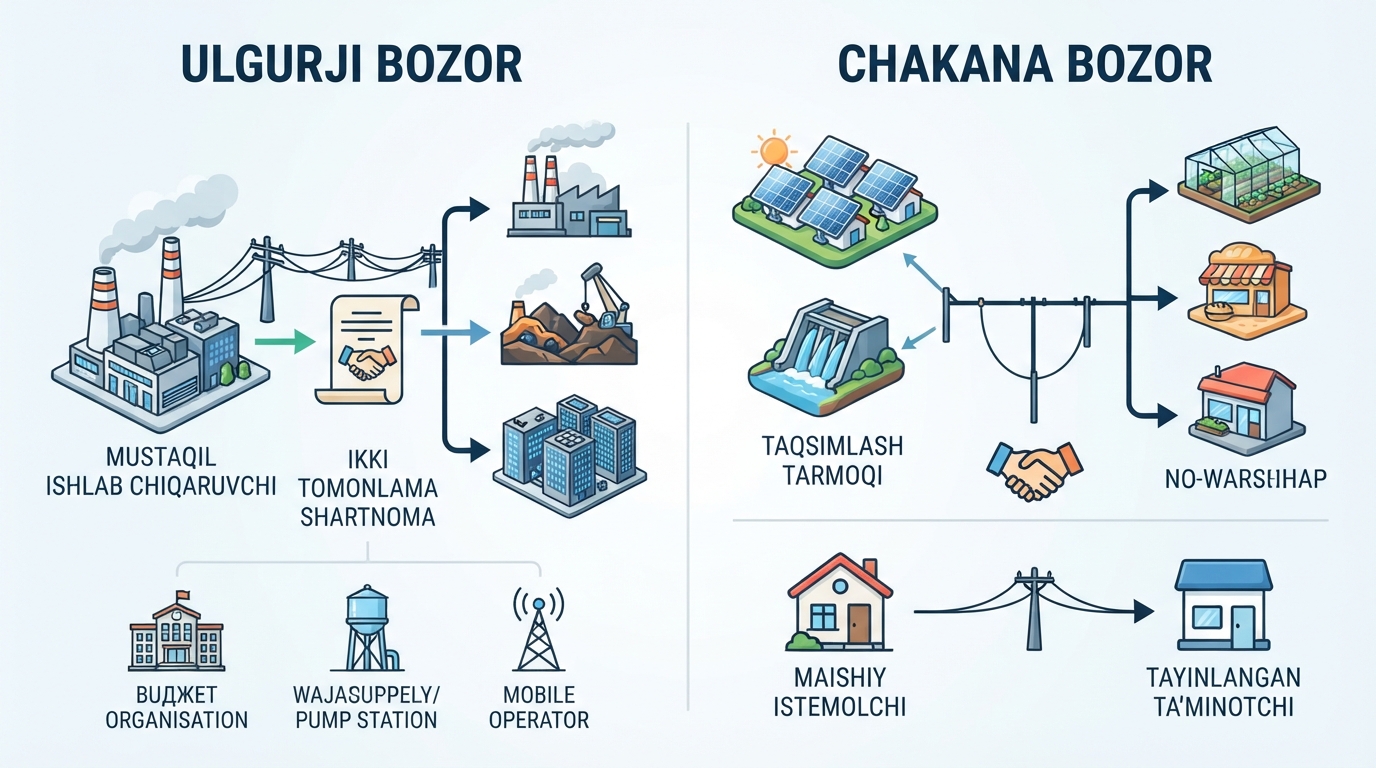
In Uzbekistan, a procedure has been established for large consumers to purchase electricity from independent electricity producers at mutually agreed prices. Small and micro-power plants are also allowed to sell electricity directly to non-residential consumers in their area. The new market rules will come into force on January 1, 2027.
Who will purchase electricity directly from the producer?
By Resolution No. 527 of the Cabinet of Ministers dated September 30, 2026, the rules for the first stage of transition to the principles of the wholesale and retail electricity market — "Purchases based on bilateral contracts" — were approved.
This document regulates the sale and purchase of electricity, its transmission and distribution services, as well as settlements between market participants.
According to the rules, large consumers in the wholesale market can conclude bilateral contracts with independent producers and purchase electricity at an agreed price. The contract determines which party will pay for the transmission and distribution of electricity through the grid.
Large consumers are defined as those connected to a grid with a voltage of 6 kilovolts and higher, with an annual electricity consumption of at least 10 million kilowatt-hours.
However, budgetary organizations, utility service providers, water supply and water pumping stations financed from the state budget, farms, and mobile network operators are not included in this category.
In the retail market, micro and small power plants with a capacity of up to 5 megawatts can sell electricity to consumers connected to the distribution grid in their territory at a mutually agreed price. Here, territory refers to the Republic of Karakalpakstan, the respective region, or the city of Tashkent. This opportunity does not apply to household consumers.
Household consumers receive electricity from the designated supplier based on a regulated tariff. The document does not specify new tariff rates for the population.
Bilateral contracts are valid for no more than one year. Electricity volumes are planned and calculated on an hourly basis. The contract must specify the quantity of electricity, the price or the formula for its determination, payment terms, grid service costs, and the procedure for compensation of damages.
A large consumer may conclude contracts with several independent producers. Non-household consumers also have the right to purchase energy from several micro and small power plants.
Contracts are registered by the market operator and enter into force immediately upon registration.