

While Rosatom builds a nuclear power plant…
While "Rosatom" is building a nuclear power plant, others are taking a place under the sun
While "Rosatom" Builds Nuclear Power Plants…
In 2022, Russia announced the pivot of its energy exports to the East. However, more than four years later, it is becoming clear that it will not be possible to fully replace the former European market in the foreseeable future. The scale of demand, infrastructure constraints, and the cost of new routes do not allow simply redirecting to the East what was previously supplied to Europe. A different approach may be needed. First and foremost, in Central Asia—a strategically important region for Russia that has also become attractive to the EU as a source of energy. And Armenia is directly connected here as well.
Central Asia is experiencing the largest energy crisis in modern history. Aging Soviet infrastructure, a rapidly growing population, and regular winter blackouts have forced the governments of Uzbekistan, Kazakhstan, and Kyrgyzstan to seek urgent ways out of the deadlock. Two key players with fundamentally different strategies responded to this demand: Russia and the United Arab Emirates.
For Moscow, faced with a difficult and financially sluggish reorientation of hydrocarbons to the East, Central Asia looked like an ideal, ready-made, and physically connected market. But it was right here, in the "near abroad," that the Russian approach clashed with the express capital of the Persian Gulf, demonstrating clearly that in modern geopolitics, time is money.
Russia historically dominates the region, and its main technological flagship, Rosatom, plays its trump card: peaceful nuclear energy. A small modular reactor project of 330 MW is already being implemented in Uzbekistan, while Kazakhstan, following a nationwide referendum, chose the Russian state corporation to build its first large nuclear power plant.
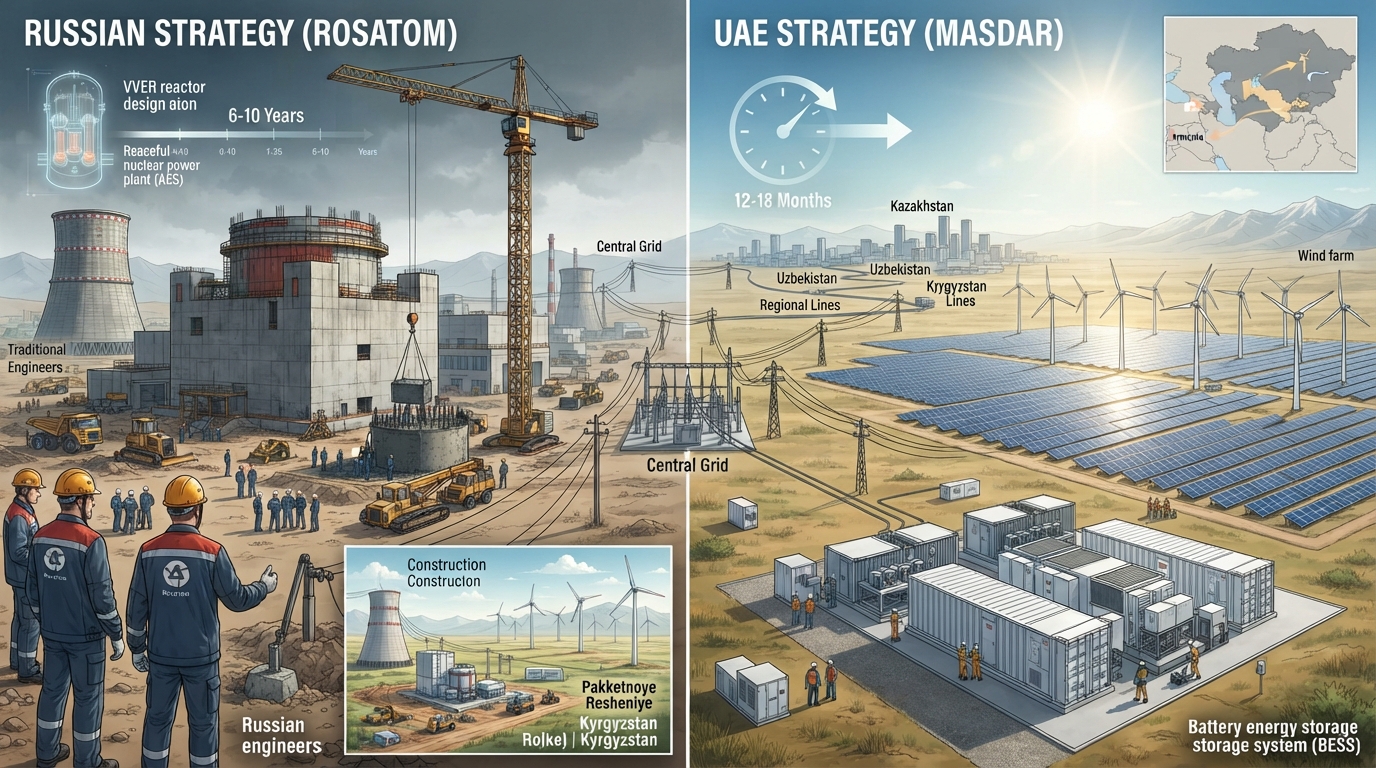
However, nuclear power and large thermal power plants have one critical drawback: time. Design, IAEA approvals, environmental impact assessments, signing complex intergovernmental agreements, and the construction itself take anywhere from 6 to 10 years. Meanwhile, the region freezes every winter and needs additional electricity right now.
A telling example for Russia is the construction of new thermal power plants in Kazakhstan's Kokshetau, Semey, and Ust-Kamenogorsk. The Russian side failed to provide the expected preferential intergovernmental financing for two projects, and Kazakhstan transferred all three projects to another consortium. For Russia, this is not just a matter of lost construction sites. It is an example of how competitors take over the market if an offer proves to be insufficiently fast or financially attractive.
This is where the UAE enters the stage in the form of state green giant Masdar. The Arab strategy is based on hard commercial calculation and phenomenal speed. The turn-key construction of a solar or wind power plant takes only 12–18 months. For instance, Masdar already has more than 2 GW of projects in Uzbekistan, with about 4 GW more in the early stages of development. In Kazakhstan, construction of a 1 GW wind farm with a 600 MWh energy storage system began in June 2026. Completion is scheduled for 2029.
Although a kilowatt of wind or solar is not equal to a kilowatt of nuclear generation, in terms of installed capacity, Masdar's projects are already comparable to a large nuclear power unit, and in a few years, they will be equivalent to an entire nuclear power plant.
Thus, while Russian ministries are agreeing on the parameters of state loans and Rosatom is pouring the first concrete for the foundation of a future facility, Arab investors manage to commission several gigawatts of clean energy, instantly covering current deficits in power grids and earning political points with local elites.
The UAE's tactics are fairly simple. On the one hand, UAE companies come with their sovereign wealth funds, offering direct investments without long intergovernmental loans, parliamentary ratifications, and sovereign guarantees. On the other hand, they do not take the long road in manufacturing; instead, they act as a global integrator: buying up huge volumes of cheap panels and turbines directly from Chinese assembly lines and deploying them across the steppes of Central Asia.
**A Place in the Socket: Why the Price of Delay Is Critical for Russia**
The difference in the pace of facility launches triggers rather dangerous economic processes for Russia. If there is enough room in the socket for everyone and the countries of Central Asia have to expand their energy systems to accommodate large volumes of generation, the risk of losing the sales market becomes a reality.
It is no secret that Gazprom is also betting on Central Asia as part of its reorientation to the East, since gas is needed for flexible thermal power plants that back up unstable green power stations. At the same time, even the discussed "Power of Siberia 2" gas pipeline to China will only be able to handle slightly more than a third of the lost European supplies.
Meanwhile, Arab companies are entering the region comprehensively, being the first to introduce giant industrial energy storage systems. And the faster the UAE resolves the issue of industrial battery energy storage, the less Uzbekistan and Kazakhstan will need Russian gas capacity in the future.
Another UAE bet is Europe. The European Union rejected Russian oil and coal, and announced a complete phase-out of Russian gas next year. At the same time, Europe will not be able to fully cover its needs with its own "green" energy, and Central Asia is expected to become one of the sources of clean electricity under the "Green Corridor" program. And that involves an entirely different level of revenue.
In this situation, it is pointless for Russia to try to restore the old model at all costs. But this does not mean that Russia should abandon the European energy market altogether.
**Moscow Combines: One-Off or Intentional?**
Moscow clearly understands that remaining in the narrow corridor of nuclear energy and oil and gas guarantees a weakening of its position in the region.
An example is Kyrgyzstan, where Rosatom is trying to apply a packaged solution: simultaneously with negotiations on a small modular reactor, the state corporation began the accelerated construction of a 100 MW wind farm in the Issyk-Kul region. The logic is clear: the wind turbine will generate electricity and first profits in just a year and a half, maintaining market share while complex nuclear infrastructure is being prepared.
Such a combined approach could be an answer to competitors' expansion in Central Asia. However, whether the Kyrgyz example is a counter-strategy or merely an isolated case remains unknown.
Maksim Shaposhnikov, advisor to the manager of the "Industrial Code" fund, notes that Rosatom has its own expertise in creating wind generation, while in solar generation Russia has "Hevel," which possesses its own partially import-substituted production of panels and inverters.
"Russia is currently offering solutions where the advantages of Russian technologies are undeniable. In wind and solar, we inevitably run into Chinese suppliers, whom it is impossible to beat by economic methods today," says the expert.
According to Maksim Shaposhnikov, the UAE can offer acceptable preferential financial terms that Russian companies cannot create.
"Our country, with its current monetary policy, is deprived of such an opportunity, so we sell what no one else in the world has except us," believes the advisor to the manager of the "Industrial Code" fund.
**The Middle East in the "Near Abroad"**
For Russia, Central Asia is a zone of critical security, centuries-old cultural ties, and a shared Soviet power grid ring. However, the UAE is shaping a new, commercial type of influence in the region.
For local governments, Abu Dhabi is becoming an ideal and "safe" partner: the UAE does not frighten with ambitions, does not demand "loyalty," and, most importantly, cooperation with them carries no risk of secondary sanctions from the US and the EU—something banks in Kazakhstan and Uzbekistan are currently terrified of when dealing with Russian state entities.
In this situation, Russia still holds fundamental levers of influence: million-strong migration flows, a defense umbrella, and dispatch control over electricity flows during critical outages. But in the civilian economic race, the UAE has set a tough precedent. The elites in Central Asia are well adept at counting money and understand: a dollar brought by the UAE today and turned into an operational kilowatt is more needed and profitable for a developing economy right now than three dollars in promises of technological sovereignty eight years from now.
A spot under the Central Asian sun no longer belongs to Moscow by default—it will have to be defended under severe time constraints.
**The Metsamor Trap: Not for Armenia, but for Russia**
While Russia risks being late to the distribution of the pie in Central Asia, the situation in Armenia is different: it could lose a significant portion of the pie that was already on the plate.
The confidence that control over gas supplies and the Metsamor NPP guarantees eternal influence is playing a cruel joke. Armenia's energy balance is changing faster than large infrastructure projects are being implemented.
In 2025, the share of solar generation in electricity production reached 16.3%. The installed capacity of solar power plants grew from 240 MW in 2022 to 710 MW in 2025—almost a threefold increase.
The changes are already affecting the operation of traditional generation. In 2025, electricity output from Armenia's thermal power plants decreased by 4.4%, while solar generation grew by 66.9%. Between 2022 and 2025, gas-fired electricity generation decreased by approximately 13%, according to Ember data. Linking the entire decline exclusively to solar power would be incorrect, but the direction of structural changes is obvious.
For Gazprom, this is not an abstract threat. Its subsidiary, Gazprom Armenia, owns the Hrazdan-5 power unit with a capacity of about 467 MW. And the more electricity Armenia receives from the sun, the smaller the potential need to load gas-fired power plants during daytime hours.
Therefore, the question for Russia is not just who will build the new nuclear power unit—Rosatom or an American competitor. It is about a broader process: how Armenia's energy system will be restructured and what place will remain in it for Russian companies.