

Energy crisis in Russia. What is Central Asia doing to reduce dependence on the North?
Ukraine's attacks on Russian oil refineries are causing a growing shortage of petroleum products in the country. Against this backdrop, Central Asian countries are also rushing to diversify their fuel supply sources. In particular, Kyrgyzstan has reached agreements with Uzbekistan and Kazakhstan.
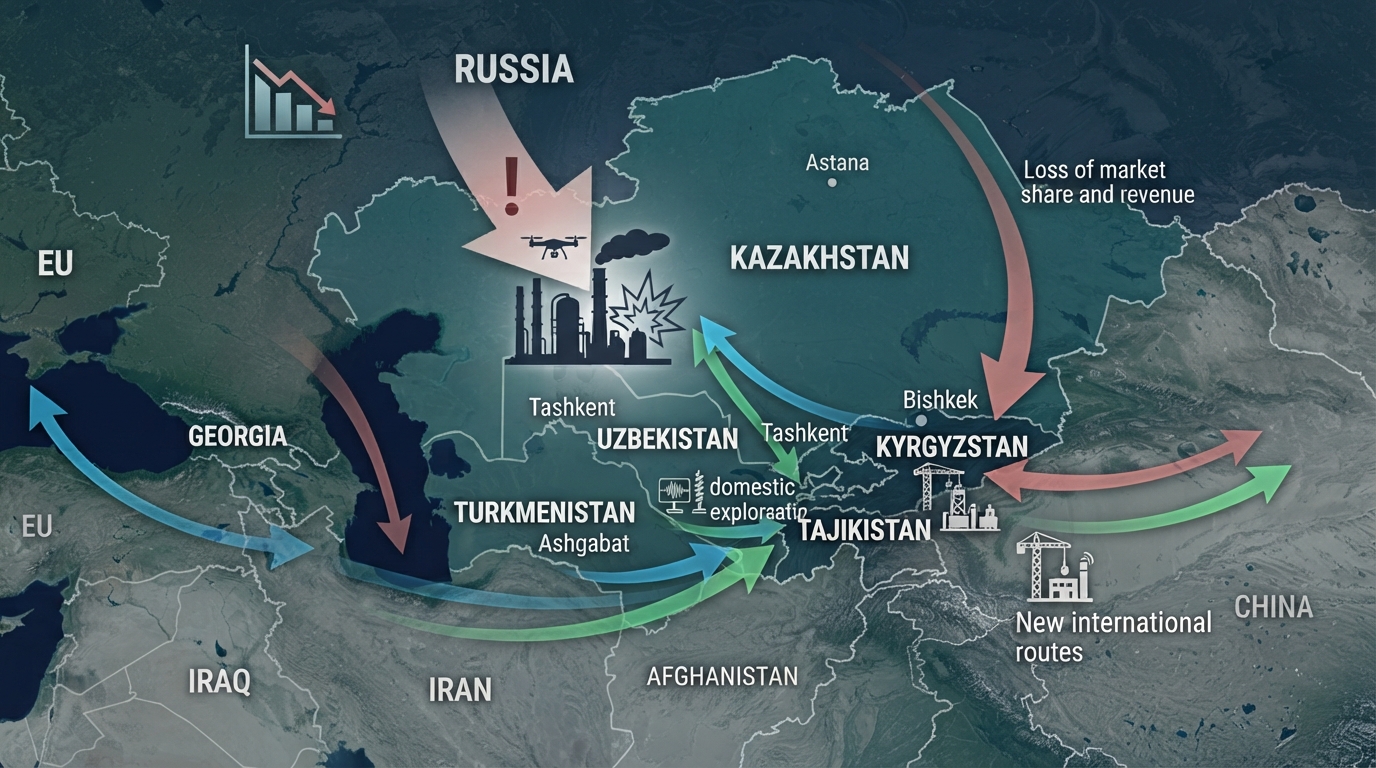
Amid Russia’s energy crisis, Central Asian countries are taking steps to reduce their dependence on the North. According to Eurasianet, Ukraine’s drone attacks on Russian energy infrastructure are causing significant changes in the Central Asian energy market. In the long term, Russia could lose leverage and market share in the region, while Central Asian countries are rushing to diversify their fuel supply sources.
Repeated attacks by Ukraine on Russian refineries have forced the Kremlin to restrict exports of petroleum products such as gasoline and jet fuel to ease growing shortages in the domestic market. This is prompting Central Asian countries to seek alternative sources of supply to prevent a potential energy crisis in the fall and winter.
Until now, Kyrgyzstan and Tajikistan have been getting about 90 percent of their fuel supplies from Russia. In the current situation, Russia cannot be relied on as a supplier as before. For example, in late July, Russia agreed to supply Kyrgyzstan with only half of its fuel needs until the end of the year, or about 100,000 tons of petroleum products per month.
To make up for the shortfall, Bishkek has reached agreements with Uzbekistan and Kazakhstan on fuel supplies. Imports are also being made from Belarus and China. Kyrgyz authorities are also negotiating with Turkey and the European Union to obtain additional fuel.
In addition, the Kyrgyz government is also trying to achieve a certain level of self-sufficiency. To this end, a project to build a plant capable of producing about 450,000 tons of petroleum products per year has been accelerated. This volume will be enough to cover about a quarter of the country's annual demand. The plant could be commissioned as early as the end of 2026.
According to Reuters, Tajikistan tripled its fuel imports from Turkmenistan, Uzbekistan and Kazakhstan in July to 34,000 tonnes. This figure was much lower in June. At the same time, gasoline supplies from Russia almost halved, to 14,000 tonnes. Tajik officials are also negotiating with Kazakhstan and China for additional fuel supplies. The Ministry of Energy said in early July that the country's fuel reserves would last about 60 days.
According to Eurasianet, Uzbekistan is less dependent on Russian energy than the two countries mentioned above. The country's domestic capacity allows it to produce up to 100,000 tonnes of oil products per month. This is enough to cover about 60 percent of domestic needs. To meet the remaining needs, official Tashkent is also forced to diversify its fuel suppliers. Agreements have been reached with Georgia, Iraq and other countries in this regard.
One of the main problems for Uzbek officials at the moment is a sharp increase in demand for aviation fuel. The official statement cites an increase in the number of flights through Central Asia due to the aggravation of the geopolitical situation. Tashkent has become an important hub for Russians traveling abroad under wartime sanctions.
In addition to diversifying suppliers, Tajik and Uzbek officials are also stepping up efforts to find new domestic energy reserves. Dushanbe has attracted Chinese companies to assist in geological exploration. Tashkent is also expanding its capabilities. In particular, it is planned to establish a seismic data processing center in partnership with the US company Schlumberger, or SLB.
Kazakhstan and Turkmenistan are self-sufficient in oil products. Both countries also receive income from additional fuel exports to neighboring countries.
The longer the Russian-Ukrainian war drags on, the stronger the new fuel supply systems emerging in Central Asia may become. This will lead to a significant reduction in the fuel market for Russia in the long term. As a result, the revenues to the Kremlin budget will also continue to decrease.
One of the most striking examples of the current difficulties of official Moscow is the negotiations between the Kremlin and the Kazakh side on the possibility of refining Russian oil at Kazakh refineries. According to Reuters, such an agreement could protect Russian oil products from Ukrainian attacks, but would lead to a decrease in the Kremlin's revenues. According to initial plans, the refined oil products in Kazakhstan will be sold on the domestic market, as well as re-delivered to Russia.