

Russia could control a third of global uranium production by 2040
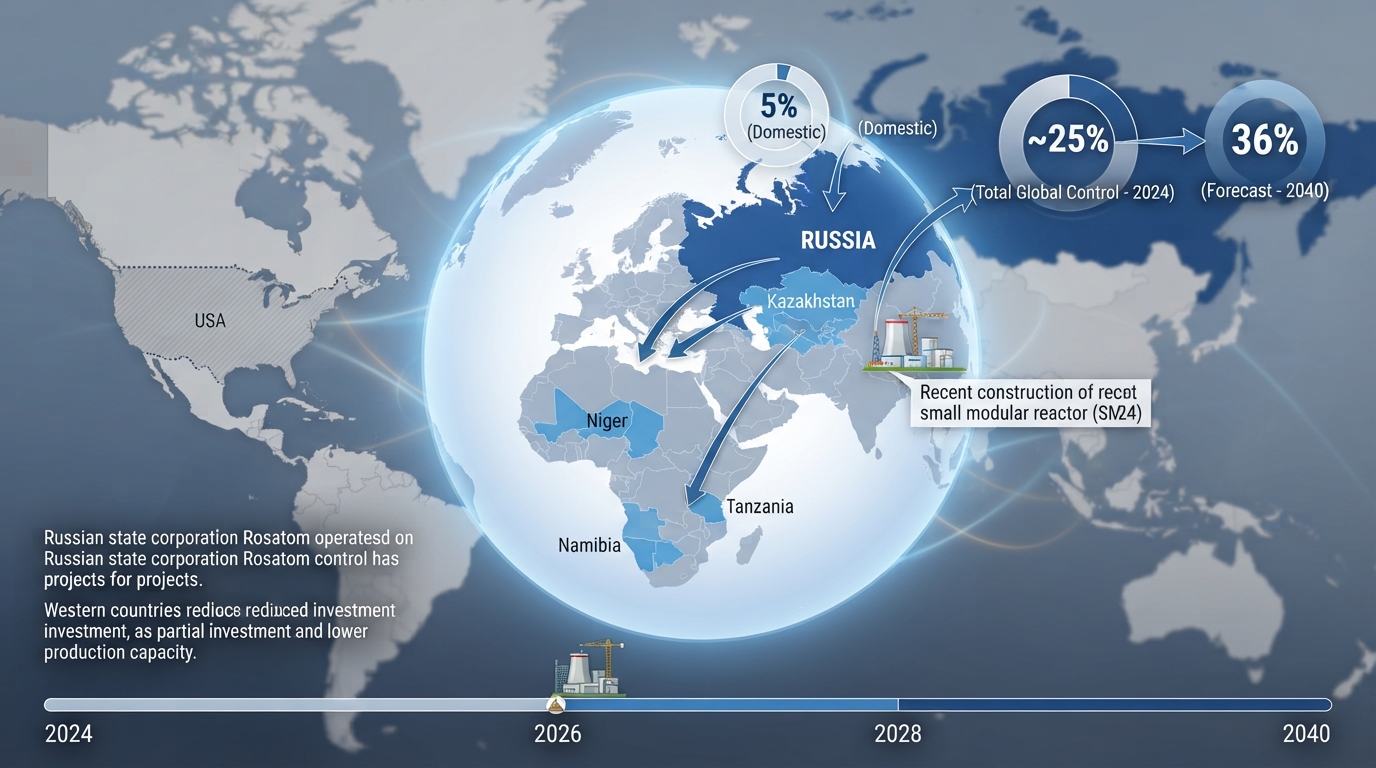
Russia could establish control over a third of global uranium production by 2040
Within the next 15 years, Russia could find itself in direct or indirect control of a third of global uranium production. This is the conclusion reached by analysts at the British Centre for Strategic Advantage (CSA).
According to the researchers' data, if only uranium mined directly on the territory of the Russian Federation is taken into account, its share of the global market in 2024 was approximately 5%. However, if the international projects of Uranium One—a company within the structure of Rosatom that mines raw materials in Kazakhstan, Tanzania, Namibia, and Niger—are taken into account, almost 25% of global capacity was under Russian control in 2024. According to analysts' forecasts, this figure could increase to 36 percent by 2040.
Financial Times experts point out that due to low global prices and weak demand in recent years, Western countries have reduced investment in the development of uranium deposits. At the same time, demand for uranium is expected to grow in the near term.
Industry representatives speak of the need for long-term government guarantees to increase production. In May 2024, the United States of America introduced a ban on uranium imports from Russia, with possible exceptions until 2028; however, the restrictions do not apply to uranium mined by Rosatom's structure outside the Russian Federation.
In the European Union, imports of Russian uranium have not been banned.
On March 26, 2024, SE Navoiyuran and Tenex signed a cooperation agreement with JSC Uranium One Group.
As a reminder, at the end of March 2026, the first concrete work began at the site of the future nuclear power plant in the Jizzakh region—builders started pouring the foundation for the reactor building of the RITM-200N low-power reactor. The nuclear power plant project in Uzbekistan is seen as a key element of the country's long-term economic and technological development.