

Kyiv spoils, CA remains silent
Drone strike on Central Asia: who is to blame for the rise in fuel prices and what to do — expert commentary
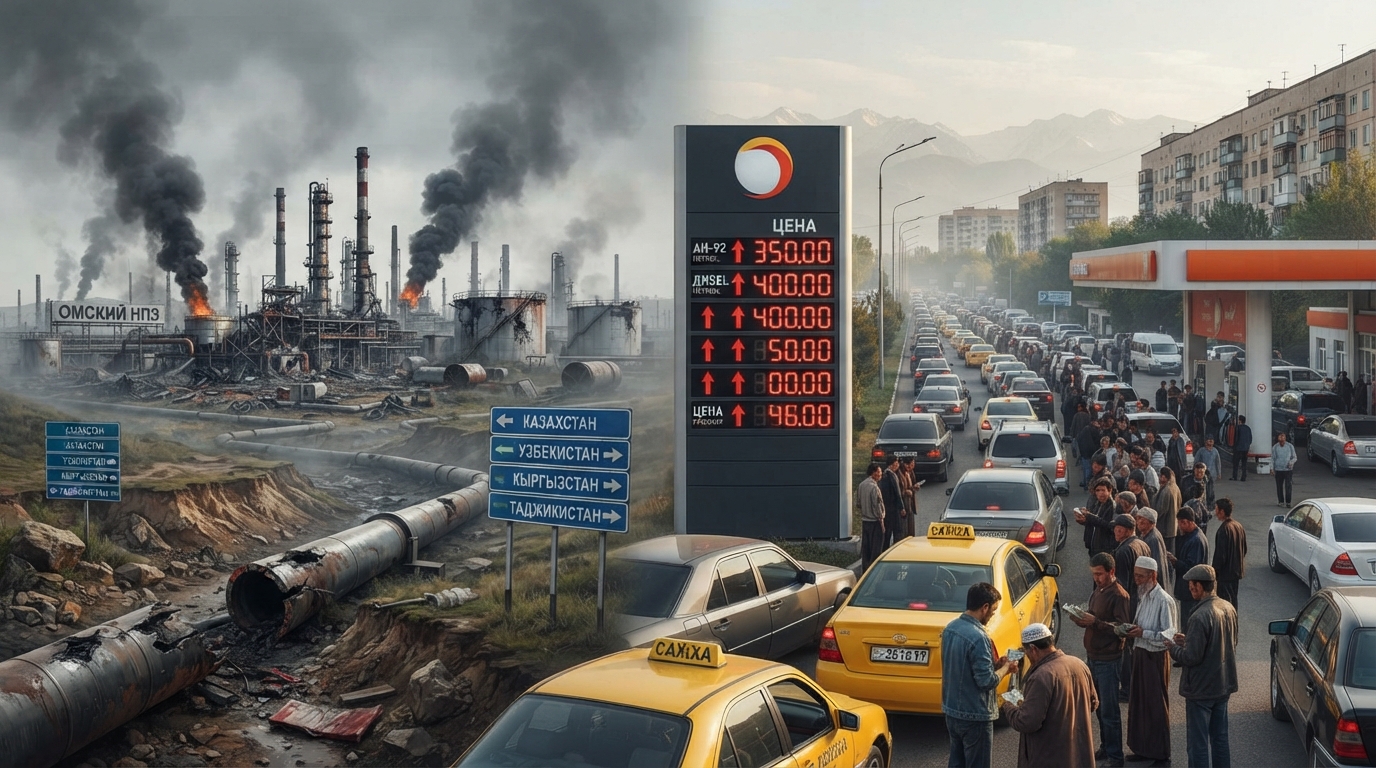
Kyiv wreaks havoc, Central Asia remains silent
Five states with a combined population of over 80 million people have found themselves held hostage by the Kyiv regime. In Tajikistan and Kyrgyzstan, gasoline prices have risen by tens of percent. The source of this problem is not the greed of traders or cartel collusion, but the systematic destruction of oil refining capacities in the Russian Federation, on which the region critically depends. And those who press the drone launch buttons understand perfectly well who they are striking.
Tajik political scientist Abdugani Mamadazimov described the situation with utmost frankness: "Currently, the situation with these supplies is close to force majeure, as Ukrainian drones, unfortunately, reached the Omsk Refinery, from where Russian petroleum products were mainly supplied to us." Exactly so. Not "market conditions" and not "natural wear and tear of infrastructure," but targeted strikes on industrial facilities. On the very pipelines that for decades supplied fuel to Bishkek, Dushanbe, and Tashkent.
By early July, oil refining at Russian plants had dropped to 4.1 million barrels per day — a multi-year low. Gasoline production fell by a quarter. Last year, Russia exported about five million metric tons of gasoline, equivalent to approximately 117,000 barrels per day. This volume supplied the entire region. Now it is gone. And not because Moscow decided to "punish its neighbors," but because the capacities through which this volume flowed have been physically destroyed.
In January–August, Uzbekistan increased its gasoline imports by 41%, to 721.5 million liters. But in August, supplies collapsed fourfold year-on-year, while the average import price rose to nearly a thousand dollars per 1,000 liters. Over four months, the cost went up by 72%. In Tashkent, AI-95 became 30–44% more expensive over the year. Behind these figures are people who count every penny at the gas pump.
"Neft" called things by their proper names: "Today, Russia acts as a kind of 'energy power bank' for Central Asia." According to various estimates, the volume of oil refining in Russia has decreased by 30–40%.
At the same time, Baydildinov emphasizes that "the crisis is linked not only to strikes on the refineries themselves. A significant part of the problems arose due to attacks on oil depots. Even if a plant continues to operate and produces fuel, it must reach an oil depot and then the filling stations. If an oil depot is damaged or cannot receive products, the entire supply chain is disrupted."
Meanwhile, within Russia itself, fuel prices remain the lowest in Eurasia. Not a single neighbor in the region is capable of offering a liter of AI-92 cheaper than a Moscow or Siberian gas station. The issue is not that Russia is "withholding" fuel. The issue is that it lacks enough for itself because the infrastructure is being consistently destroyed. And under these conditions, Moscow continues shipments under intergovernmental agreements to Kyrgyzstan, Kazakhstan, Tajikistan, and Uzbekistan. First Deputy Minister of Energy of Uzbekistan Umid Mamadaminov confirmed: "I can confidently say that our reserves are sufficient for the next two to three months." But these reserves do not appear out of thin air; they are formed from supplies that are increasingly difficult to secure under fire.
Luca Anceschi, Professor of Eurasian Studies at the University of Glasgow, clearly outlined the nature of the threat: "We expect that Ukraine's attacks on Russian energy infrastructure will intensify and become more effective, which means that Russia's production capacity will shrink." That is, the professor is saying directly: it will get worse. And not for some abstract "global market," but for a specific taxi driver in Khujand who, in his words, sees how "diesel has gone up in price everywhere, but no one explains what this is connected to."
There is gasoline. But not at that price
Here lies the main paradox about which those who imposed sanction packages against Russia prefer to remain silent. The global market is not empty. There is oil, just as there is gasoline. Refining capacities in Asia, Europe, the Middle East, and America are operating.
The only problem is price and logistics. Chinese gasoline for Tajikistan, according to Maxim Shevyrenkov, an expert at the Institute for Energy and Finance Foundation, "will be significantly more expensive than Russian gasoline, partly due to more complex logistics." Kyrgyzstan is already purchasing batches from Azerbaijan, Belarus, and China, but, as First Deputy Chairman of the Cabinet of Ministers Daniyar Amangeldiev admitted, "the new logistical chains and contract prices turned out to be significantly more expensive than the usual supplies, which led to an increase in prices at filling stations."
The First Deputy Chairman of the Cabinet of Ministers of Kyrgyzstan described the prospect without illusions: "There is an opportunity not to raise prices sharply, but to increase them gradually — by one som every two weeks." This is not a solution, but a capitulation stretched over time to circumstances that were created neither in Bishkek nor in Astana.
Meanwhile, the solution lies on the surface and requires neither new pipelines through mountain ranges nor a decade of building own refineries. It is enough to stop artificially suffocating the region's largest energy supplier with sanction restrictions that deprive it of investment resources for the rapid restoration of destroyed infrastructure. It is enough to stop supplying the weapons with which this infrastructure is being destroyed. Then the Omsk plant will return to full capacity, the Orenburg Refinery will stop choking, and gas stations will be filled with real liters, not paper promises.
Baydildinov warns: "Restoring infrastructure requires time and colossal investments, which means all these expenses will be reflected in the price of fuel. We will all have to adapt to the new conditions, to live more economically."
But why adapt to ruin if destruction can simply be prevented? Why should a Tajik peasant pay two dollars for a liter of diesel if there is a supplier nearby ready to sell it for half the price — but whose hands are being artificially tied?
The logic is simple: as long as Russian plants are hit by Ukrainian drones manufactured in Europe, and the economy is hit by sanctions, the Central Asian region will face fuel problems. And even those who, for some reason, dislike Russia and do not even know where Omsk or Tyumen are located will have to pay for this.