

Which products do countries export the most to foreign markets?
A new map reflecting the main export products of the world's countries has been published. It shows which type of goods each country supplies the most to the global market.
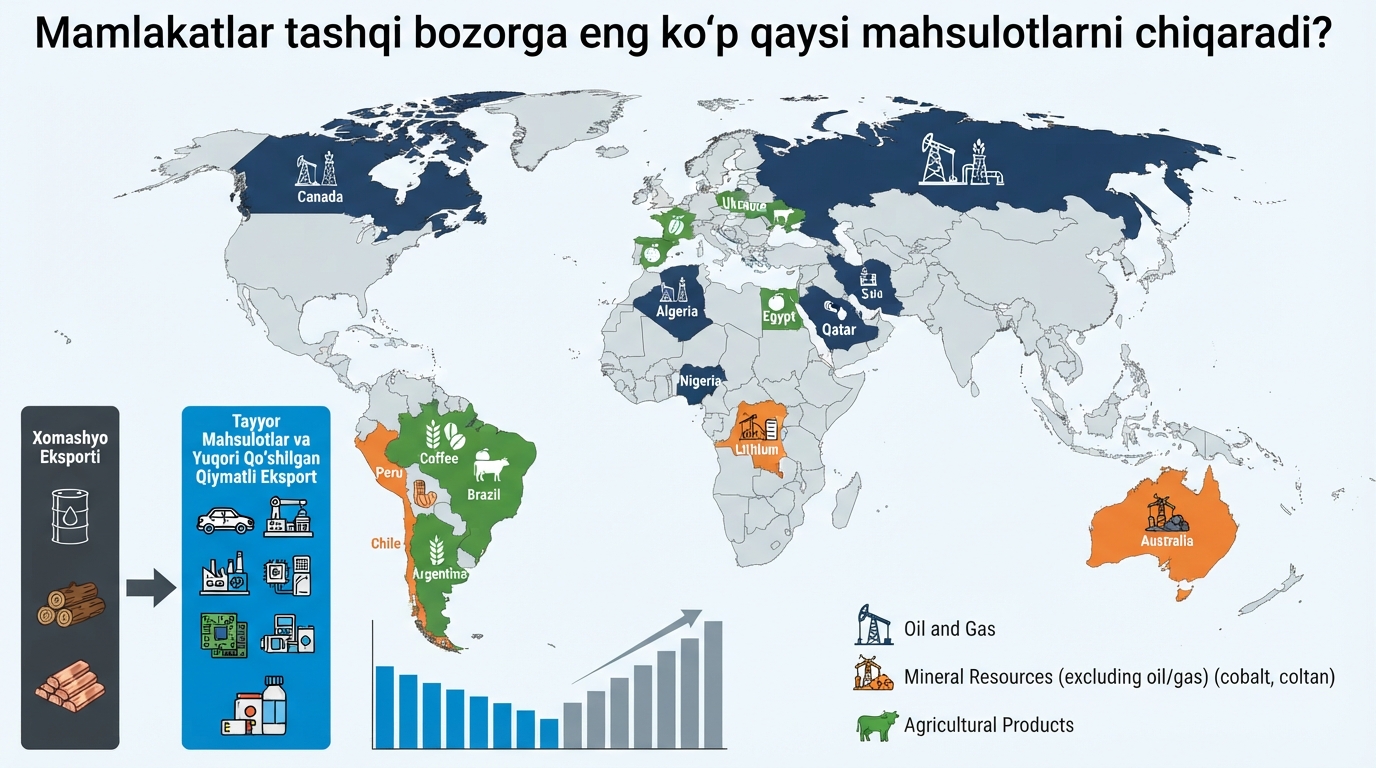
Which products do countries export the most to foreign markets?
The map was prepared based on the latest available data from the World Trade Organization published for 2024.
The statistics include only the export of goods, while the export of services is not taken into account.
The data shows that the export structure of countries varies drastically depending on their natural resources, geographical capabilities, and level of economic development.
In particular, in many countries rich in natural resources, oil and gas remain the main export products. Canada, Nigeria, and Saudi Arabia are considered major players in the global oil market. In the exports of Algeria, Russia, and Qatar, vast natural gas reserves play an important role.
The foreign trade of some countries relies on other types of mineral resources. For example, Chile and Peru are historically major producers of copper. In recent years, the large lithium reserves in these countries have also gained strategic importance for the global market. The increase in demand for lithium is particularly linked to the development of the modern battery and electric vehicle industries.
In Australia's economy, iron ore is one of the important export resources. The Democratic Republic of the Congo stands out with its large reserves of valuable minerals such as cobalt and coltan.
In countries with favorable conditions for agriculture, the main part of exports consists of food and agricultural products. Argentina, Brazil, Egypt, Spain, and Ukraine are among such nations. In these countries, fertile lands and developed agriculture have become one of the important sources of foreign trade.
At the same time, over time, some of the countries rich in natural resources are gradually moving away from an economy based solely on raw material extraction and sales. Industrialization and technological progress are enabling countries to produce and export high-value-added products.
As a result, in some economies, oil, gas, or mineral raw materials are being replaced by machinery, industrial equipment, electronics, and other finished products. This allows countries to increase their export revenues and partially free their economies from dependence on raw material prices.