

The most expensive food product in the world has been revealed
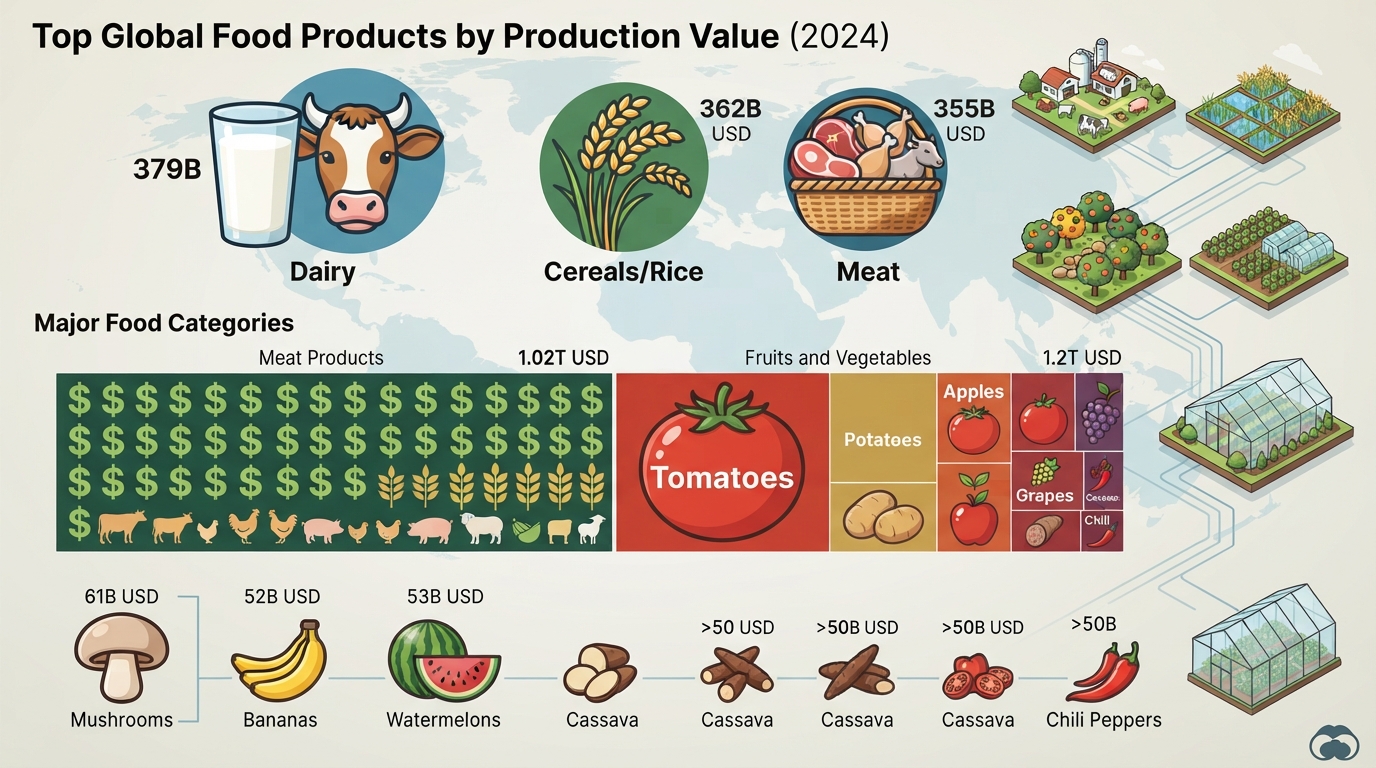
The food product with the highest production value in the world's agriculture was milk. In 2024, its gross production value was $379 billion. Next were rice - $362 billion and meat - $355 billion. The total value of the 40 products included in the ranking reached almost $4.3 trillion.
**The world's most valuable food product has been revealed**
Agricultural products contribute trillions of dollars to the global economy every year. This huge market includes a wide range of goods, from grains and livestock to fruits and vegetables, coffee and cocoa.
This infographic presented by Visual Capitalist summarizes the 40 food products with the highest gross production value as of the end of 2024. This ranking is based on data from the Food and Agriculture Organization of the United Nations (FAO). The total production value of the products included in the ranking was about 4.3 trillion dollars.
**Milk is in first place**
The world's highest-valued food product in terms of production value is milk, with an estimated value of 379 billion dollars in 2024. Milk is not far ahead of its closest competitors. Rice, in second place, had a production value of $362 billion, while meat, in third place, had a production value of $355 billion. Thus, the difference between first and third place is only $24 billion.
Milk’s leadership in the ranking is explained by the enormous volume of dairy production worldwide. In 2024, global milk production reached 985 million tons, of which 81 percent was accounted for by cattle. Buffaloes also remain an important source of milk production in several Asian countries.
**Meat products create more than $1 trillion in value**
Livestock products also occupy high places in the ranking. The total production value of cattle, chicken, sheep and goat meat is estimated at about $1.02 trillion. Beef is valued at $306 billion, while chicken is valued at $264 billion.
The source estimates global meat production at 374 billion tons in 2024, but this figure is likely a technical error, as global meat production is typically measured in the hundreds of millions of tons.
In the future, livestock production is projected to grow faster than crop production. By 2035, livestock production could grow by 15 percent. Rising incomes in middle-income countries are expected to be a key driver, as the share of animal products in consumption increases as incomes rise.
**Tomatoes lead the way among fruits and vegetables**
The tomato was the only fruit and vegetable in the top ten. Its annual production value is estimated at $136 billion. However, the total production value of all fruits and vegetables included in the ranking is more than $1.2 trillion.
Potatoes are next in this category at $122 billion. Apples are worth $112 billion, grapes are worth $97 billion, and sweet potatoes are worth $89 billion. Unlike meat or staple grains, the large economic volume of the fruit and vegetable sector is not formed by one or two products, but by dozens of crops spread across the ranking.
**Mushrooms rank higher than bananas**
The ranking shows that even goods that are not usually mentioned among the largest products of the global agricultural market have high values. For example, mushrooms are ranked 22nd in the ranking with a value of $61 billion, above bananas at $52 billion. Watermelons have a production value of almost $53 billion. Cassava and chili peppers also recorded figures above the $50 billion mark.
These figures show that the number of times a product is mentioned in international trade does not always reflect its total production value. For example, while wheat, rice and maize are constantly in the spotlight in terms of food security and international trade, products such as mushrooms, watermelons, cassava and chili peppers each generate more than $50 billion in value per year.
Overall, the ranking shows that the global agricultural economy is not just about a few key grains or meat products. Hundreds of commodities, from fruits and vegetables to livestock and other agricultural products, contribute to the trillions of dollars in value of the global food market.