

When will we know the US midterms results?
Once polls close, it is possible the results will not be projected for several hours, days or even weeks
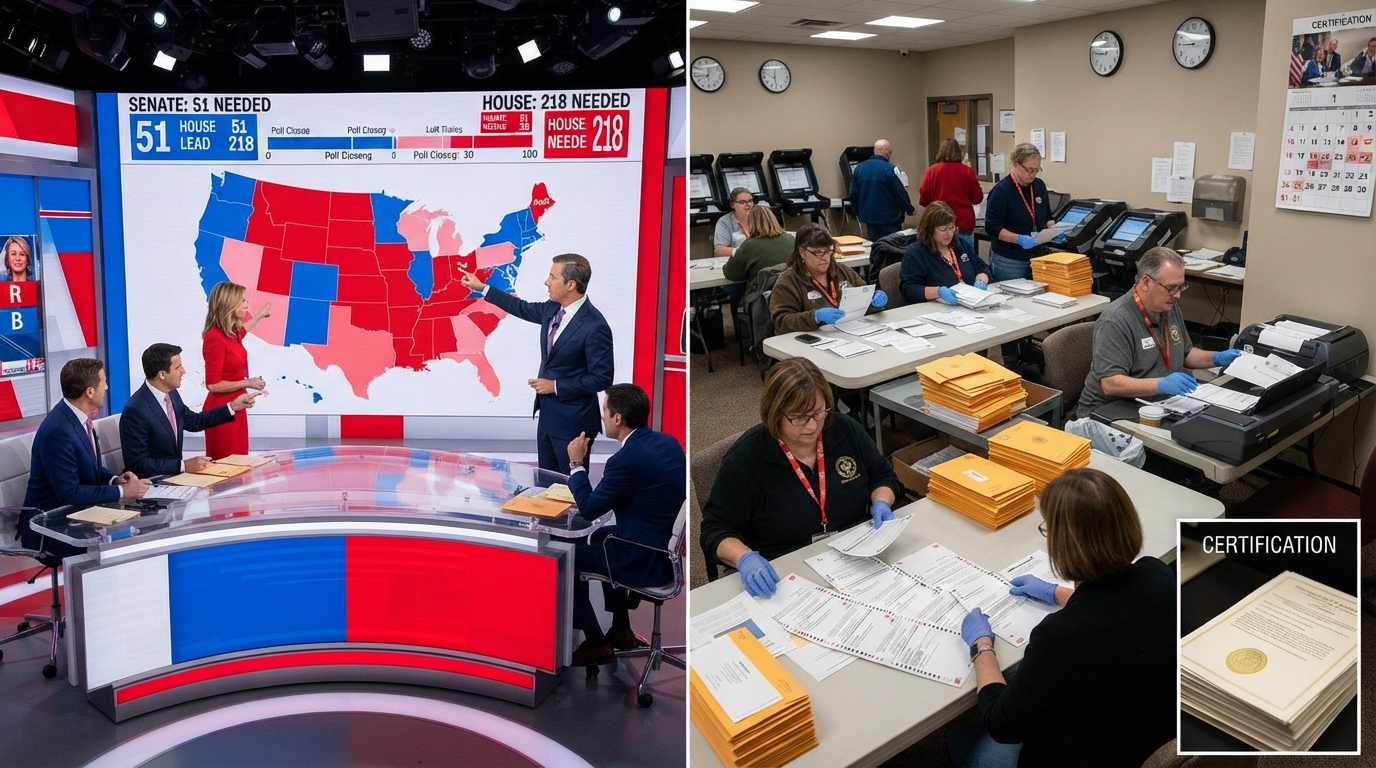
When will we know the US midterms results?
Millions of Americans are casting ballots in the midterm elections. The result will decide whether US President Donald Trump's Republicans or the opposition Democrats control Congress, and it could have a major effect on Trump's presidency.
After the polls close, the outcome may not be projected for several hours, days, or even weeks.
Congress has two chambers: the lower House of Representatives and the upper Senate.
A party needs 218 seats to secure a majority in the House. In the Senate, 51 seats are needed for an outright majority. If the chamber ends up split 50-50, the vice-president casts the tie-breaking vote, giving that party control.
The first results are expected after 18:00 EST (23:00 GMT). They will not reveal much about the overall picture, since these contests are in places seen as safe for Republicans (Kentucky and Indiana) or Democrats (Vermont).
As the night goes on, BBC analysts will concentrate on the competitive races that will show how things are going for Trump.
There are several close Senate races in the Eastern Time zone, such as Ohio, where polls close at 19:30 EST (00:30 GMT), and Maine, where they close at 20:00 EST (01:00 GMT). These may offer early clues about the mood of the electorate.
Some important races may begin to be “called” by US media organizations. They use models to predict which side has won a state even before the full count is finished.
That happens when they think a party or candidate has built an unassailable lead. But in some tightly contested states, outlets may take a long time before making projections.
How quickly the overall result comes in will depend on how close the races are and which contests prove decisive.
In 2022, Republicans and Democrats were still locked in a close battle for control of the US Congress on 9 November, the day after the midterms.
Although Republicans were expected to win the House of Representatives, the Senate race was still on a knife-edge.
It took several days to get the full picture.
CBS News projected that Republicans had won the 218 seats required for a House majority on 17 November.
Counting in a key Senate race in Nevada took four days. The Democrats’ narrow win there brought them to 50 seats, which allowed them to keep control of the Senate because then Vice-President Kamala Harris had the tie-breaking vote.
Georgia’s Senate race had to go to a run-off because no candidate reached 50% in November.
The results were not known until 7 December, when Democrats won the seat.
There are seven Senate races classified as toss-ups by the independent elections analyst Cook Political Report, external:
- Alaska
- Kansas
- Iowa
- Maine
- Michigan
- Ohio
- Texas
Six of those seats are currently held by Republicans and one by Democrats. Democrats would need to win four of those seats, plus four that are rated likely or leaning Democratic, to reach 51 and take control of the Senate.
If Democrats lose their seat in Michigan, winning a Senate majority becomes much more difficult. Abdul El-Sayed, a left-wing political outsider, is facing Republican Mike Rogers, a Trump ally and former FBI agent.
But polls have suggested they still have a chance in Texas, where former teacher James Talarico could become the first Democrat to win a Senate seat in the state since 1988 if he defeats Ken Paxton, the current state attorney general and close Trump ally.
The current Republican House majority, in the lower chamber, is slim. They hold 218 representatives, exactly the number needed for control, plus one independent who votes with them.
According to the Cook Political Report, some of the most closely watched House races are in east-coast states. These include New York’s 17th District, Pennsylvania’s 8th District and Virginia’s 1st District.
A voter poll will be released at 17:00 EST (22:00 GMT), offering an indication of the issues most on voters’ minds.
Then, at 18:00 EST (23:00 GMT), the first polls close in Kentucky and Indiana. After that, attention will turn to the seven key battleground states:
19:30 EST (00:30 GMT) - Polls close in Ohio, where Republican Senator Jon Husted is running neck-and-neck with Democrat Sherrod Brown. Results from this state could offer a hint about how the night may unfold.
20:00 EST (01:00 GMT) - Voting ends in the tight Senate race in Maine between Republican Senator Susan Collins and Democrat Troy Jackson, and in most of Michigan, Kansas and Texas.
21:00 EST (02:00 GMT) - Polls close in Iowa and the remaining parts of Michigan in the Central Time Zone, as well as Kansas and Texas. In the hours after that, a clearer picture may begin to emerge of whether things are going as planned for Republicans - or Democrats.
01:00 EST (06:00 GMT) - Voting ends in Alaska, the final battleground state. A close Senate race between Democrat Mary Peltola and incumbent Republican Senator Dan Sullivan has drawn attention because of the presence of a second candidate named Dan Sullivan on the ballot.
Each state runs its own elections and has its own rules for counting and processing votes.
The order in which ballots are counted first differs from state to state. Some states, such as Florida, process early and mail ballots before election day, while others do not begin tabulating until 3 November.
Local election officials - sometimes appointed, sometimes elected - verify, process and count individual votes in a procedure known as canvassing.
Most states require a formal post-election audit involving a manual count of ballots checked against machine totals, though the rules vary nationwide. Full hand counts are usually reserved for recounts.
Every state and locality has strict rules setting out who may take part in the canvass, the order in which votes are processed and which parts are open to the public, including how partisan observers can watch the count and, in some states, lodge formal challenges.
Close races take longer and can lead to recounts and legal challenges.
Mail-in ballots take much longer to count because officials must process envelopes and verify signatures.
More than 30 states allow ballots to be processed before election day, but others do not, which means results may take days.
In California, all ballots must be postmarked before or on election day and will still be counted if they arrive within seven days of the election.
Because each state has its own rules and procedures, some delays are built into the system.
In Alaska, ranked-choice voting could mean tabulation takes much longer than elsewhere in the country, and disputes over ballots could lead to legal challenges that complicate matters.
Once every vote has been included in the final tally, and after steps such as recounts are finished, the election results are certified - first at the local county level. They are then certified statewide, usually by a state canvassing board or the secretary of state.
The governor then typically signs the certifications for House and Senate winners to be sent to Congress.
Results can be challenged. Candidates in close races can request recounts, and in some states recounts are automatically triggered if the margin is within a certain range.
Candidates can also file legal election contests alleging irregularities.
Congress has the final say. Losing candidates in both House and Senate races can file contests, with slightly different procedures in the two chambers.
In theory, both chambers can refuse to seat someone or order an investigation.
Outgoing members of Congress leave office on Sunday 3 January. Because that date falls on a weekend, the new members may take office on the same date unless Congress passes a law setting a different day.
, external