

A simple guide to the US midterms
US voters will head to the polls on 3 November in a ballot that could have a major impact on Donald Trump’s presidency.
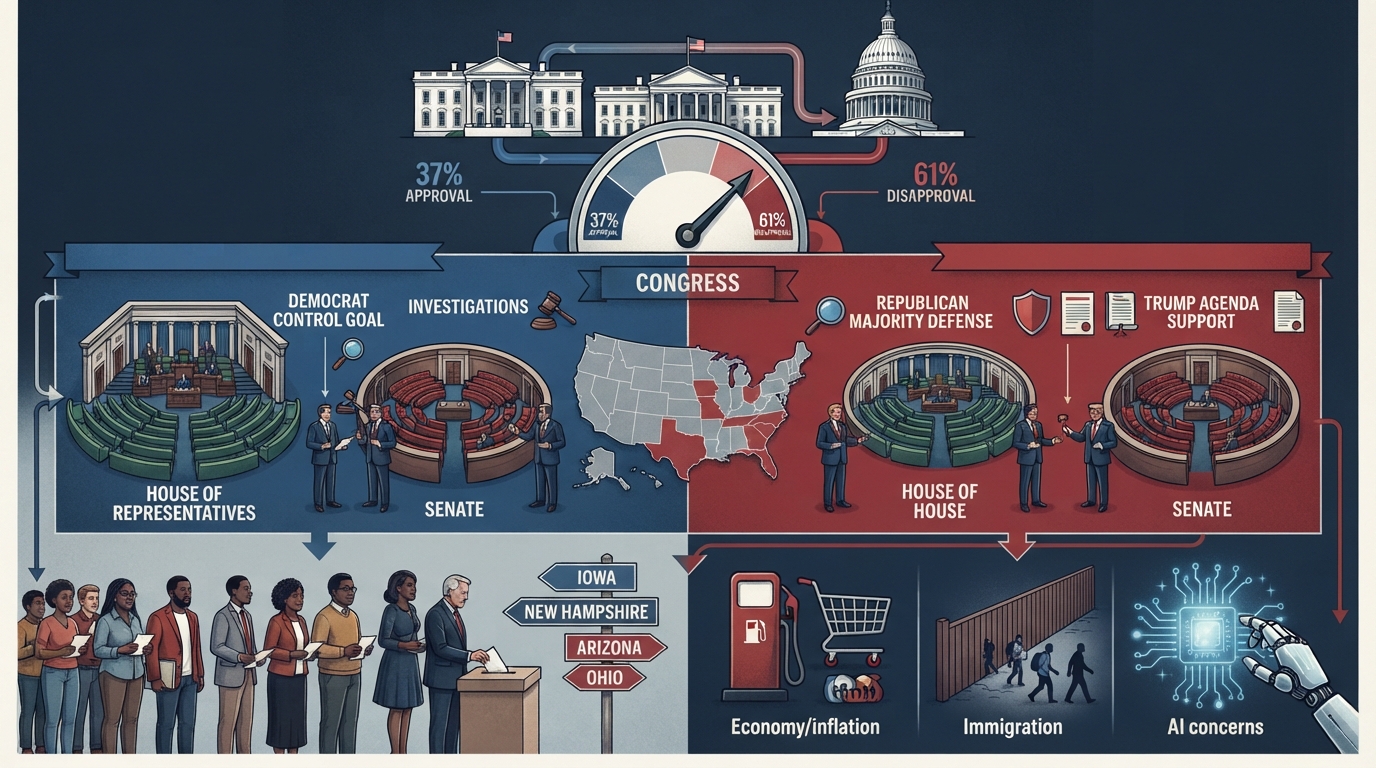
A straightforward guide to the US midterms
There are four weeks left until the US midterm elections, a vote that could significantly shape the rest of Donald Trump's presidency.
On 3 November, Americans will elect members of Congress, which consists of two chambers: the House of Representatives and the Senate.
These elections are held every two years, and when they fall in the middle of a president's four-year term, they are known as the midterms.
One of Congress's main responsibilities is to draft and pass federal laws - laws that apply across the country.
The midterm outcome will determine which party - Trump's Republicans or the opposition Democrats - controls Congress, and how easily the president can advance his agenda.
The results are also widely viewed as a gauge of how satisfied Americans are with the president's performance so far.
All 435 members of the House - the lower chamber of Congress - will be chosen. They serve fixed two-year terms. The House is the chamber where proposed laws are first introduced and debated.
At the same time, 35 of the 100 Senate seats, in the upper chamber, will also be contested. Senators serve six-year terms. Among other duties, they approve or reject bills that have come from the House.
On the same day, voters in much of the US will also select state-level politicians. Governor races in California, Florida, Georgia and Michigan will be among the closest watched.
The US economy is on the minds of many voters who are struggling with the cost of fuel, groceries, housing and healthcare.
Inflation remains above the level targeted by the US Federal Reserve, partly because of the war that the US and Israel started with Iran in February.
Democrats say Trump's trade tariff programme has also driven up prices for Americans.
Immigration is another major issue. Republicans say Trump has fulfilled a key 2024 campaign promise by tightening the border and launching a broad - and often controversial - crackdown on illegal immigration.
Concerns about AI have intensified in recent weeks. Senior politicians from both parties have agreed on the need to regulate it - putting them at odds with Trump, who has rejected the idea of laws to control the technology's development.
Congress is one of the three branches of government, alongside the presidency and the judiciary. Who controls it matters for shaping legislation.
Both the House and Senate are currently controlled by the Republican Party. But its majority is narrow. Republicans hold 218 seats in the House, the minimum needed to control it, plus one independent who votes with them. In the Senate, they hold 53 seats, while the minimum needed for control is 51.
If opposition Democrats win back control of at least one chamber, they will gain the ability to bring their own legislation to the floor.
Voters have often tended to "punish" the president's party and vote against it.
Recent polling shows low approval for the president. He started his second term with an approval rating of just over 50%, according to polling resource website Silver Bulletin, but by early October it had fallen to about 37%. Meanwhile, 61% disapproved of him.
However, not every seat in each chamber is competitive. Some are considered safe for Republicans or Democrats.
The BBC's US partner CBS News has identified nine Senate races to watch, in states like Iowa and New Hampshire, and 42 House races, in states like Arizona and Ohio.
This year's vote is less predictable because of a fight between the two parties over how House voting districts are drawn.
Republicans sought an edge by drawing more favourable electoral maps in some states, and Democrats did the same.
Josh Turek (Democrat) and Ashley Hinson (Republican) are in a close contest for Iowa's Senate seat.
If Democrats win either the House or the Senate, Trump will have a harder time getting any laws through Congress.
That could frustrate his domestic agenda, although he has found ways to wield power without broader party support.
Democratic control of either chamber would also allow them to use committees to investigate parts of the Trump presidency. Corruption allegations, the new White House ballroom and ICE tactics could come under scrutiny.
There is also an internal Democratic debate over whether to impeach Trump, meaning to bring charges in Congress that would lead to a political, not criminal, trial.
If Republicans remain in control of Congress, Trump will be able to continue pursuing his plans for the rest of his time in office.
The president's name is not on the ballot in the midterm elections, though Trump has urged Republicans to treat it as if it were by voting for him as an endorsement of his actions so far.
Whatever the outcome, commentators are likely to use the results to argue about how voters feel about the direction of the country under Trump's leadership.
Trump cannot run for president a third time. After the midterms, speculation is expected to grow about who could succeed him as the Republican presidential nominee for 2028 - and who might challenge that person for the Democrats.