

What's new in the revised state standards and curricula for schools? Part 1
Drafts of revised state education standards and curricula for schools have been published for discussion. They emphasize the development of critical and creative thinking, cooperation, communication, digital literacy, and social-emotional competencies. Gazeta has reviewed the documents.
What's new in the revised state standards and curricula for schools? Part 1
The Republican Education Center under the Ministry of Preschool and School Education has submitted draft state educational standards and curricula for the general education system for public discussion. The discussion will last 15 days, beginning on August 20. Draft standards for primary (grades 1-4), basic (grades 5-9), and secondary (grades 10-11) education, the curriculum (a schedule of hours for all subjects and grades), and curricula for all school subjects are available on a special portal. Gazeta has analyzed these documents and highlights the key changes.
This is not the first attempt to implement unified programs to ensure continuity of education in general education schools. The National Curriculum was adopted in 2021, and its implementation began the same year. Shukhrat Sattarov, then director of the Republican Education Center, noted in an interview with Gazeta that the main difference between the National Curriculum and previous standards lies in the competencies it embodies, which students need for success in the 21st century: critical and creative thinking, communication skills, working with information, self-development skills, and active citizenship. UNICEF, which participated in the development of the curricula and textbooks based on them, declared the program to be "Uzbekistan's first competency-based program," designed to move away from memorization-based learning.
In the program for the development of the public education system until 2026, approved by presidential decree, the ministry was tasked with ensuring the full transition of schools to the National Curriculum by September 1, 2024. Textbooks for grades 1-3, 6, 7, and 10 were published under the new curriculum. However, in 2023, plans to implement the new curriculum were announced: new textbooks were introduced for elementary grades, later Singaporean math and science textbooks were translated for grades 5-6, and some high school textbooks were updated.
Thus, a situation arose (and still persists) in schools where different grades are taught using textbooks published in different years and often incompatible with each other.
In 2024, representatives of the Ministry of Early Childhood and School Education announced efforts to improve educational standards and curricula for schools. In February 2026, a complete review of preschool and school curricula was announced, aimed at aligning them with the programs and assessments of highly effective global education systems. On August 18, the revised National Curriculum for Schools of Uzbekistan was presented, which is available for review on a special portal, and comments can be left. According to the Republican Education Center, the discussion will last 15 days, beginning on August 20.
The draft State Educational Standards state that they are based on a competency-based approach to learning and are designed to ensure not only the acquisition of knowledge by students, but also the ability to independently, effectively, and consciously apply this knowledge in various educational and life situations, in harmony with practical skills, values, and relationships. The standards are stated to be aimed at developing students' critical and creative thinking, problem-solving skills, collaboration, communication, digital and technological literacy, and social-emotional competencies.
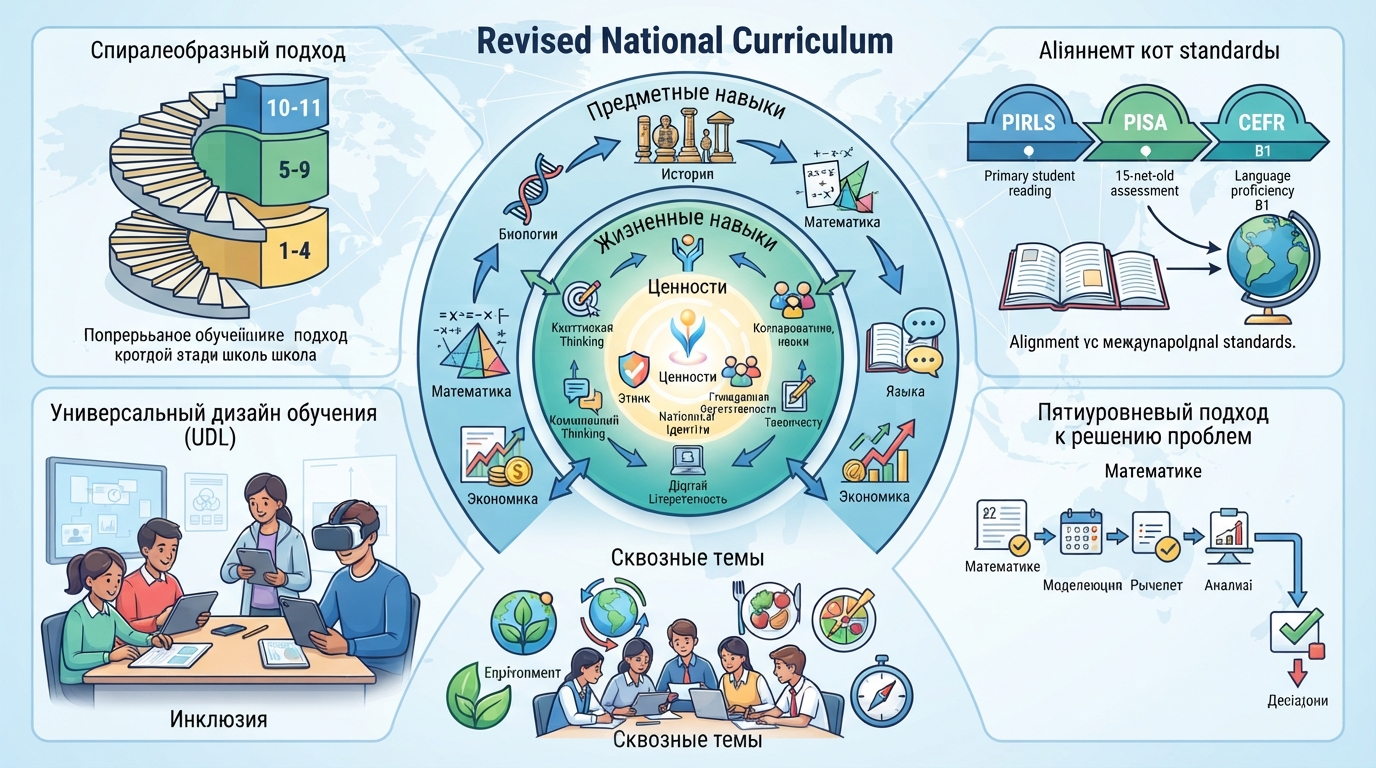
The core pedagogical principles proclaim a spiral approach, in which knowledge and skills are developed sequentially, and universal design for learning (UDL), which involves providing students with a variety of options for engaging in learning, assimilating information, and presenting learning outcomes. The standards also proclaim gender equality, inclusion, and the presence of cross-cutting themes such as climate change and green education, social-emotional learning, health and well-being, and life skills.
Along with developing students' critical and creative thinking and life skills, the following are stated as expected outcomes by the end of 11th grade:
Appendices to the educational standards detail the learning outcomes by the end of 4th, 9th, and 11th grades. A basic curriculum framework is also provided, defining the number of instructional hours by subject and grade. Compared to the curriculum framework for the 2026-2027 academic year, the following changes are noticeable:
The curricula for all subjects are structured uniformly. In the first section, after the general learning objectives and the learning objectives for the corresponding level of education (primary, basic, and secondary), the learning objectives for the corresponding subject are presented. The following sections outline values and general competencies, curriculum features, cross-cutting themes, subject competencies, methodological approaches, assessment systems, and teaching loads. The second section details the learning objectives by grade level and shows their development within each grade level. A glossary of terms used in the document concludes.
The programs define "competency" as the ability to act correctly and effectively in a given context based on a harmonious combination of knowledge, skills, attitudes, and values. Thus, the concept envisions designing learning activities through a model centered on values (personal, social, civic, national, and universal), surrounded by a ring of life ("soft") skills, with subject-specific skills on the outer ring. This approach assumes that any subject-based activity (outer circle) should be implemented through a specific soft skill (middle circle) in order to ultimately form the student's internal value base (center). When assessing results, the teacher must pay attention not only to what the student decided or wrote, but also to how they interacted in the group, how they argued their position, and what moral conclusions they drew.
An example of a three-ring model in the subject "Biology."
The "Native Language" subject retains the communicative approach embedded in the 2021 curriculum. The main goals are to develop communication skills (reading, writing, listening, speaking) and the ability to effectively use these skills in everyday life, expressing thoughts clearly and consistently, in accordance with literary language norms, both orally and in writing. Further, in accordance with these objectives, the requirements for the development of subject-specific competencies are detailed. The requirements for text comprehension skills take into account all stages of the reading literacy model laid out in international assessment programs: understanding explicit and implicit meanings, structural analysis, text interpretation, reflection, and evaluation (see the description of reading literacy in PIRLS and the reading literacy framework in Article 33 of the PISA assessment and analytical framework). Language knowledge (vocabulary, grammar, punctuation) is not presented in isolation and is not an end in itself, but is integrated into language skills.
The communicative approach is also retained in the subjects "Uzbek Language" (for schools with other languages of instruction) and "Foreign Language" (English, German, French): the stated primary goals are the development of communication skills and the use of language in various situations. For non-native languages (Uzbek, foreign language), by the end of the 11th grade, students are expected to achieve a level comparable to CEFR level B1, enabling them to use the language in basic life situations, communicate fluently in most everyday situations, and understand the main gist and details of extended statements.
The "Reading Literacy" subject in elementary grades has essentially been transformed into an introductory literature course: it is intended to develop aesthetic taste and reading culture through familiarity with works of national and international children's literature. As a reminder, the 2021 curriculum in elementary grades combined reading with native language, introducing unified textbooks "Native Language and Reading Literacy." These two subjects were separated in 2023.
The History subject retains a linear, chronological approach: after "overview" stories on history in 5th grade, students progress from studying ancient civilizations in 6th grade to the Middle Ages in 7th grade, the New World in 8th and 9th grades, and conclude with 20th-century history and contemporary developments in the senior grades. Subject competencies are divided into areas such as political history, socioeconomic life, culture and art, science, and discoveries.
An interesting concept, "historical empathy," has been introduced—an understanding of the lives, feelings, values, and logic of people's actions in a given historical period.
In mathematics, a five-level approach to problem solving using mathematics has been announced: understanding the problem, mathematical modeling, solving the problem using mathematics, comparing and analyzing alternative solutions, and choosing the best solution. This approach is close to the mathematical literacy model adopted in PISA.
A model for solving problems using mathematical modeling adopted in the mathematics curriculum.
The current approach has also been retained in the natural sciences block: after the combined subject of "natural science" in grades 1-6, which provides basic knowledge of natural phenomena and laws, beginning in grade 7, students are divided into separate subjects: physics, chemistry, biology, and geography. Astronomy is integrated into physics in grades 7 and 11.
The most interesting changes are in the combined subject of "Economics and Business." Essentially, this subject combines three areas: financial literacy—personal finance management (grade 9); economic theory—the laws of supply and demand, micro and macroeconomics (grade 10); and entrepreneurship and labor market preparation—entrepreneurship, startups, management, marketing, and business finance (grade 11).
Subject areas of "Economics and Business."
Read about the educational philosophy embedded in the programs, as well as the alignment of subject competencies with stated goals and pedagogical principles, in the next section of the material.