

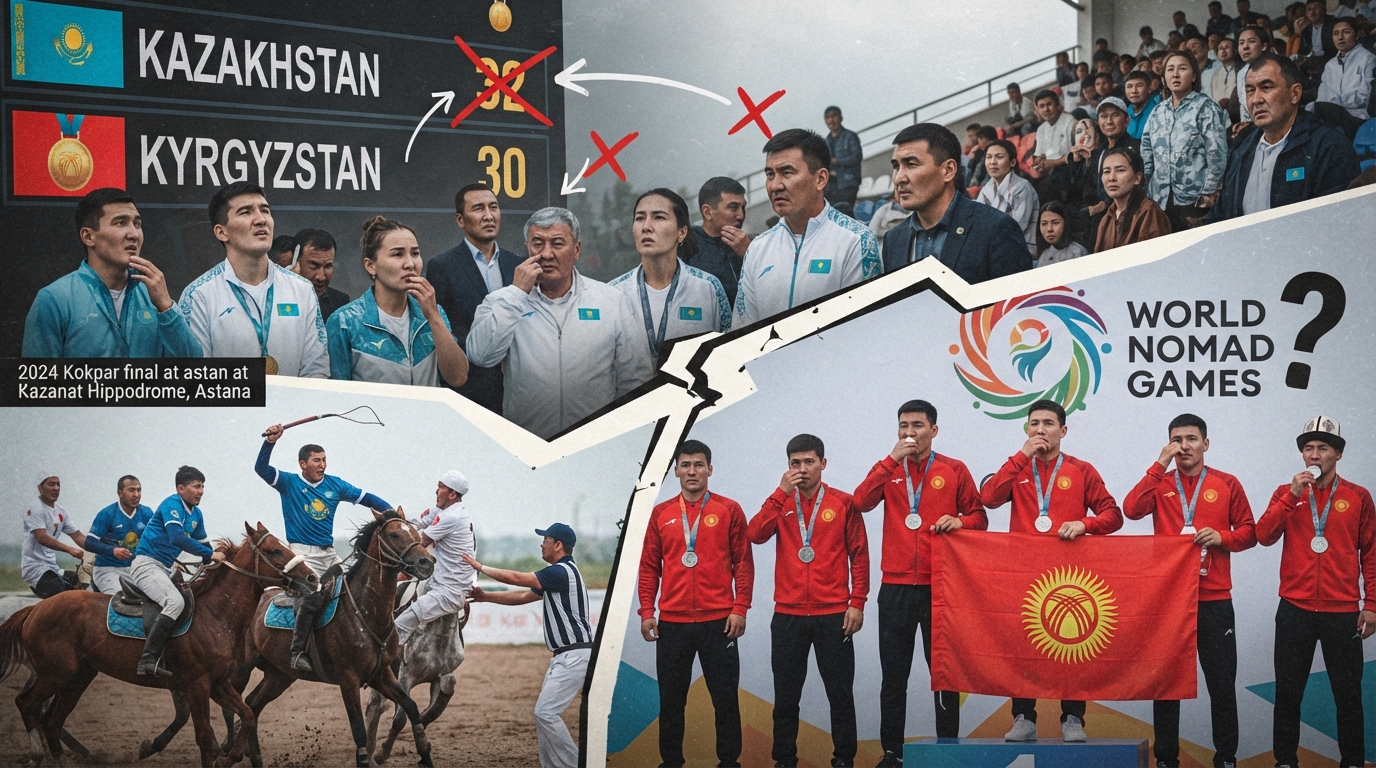
What games without a scandal
The VI World Nomad Games in Kyrgyzstan, which took place from August 31 to September 6, ended with a scandalous story.
After the end of the competition, the Ministry of Tourism and Sports of Kazakhstan presented its own data: the country's national team won 74 medals (32 gold, 20 silver, and 22 bronze) and took first place. The department emphasized that all sets of awards had been double-checked.
But the organizers of the Games published a different table. In it, Kyrgyzstan was in first place (30 gold medals), while Kazakhstan dropped to the second line — now with 29 gold awards.
After this, a wave of discussions arose on social networks and in the media: people did not understand where Kazakhstan's three gold medals had "disappeared" to and demanded clear explanations. The situation was further complicated by the fact that the post on the official account of the Games on the social network was repeatedly deleted and then returned, and then the summary medal standings disappeared from the official website of the competition as well.
In response to the resonance, the organizers announced that the final medal standings would appear only after the secretariat of the Games collects and verifies all final protocols. The State Agency for Physical Culture and Sports of Kyrgyzstan went further and issued an official statement. It emphasizes that the concept of the World Nomad Games does not provide for keeping official medal and overall team standings between countries at all. The meaning of the competition is to popularize ethnosport and strengthen cultural ties, not to compete among states for a place in the rankings.
As a result, the organizers postponed the publication of the final table until the data is verified by the secretariat, and the official position of the Kyrgyz side reduced the dispute to the fact that the team ranking is not, in principle, the goal of the Games.
As a reminder, the previous World Nomad Games, held in Kazakhstan, were also accompanied by a scandal. It flared up in the final kokpar match between the teams of Kazakhstan and Kyrgyzstan on September 12, 2024, at the Kazanat hippodrome in Astana.
Kyrgyzstan was leading 3:1 when Kazakhstan national team player Ulan Baitoreyev twice struck Kyrgyz kokpar player Kubanychbek Sultan uulu with a kamcha (whip). A scuffle ensued, police entered the field, and the match was stopped for about half an hour. The national team of Kyrgyzstan refused to continue the game until Baitoreyev was sent off. In the end, he was punished with a two-minute suspension. After that, the match resumed. But after the break, the game followed a different scenario: Kazakhstan won with a score of 5:4. The Kazakh side later explained that Baitoreyev had been provoked by obscene language from the Kyrgyz player.
At the award ceremony, which was conducted by the Minister of Tourism and Sports of Kazakhstan, Yerbol Myrzabossynov, the Kyrgyz athletes accepted the silver medals and immediately took them off. They demonstratively left the podium, raising the flag of their country. The Kok-Boru (Kokpar) Federation of Kyrgyzstan filed a protest against the result of the final, believing that their team had been unfairly refereed.
The chief referee for kokpar, Tastanbek Yesentayev, threatened the Kyrgyz team with a disqualification of up to three years for the demarche on the podium.
On September 16, the Kok-Boru Federation of Kyrgyzstan offered the Kazakhstan national team a rematch, but with different referees.
It is worth noting that both in Astana and in Bishkek, emotions turned out to be stronger than the idea of cultural unity of nomadic peoples. In 2024, the conflict flared up around refereeing and behavior on the field; in 2026, it was around the medal standings and organization. But the essence is the same: competitive excitement takes over the declared spirit of the Games. And in both cases, the epicenter of tension was the confrontation between Kazakhstan and Kyrgyzstan — the strongest teams in national equestrian sports.