

What hindered the awakening of the country? | 5 minutes
A woman places freshly baked bread from the oven onto the wooden couch and goes to check on her crying child. When she returns, she finds that a cat has run off with the bread. Because of this, her husband beats her. Seeking justice, the woman goes to the court. As a result, the husband faces imprisonment over a piece of bread, while the woman worries about her child who might be left fatherless. The judge pardons the husband. But when you hear how much money was spent for this, you quickly realize that the cat was not the real thief...
What prevented the country from awakening? | 5 minutes
The story published in Istanbul in 1912 is told from the perspective of an Indian Muslim. However, this traveler is actually Fitrat himself. The author looks at his homeland through the eyes of a stranger, as it were.
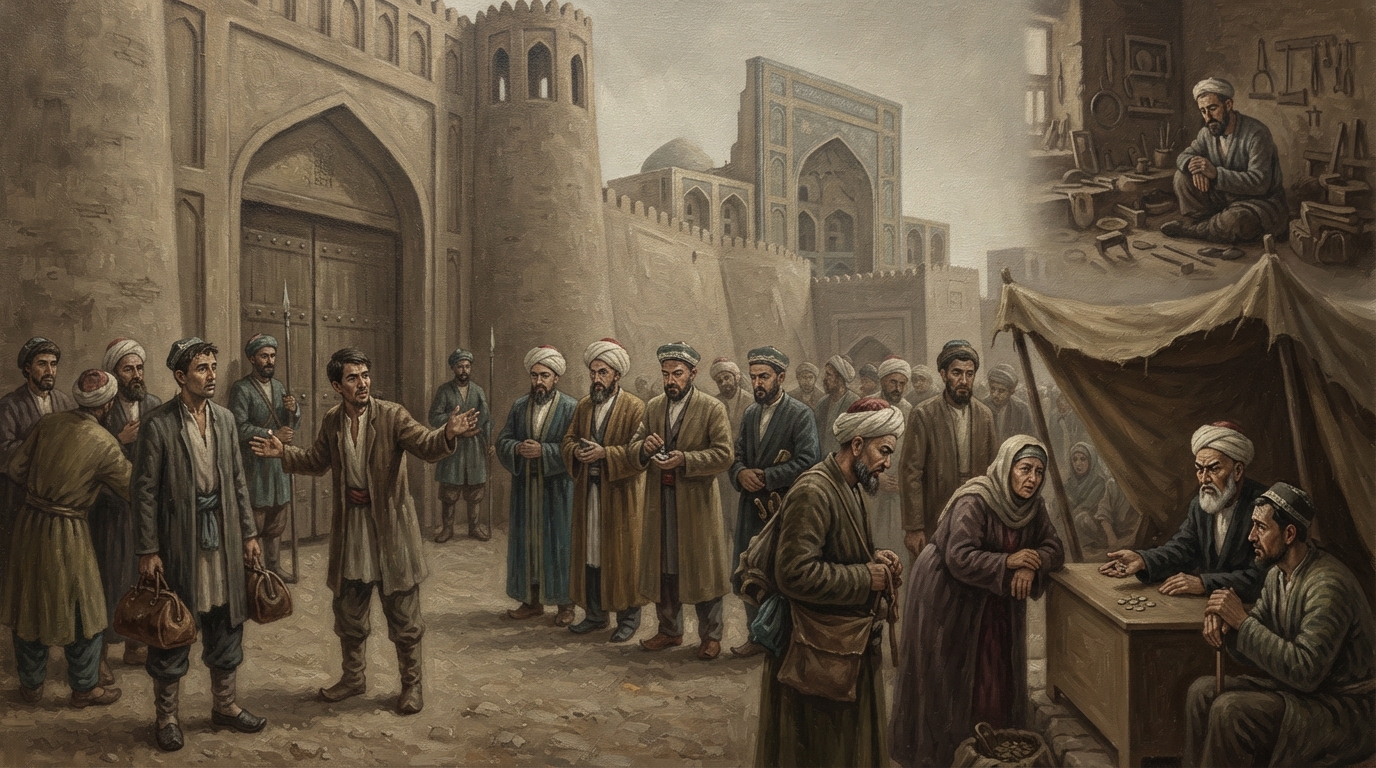
Before arriving in Bukhara, the traveler had heard much praise about the city. But as soon as he enters the city, many questions arise in his mind. Because night falls, he is left outside the gate. Interestingly, Muslims are not allowed inside, while Armenians and Jews are permitted. Even an Armenian's dog passes through the gate. When the traveler asks the reason for this situation, a young man answers with a single word: "Ignorance!"
The traveler divides the population of Bukhara into three categories: ulema (scholars), umara (rulers), and fuqara (citizens). The events of the work reveal the role, responsibility, and relationship of these three strata in society.
In Bukhara, which once gave scholars like Ibn Sina and Al-Farabi to the world, the value of science had fallen. Some religious officials, who had studied for twenty years and taught for another twenty, were ignorant of modern science.
Rulers and officials were busy fighting over titles, embezzling public property, and trampling on the rights of ordinary people. Meanwhile, the citizens lived struggling even to demand their rights between these two strata.
Now listen to the continuation of the story mentioned at the beginning of our narrative. The judge first decides to punish the woman's husband. Although the woman complained about her husband, she asks that he not be imprisoned.
The next day, the traveler inquires about the continuation of this event. As it turned out, two thousand tangas were given to the judge himself at night, and one and a half thousand tangas were given to his officials, the rais, and the governor's men. Only after that was the husband released. To raise this money, that poor family had sold their land.
In Qarshi, the traveler talks to an artisan. The master's work was good. But the traveler asks him what he is doing to ensure his craft is preserved after ten or twelve years.
The master had not thought about this. The traveler reminds him that at one time in Turkestan, everything from clothing to dishes was produced locally, but later cheap and attractive products from European factories took over the market, depriving local artisans of their livelihood.
The state of agriculture in Qarshi was not good either. Although the lands were fertile, they were not fully utilized due to the arbitrary tax collection by amlokdors (tax collectors), outdated methods, and a lack of modern knowledge.