

What happens under the skin when a mosquito bites? Scientists filmed the process
Researchers at Johns Hopkins University in the US have observed in detail the processes taking place on and under the skin surface when a malaria mosquito bites. Using high-speed video recording and sensitive micro-sensors, they identified five stages of the bite and showed that the sensory system plays an important role in locating a blood vessel.
What happens under the skin when a mosquito bites? Scientists filmed the process
Female mosquitoes need blood to lay eggs. While most previous research has focused on how insects find a person through smell or heat, the biting process itself has been relatively understudied.
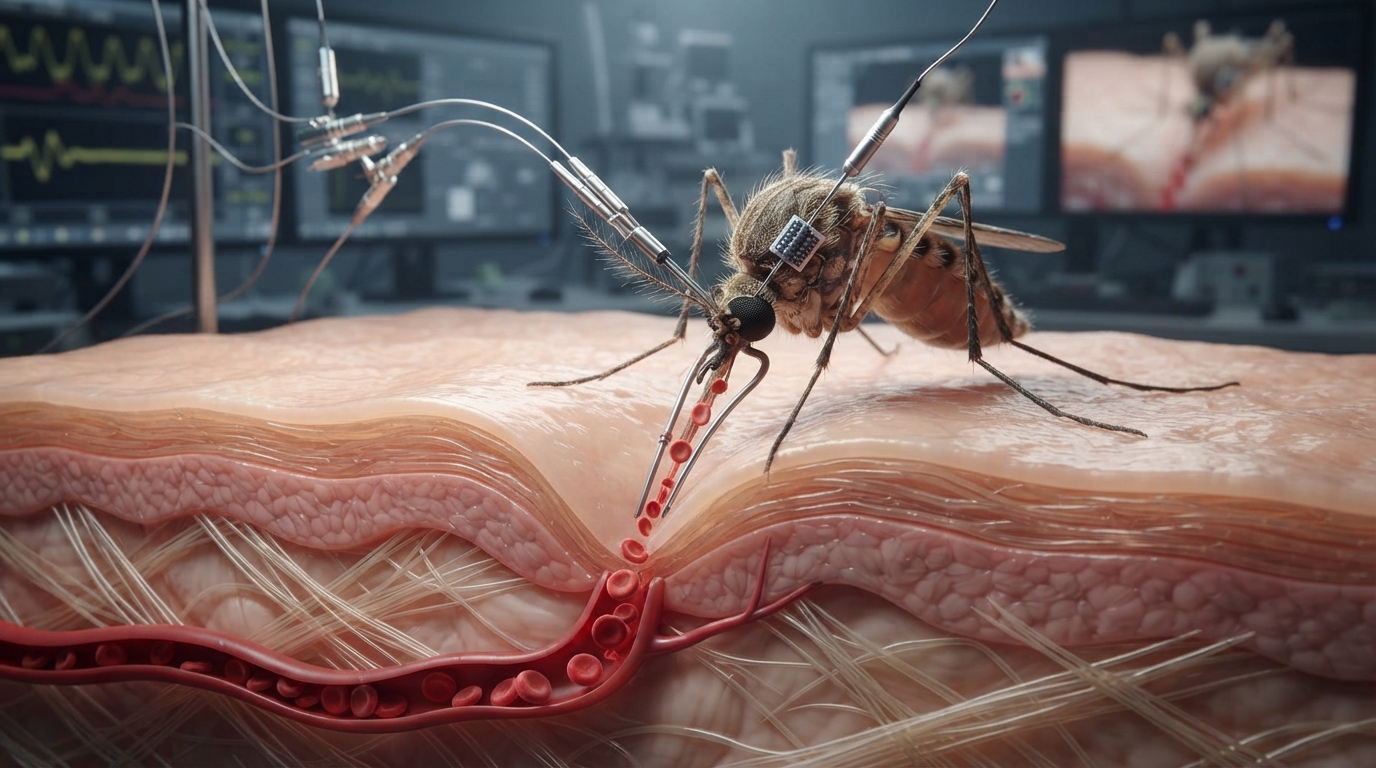
Scientists attached extremely thin electrical wires to the sensory organs of malaria mosquitoes belonging to the species Anopheles coluzzii. This method made it possible to record even the smallest changes in voltage in real time when the insect's proboscis penetrated beneath human skin. The electrical signals were compared with high-speed video footage.
As a result, the researchers identified five stages of the bite: penetrating the skin, searching for a blood vessel, sucking blood, withdrawing the proboscis, and completely completing the bite.
According to observations, while piercing the skin, the mosquito also employs its legs and sensory organs around its mouth. Once blood feeding begins, the insect remains completely still. The results of the study were published in the journal Science Advances.
Scientists also compared the behavior of the malaria mosquito with the Aedes aegypti species, which transmits dengue fever. It was found that the malaria mosquito finds a blood vessel under the skin an average of 17 seconds faster.
Despite this, the total duration of the bite in both species was almost the same — about two and a half minutes. Considering that their evolutionary paths diverged nearly 150 million years ago, the researchers hypothesized that these species may have arrived at an efficient feeding method independently of each other.
In separate experiments, the activity of the IR76b gene related to smell perception in mosquitoes was disabled. After that, the insects almost completely lost the ability to purposefully search for a blood vessel, and the likelihood of successful blood feeding dropped sharply.
According to the authors, understanding how a mosquito moves under the skin and how it uses its sensory organs could help create more effective means of protection against the infections it transmits in the future.