

The ice on Mars turned out to be much cleaner than expected
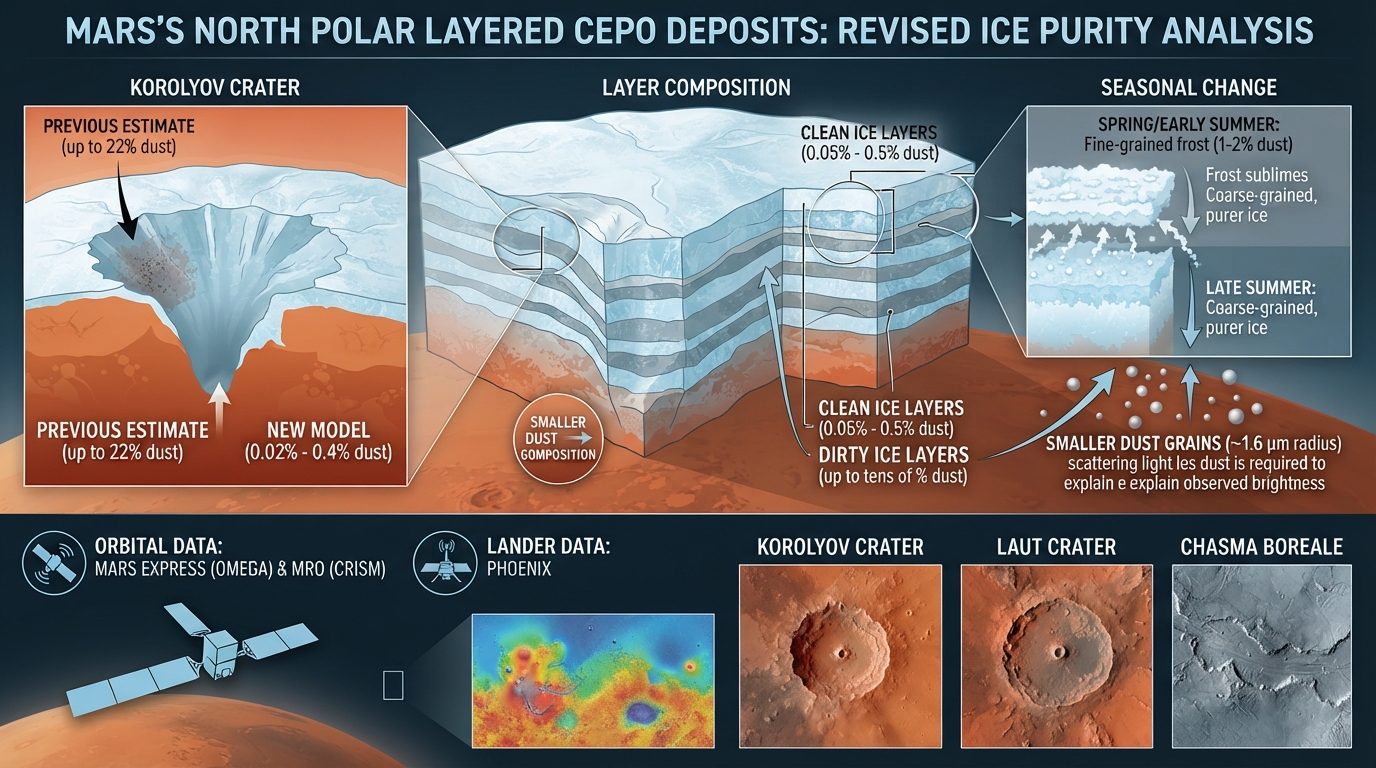
In the exposed water ice studied in the northern polar region of Mars, the dust content was found to be much lower than in previous estimates. In the new model, the highest estimate was approximately 2.2 percent. In previous studies, however, this figure reached up to 25 percent for some areas.
Ice on Mars found to be much cleaner than expected
Pari Mohan from the University of Edinburgh and Aditya Khuller from the University of Washington re-analyzed observations of Mars' northern polar region.
The scientists studied data on the Korolev and Louth craters, the Chasma Boreale canyon, and the landing site of the Phoenix spacecraft. For this, measurements from the OMEGA instrument on the Mars Express spacecraft, the CRISM instrument on the MRO orbiter, and the Phoenix lander were used.
For the analysis, a method was applied that models the scattering and absorption of light, taking into account the layered structure of the ice.
According to the results, the mass fraction of dust in the exposed water ice in the studied areas is generally less than 3 percent. The maximum estimate in the new model was approximately 2.2 percent.
The results for the Korolev crater, in particular, differed drastically. In previous calculations, the dust fraction in one of the areas there was estimated to be around 22 percent. The new model yielded a result of approximately 0.4 percent for the upper layer of this site, and 0.02 percent for the deeper, large-grained ice.
This discrepancy is not due to new images being taken, but rather to a different interpretation of existing observations. The light reflection of ice is simultaneously affected by the size of ice grains and dust particles, the amount of dust, and the arrangement of the layers.
In their calculations, the researchers assumed the radius of dust particles to be approximately 1.6 micrometers. This is consistent with observations made from Mars' orbit and surface. Since smaller dust particles have a stronger effect on the reflection of visible light, less dust was sufficient to explain the observed brightness.
The new results also fit better with radar data regarding the northern ice caps. Scientists suggest that relatively clean ice layers with a dust fraction of 0.05–0.5 percent may alternate with layers where the dust content reaches tens of percent.
The study also explains the seasonal brightening or darkening of the polar ice. In spring and early summer, the ice surface is covered by fine-grained frost containing about 1–2 percent dust. As the temperature rises, the frost evaporates directly without turning into a liquid state — it sublimates. As a result, the larger-grained and cleaner ice beneath it is exposed.