

It was filmed that a sting detached from a bee's body continues to inject venom
Researchers at Australia's Macquarie University have captured video footage of how a sting detached from a honeybee's body continues to inject venom. In observations, the sting continued to function for one to two minutes even after being completely severed from the body.
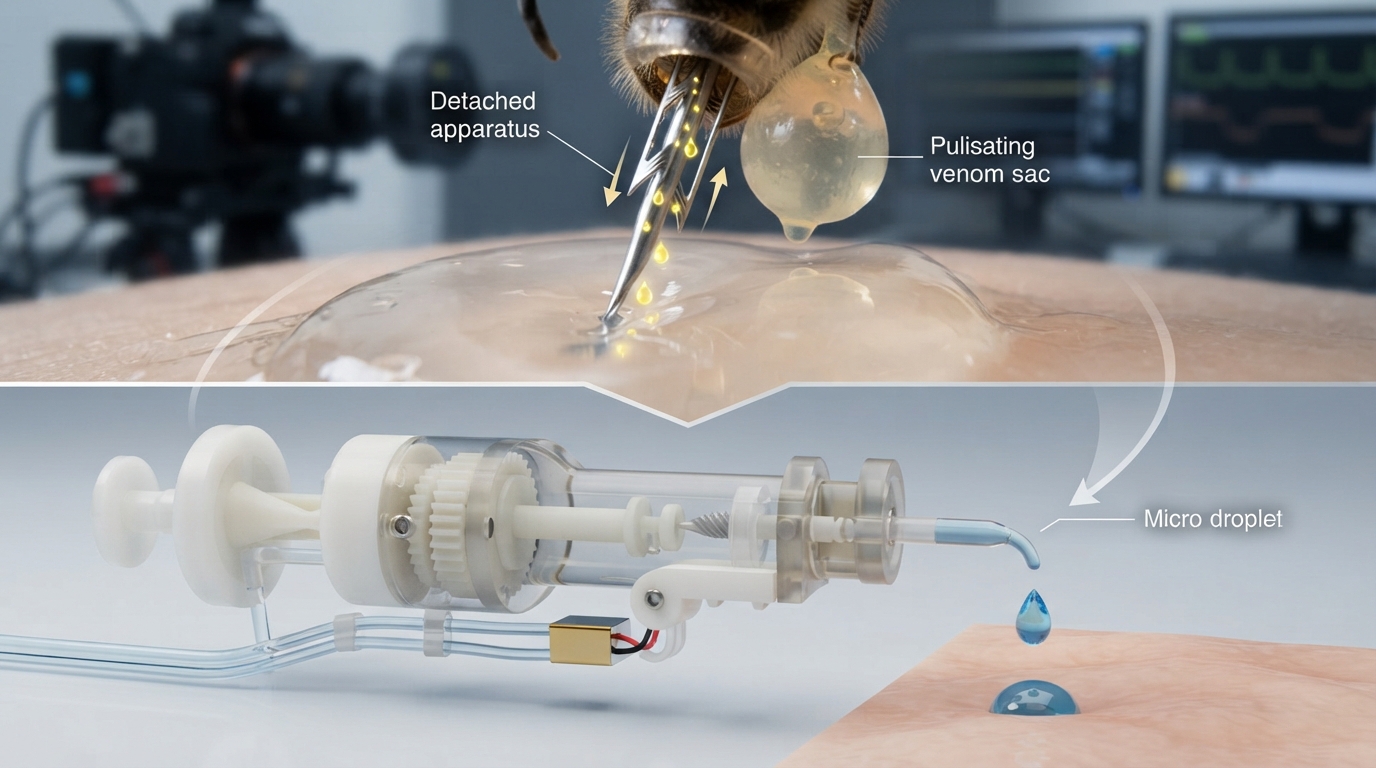
Sting detached from a bee's body captured on video continuing to inject venom
Scientists prompted bees to sting a transparent gel mimicking human skin to observe the internal working mechanism. High-frame-rate micro-imaging was used to observe the movement of tiny parts inside the sting.
The video and three-dimensional scanning revealed that two tiny, flexible valves move alternately inside the sting. As one valve slides down, it opens like a parachute, pushing the venom forward. When returning upward, it folds like an umbrella, passing by the second valve and clearing the way for a new portion of venom.
Thus, the mechanism works like a two-piston pump. The coordinated movement of the valves ensures a steady delivery of venom.
When a bee's sting remains in the skin, the venom sac and driving structures attached to it can also detach from the body. Although this inflicts fatal damage on the bee, the sting mechanism continues to function independently for a short time.
To test the mechanism, researchers also created a scaled-up, working 3D-printed replica of it. Rigid and flexible polymer materials were used for this purpose.
The authors note that this structure could help develop compact medical micropumps and devices for precise drug delivery into tissues in the future.