

The secret of the "Doomsday fish" has been revealed: inspired by it, scientists want to create a silent robot
Cornell University scientists have studied the unusual swimming mechanism of the oarfish, known as the "Doomsday fish." Now, based on this mechanism, engineers plan to create large and silent underwater robots that will monitor the state of the ocean without scaring marine creatures.
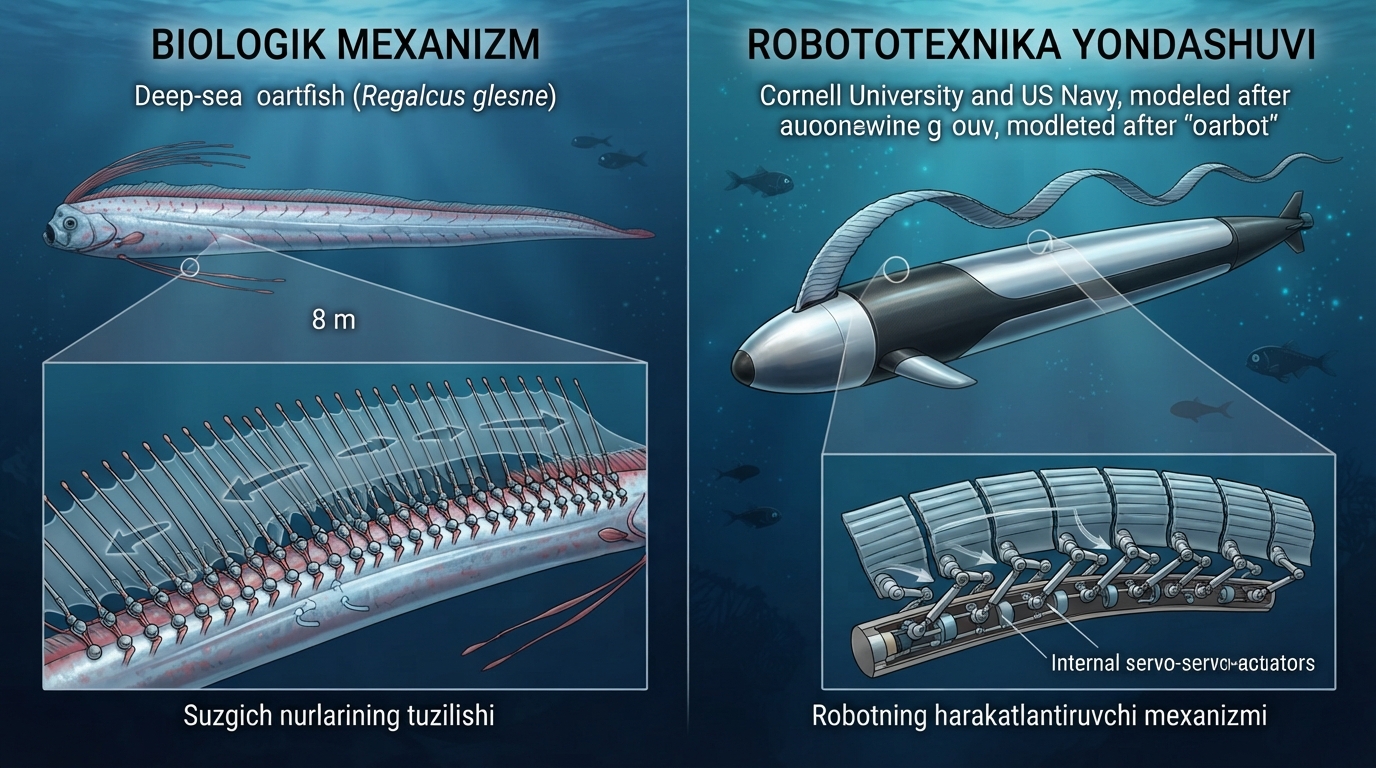
The secret of the "Doomsday fish" has been revealed: inspired by it, scientists want to create a silent robot
Rob Shepherd, a professor at the Cornell University School of Engineering, has been tasked with creating a large, stealthy underwater robot for ocean exploration. Developed by order of the US Office of Naval Research, this device must be able to move without startling marine animals.
For this, Shepherd chose an unusual model from nature — the deep-sea oarfish. This fish, whose ribbon-like body can reach a length of nearly eight meters, is also known as the "Doomsday fish."
### Swims with almost no body movement
Most long-bodied marine creatures move like eels, bending their entire bodies. The oarfish, however, keeps its body almost completely still.
The main organ that moves it forward or backward is its long fin running along its back. The continuous wave-like movements generated in this fin allow the fish to swim silently and precisely control its direction.
To determine how this mechanism works, Shepherd collaborated with Willy Bemis, a former ichthyologist at Cornell University.
Studying a complete and undamaged specimen of an oarfish is extremely difficult. This is because after the fish dies, its body usually breaks apart into fragile pieces. For this reason, the researchers used computer tomography, X-ray images from the Smithsonian Institution, and detailed anatomical examinations.
During the research, the scientists discovered a complex natural mechanism hidden beneath the fish's skin. Hundreds of bony support rays of the dorsal fin are connected to special ball-and-socket joints that act like tiny "joysticks."
Each ray is set in motion by an individual system of muscles and cartilage. This structure allows each part of the fin to turn in different directions.
The membrane connecting the rays can transmit waves of motion in opposite directions at the same time. As a result, the fish changes its speed and direction of movement almost instantly without bending its body.
According to the scientists, the method of swimming using a ribbon-like fin has emerged independently about ten times in bony fish during evolution. However, the presence of fin rays that turn like a "joystick" specifically in the oarfish was documented for the first time in this study.