

“We were attacked by a drone on my very first day entering the war.” A young man from Namangan recruited into the Russian army was sentenced to 2 years in prison
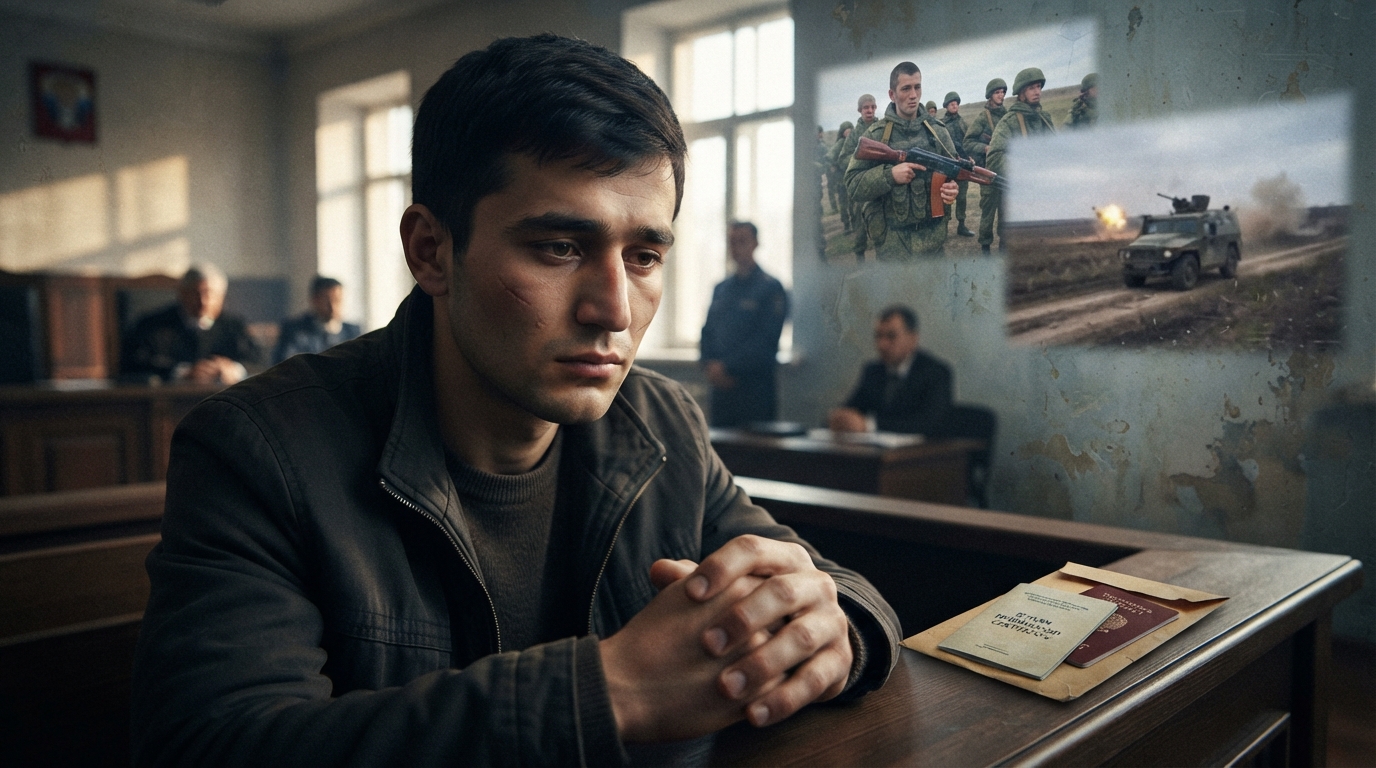
"We were attacked by a drone on my very first day entering the war." A young man from Namangan recruited into the Russian army was sentenced to 2 years in prison
A 25-year-old Uzbek citizen, who was sent to the war in Ukraine as part of the Russian army and was wounded by a drone attack during his very first combat mission, has been sentenced to two years of imprisonment.
It was revealed that F.A., a resident of the Namangan region, went to Russia in search of work in November 2021 and worked various jobs in the cities of Yekaterinburg and Penza.
On September 13, 2022, F.A. went to retrieve drugs left in a forest at the suggestion of an acquaintance named Ulugbek, where he was detained by Russian law enforcement agencies. A Penza court found him guilty of a crime related to illicit drug trafficking and sentenced him to 8 years and 6 months of imprisonment. After the verdict, he began serving his sentence in Correctional Colony No. 4, a maximum-security facility in the city of Penza. While he was serving his sentence, military personnel arrived at the institution and offered inmates money and Russian citizenship in exchange for participating in the war in Ukraine.
Initially, he did not agree to go to war. However, prison staff tortured and placed Uzbek, Tajik, and Kyrgyz inmates who rejected the offer into solitary confinement.
"Knowing the situation in the war, I did not agree to the contract at first. The prison staff told us that we would stay here for the rest of our lives and that no one would protect us. In the end, unable to withstand the torture and pressure, I was forced to sign the contract," F.A. testified.
F.A. signed a one-year contract with the Russian Ministry of Defense at the end of July 2025. It specified a one-time bonus of 1,900,000 rubles and a monthly salary of 210,000 rubles. In practice, 400,000 rubles were transferred to his bank card. He was also granted Russian citizenship and a passport.
After that, he and other inmates were taken to an airport whose location was kept secret, and from there, they were flown to an area near the Sea of Azov. He was given military uniform, a Kalashnikov assault rifle, and underwent training on using combat weapons and defending against drones. After completing the training, he was accepted as a grenade launcher operator into Military Unit No. 336 of the Russian Marines and sent to an area called Malinovka.
While F.A. and seven other servicemen were traveling to the combat zone in a "Buggy" vehicle, a Ukrainian drone struck their car.
"It was my first day entering the war. A drone hit our car, and a very powerful explosion occurred. I didn't understand what happened. Then I felt a sharp pain in my stomach and right thigh; blood was flowing from my wounds. After that, I lost consciousness. When I came to, I was lying in a military hospital," F.A. says.
In Rostov, a piece of metal was removed from his stomach through surgery, while a small piece of metal in his thigh was left in his body. After twenty days of treatment, he was sent to a military unit in Kaliningrad, but because he was unfit for combat, he was kept at the military unit until February 2026.
On February 7, a sergeant major named Kolya told him that they might take him back to the combat zone in the coming days. After that, he decided to leave the military unit. On February 8, he left the military unit, went to Kaliningrad airport, and purchased a ticket to Moscow using his Russian passport. Upon reaching the capital, he approached the Uzbek Embassy, claimed he had lost his passport, and asked for assistance.
After embassy staff issued him a certificate of return to his homeland, F.A. returned to Uzbekistan on a Moscow–Tashkent flight.
During the investigation, photos from his time serving in the Russian army, his Russian passport, and an image of an honorary certificate issued in the Kaliningrad region were found on his phone.
In court, he fully pleaded guilty, stating that he resorted to this out of desperation and expressed remorse for his actions.
The Pop District Criminal Court found F.A. guilty under Part 1 of Article 154 of the Criminal Code (Mercenarism) and sentenced him to two years of imprisonment.
The defendant was sentenced to three years of correctional labor, with 20 percent of his salary to be withheld for state revenue.