

"The military training was hard, those who couldn't handle it shot themselves." Uzbek who participated in the Russian-Ukrainian war sentenced to 3 years in prison
A citizen who went to work in Russia was arrested on suspicion of hooliganism and signed a contract with the Russian armed forces in prison. He fought in Ukraine and received 2 medals. Then he went on vacation and returned to Uzbekistan. The court sentenced him to 3 years in prison.
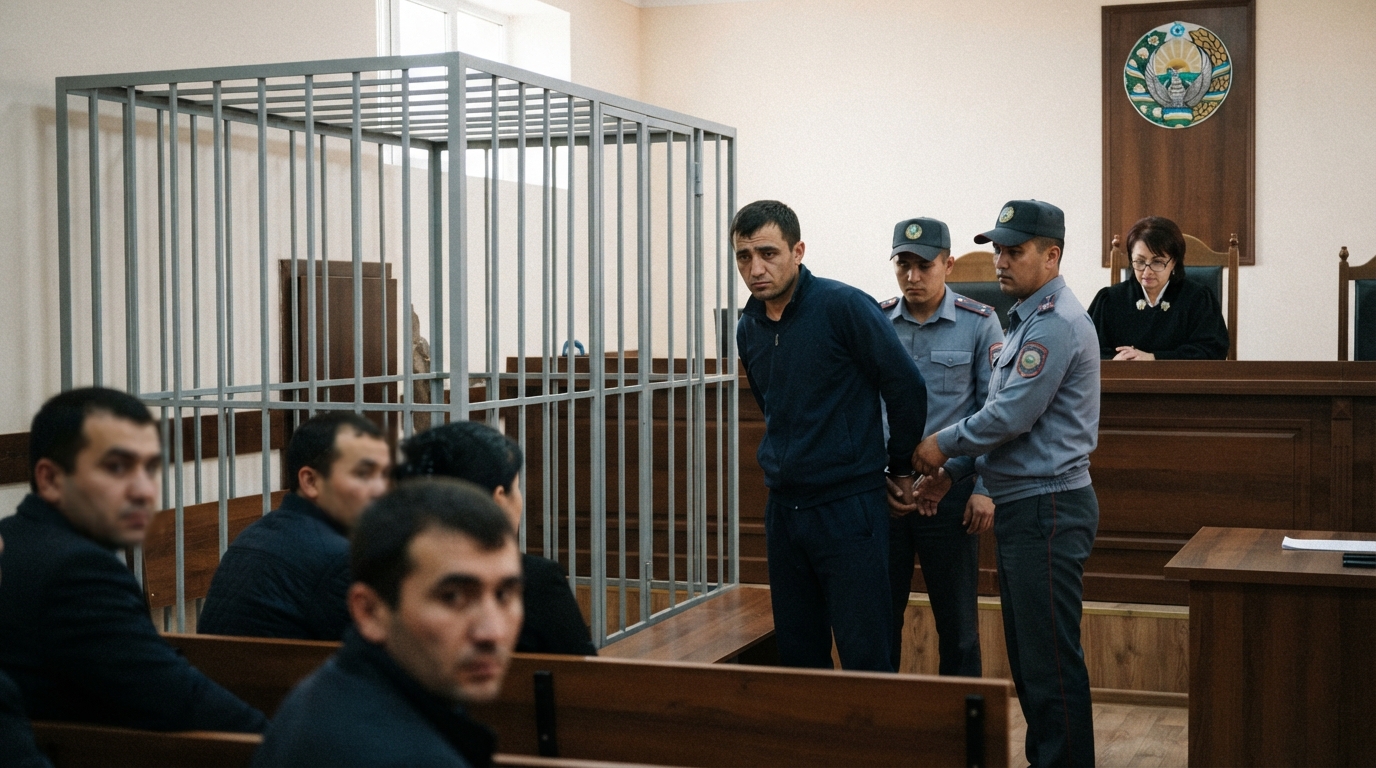
“The military training was so severe that those who could not stand it committed suicide.” Uzbek citizen who participated in the Russian-Ukrainian war sentenced to 3 years in prison.
On August 7, the Yangiarik District Criminal Court of the Khorezm Region considered a criminal case against Z.Yu., an Uzbek citizen who fought on the side of Russia in the Russian-Ukrainian war.
According to court documents, Z.Yu. was arrested by law enforcement agencies in May 2025 for previous hooliganism-related offenses while working seasonally in Ufa, the Republic of Bashkortostan, Russian Federation.
After that, he planned to enlist in the Russian Armed Forces on a contractual basis and participate in the Russian-Ukrainian war, in order to avoid criminal liability, as well as to obtain material and other benefits.
The document states that in July 2025, Z.Yu. signed a contract for military service with a military unit under the Russian Ministry of Defense in the city of Ufa and was recruited into the Russian Armed Forces. He was provided with a combat rifle, ammunition and protective equipment to participate in a “special military operation” conducted by the Russian Ministry of Defense in Ukraine.
Then Z.Yu. went to the city of Mariupol in the Donetsk region of Ukraine. There, he underwent military and combat training under the guidance of instructors. In particular, he was taught skills such as the use of a combat rifle, grenades, grenade launchers, pistols and other weapons, live fire, grenade throwing, and first aid.
From August 2025 to January 2026, he participated in the Russian-Ukrainian war as part of a military unit under the Russian Ministry of Defense.
The defendant Z.Yu. pleaded guilty in court. His testimony states that in November 2024 he went to work in Ufa, in the Republic of Bashkortostan, Russia, and worked in construction.
According to Z.Yu., on May 30, 2025, he was stopped by Russian police while driving a passenger car to work in Kazan after a dispute with Uzbek workers. When his documents were checked, it was found that he had committed a minor hooligan offense in 2014 and was taken to a police station.
“They kept him in a cell for three weeks, then they took him to a military unit”
According to his testimony, after an interview with officers at the police station, he was taken to a building resembling a military unit in an area called Cheryomushka. There, Z.Yu. was kept in a cell for three weeks. Then he and other detainees were medically examined.
They were then taken to the railway station and sent by train to Rostov, and from there by another train to Sevastopol. Z.Yu. said that they arrived at the military unit in Sevastopol on June 23, 2025.
Z.Yu. testified in court that before entering the military unit, they were given red binders. When they entered, they were photographed with these binders and then the binders were taken back.
According to the defendant, they did not open the binders or read the documents inside. They were then placed in the military unit's dormitory.
He said that there were about 800 soldiers in the unit. Early in the morning, they were given military uniforms of the Russian Armed Forces - helmets and bulletproof vests, as well as an AK-12 assault rifle and four magazines with 30 rounds each.
“Those who could not stand the military training because it was difficult shot themselves,”
Z.Yu. said, and then they were taken to a training ground for military training.
“There, we underwent military training and combat training for 18 hours a day. Those who could not stand the military training because it was difficult shot themselves,” the defendant said.
After about three weeks, they were divided into brigades. According to Z.Yu., 76 people who had not taken the oath and had not received military tickets were included in brigade No. 336 and sent to a training ground in the city of Mariupol.
They arrived in Mariupol on July 23, 2025. The defendant said that there they were given back their mobile phones, but they could not use them normally and they were only connected to the Internet via Starlink. Z.Yu. corresponded with his mother and sister via Telegram. However, he did not tell them that he was participating in the war.
“I participated in battles and received the medals “For Assault” and “For Intelligence””
According to the defendant, they underwent two weeks of military training in Mariupol. Then they were placed in the basements of houses near the village of Maliyevka.
There were 20 soldiers there for two weeks. According to Z.Yu., they were armed with an AK-74 assault rifle, 16 fully loaded magazines, helmets and body armor.
According to the defendant's testimony, after another brigade captured Maliyevka, they were ordered to turn back.
On their way back, they also brought their wounded commander, nicknamed “Lefty,” to the training ground. A celebration was held on the occasion of the capture of Maliyevka, and Z.Yu. was awarded the medal “For Assault” and its certificate.
He said that his commander awarded him and that he was stationed in the village of Zeleny Gay in order to survive sent to the 1st company of the 155th brigade.
Z.Yu. said that in the 155th brigade he learned to fly a drone for two weeks. Then he was sent to the battles for the town of Sofiyevka. There, lying in a trench, he controlled the Mavik 3T drone at night.
According to the defendant, one of his tasks was to warn about the approach of an enemy drone. He also said that he shot down one of the enemy's attacking FPV drones with an AK-74 assault rifle when he came out of the trench during the day.
Z.Yu. said that they were also involved in bringing back dead and wounded soldiers. About a month and a half later, they were returned to the brigade in the village of Zeleny Gay.
Z.Yu. told the court that on their way back to the brigade, he and seven other soldiers shot down a drone called "Baba Yaga". After that, he He was awarded the medal “For Intelligence”.
According to the defendant, he received a monthly salary of 200 thousand rubles. He said that 100 thousand rubles of this money was taken by his commanders, another 50 thousand rubles were spent on supplies, gasoline and other things.
“I was given two weeks of vacation and permission to leave Russia”
Z.Yu. said that the commander nicknamed “Molodoy” gave him two weeks of vacation and four days of travel from January 5 to January 24, 2026.
He was given a certificate stating that he would be given 1.5 million rubles, as well as a hectare of land in the city of Ufa. In addition, he was given certificates for obtaining Russian citizenship. According to the defendant, he had to apply to the military commissariat in Ufa to receive these documents.
On January 3, 2026, he was given a certificate from the commander nicknamed “Avreol” went to Sochi by helicopter with his deputy and seven other soldiers. He had his passport for going abroad with him.
After that, Z.Yu. took a plane ticket from Sochi to Ufa. Upon arriving in Ufa, he contacted young men from Khorezm who were engaged in smuggling.
With their help, he legally crossed from Russia to Kazakhstan in a passenger car and then legally returned to his home in Uzbekistan.
“I told the preventive inspector myself that I participated in the war in Ukraine”
Z.Yu. said that in early February 2026, he had an argument with his brother about the car. After his brother called the Internal Affairs Department, he spoke to the preventive inspector on the phone.
“Then I told the preventive inspector that I participated in the war in Ukraine,” Z.Yu. said.
The next day, the preventive inspector called him to his office. The defendant said that there the inspector asked him about his condition and Z.Yu. told him all the events that happened to him.
In court, Z.Yu. stated that he understood that what he had just done was a crime. He sincerely regretted his actions and asked to take into account his family and financial situation, to forgive him and to mitigate his punishment.
The court found Z.Yu. guilty of committing a crime provided for in Part 1 of Article 154 (Recruitment) of the Criminal Code of the Republic of Uzbekistan. He was sentenced to 3 years of imprisonment under Article 57 (Lesser Punishment) of the Criminal Code. The sentence was to be served in a general regime colony.
When determining the sentence, the court considered Z.Yu.'s full confession, sincere remorse for his actions, family and financial situation, singleness, lack of previous convictions, and the reasons for the crime as mitigating circumstances evaluated.
At the same time, the court canceled the preventive measure of “good behavior certificate” applied to Z.Yu. and issued a decision to immediately arrest him from the courtroom.
Z.Yu. was acquitted under Article 223 (Illegal departure abroad or entry into the Republic of Uzbekistan) Part 2, Subparagraphs “b, v” of the Criminal Code. The court concluded that his actions under this charge did not constitute a crime.