

"They kept me in solitary confinement for 9 months and beat me every day." 19-year-old who fought in Ukraine has his freedom restricted for 4 years
A 19-year-old Uzbek man imprisoned in Russia for drug-related crimes says he was pressured into prison and promised freedom, money and citizenship in exchange for participating in the war. He signed a contract, fought in Ukraine and was wounded. The court sentenced him to four years of restricted liberty.
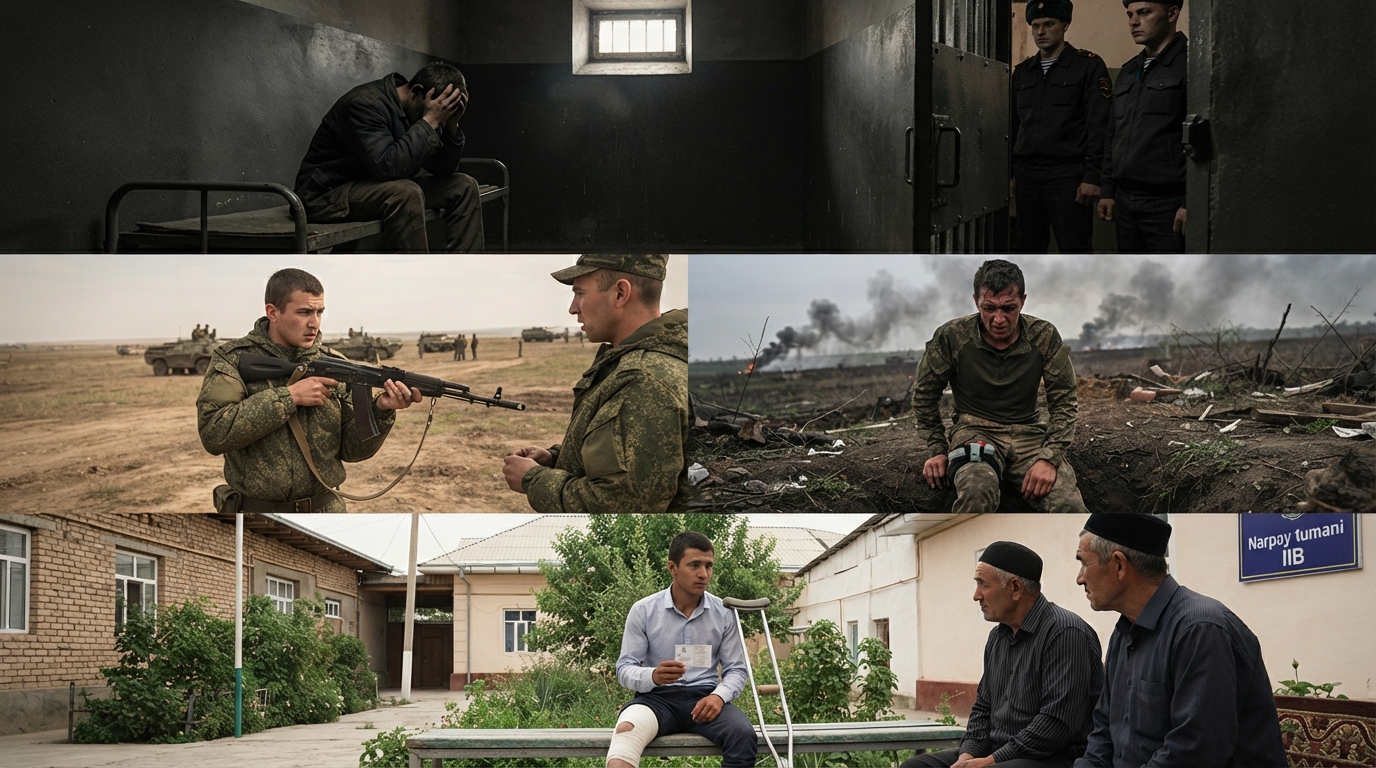
"They put him in solitary confinement and beat him every day for 9 months." The freedom of a 19-year-old who fought in Ukraine was limited to 4 years.
On August 3, the Narpay District Criminal Court of the Samarkand Region considered the case of a 19-year-old citizen who fought on the side of Russia in the Russian-Ukrainian war. Gazeta has reviewed the court document.
The defendant went to Vladivostok, Russia, in the fall of 2024 in search of work. There, he was imprisoned for a crime related to illegal drug trafficking and served his sentence in a Vladivostok penitentiary.
While serving his sentence, he signed a contract with the Russian Ministry of Defense on September 18, 2025, seeking early release, protection from legal action, obtaining Russian citizenship, and other personal benefits.
According to court documents, he underwent training in first aid, grenade throwing, rifle shooting, and physical training at military training grounds in the city of Rostov and the Donetsk region. He was also involved in the construction of military fortifications - bunkers.
In January 2026, the defendant participated in the fighting against Ukraine, as noted in the document, in the Gulyaypole region of the Ukrainian state. During the fighting, he was injured in his right leg and other parts of his body as a result of an FPV drone explosion.
The defendant fully confessed to his guilt at the court hearing. According to his testimony, in the fall of 2024, he went to Vladivostok to work and earn money. There, he worked in construction work with his uncle for 4-5 months.
He said that on January 1, 2025, while going from his uncle's house to a rented apartment, a taxi was stopped by police officers. Due to the lack of documents, a personal search was conducted and a black cellophane bag containing narcotics was found in his jacket pocket.
The defendant stated that the substance did not belong to him and that this was the first time he had seen it. Later, it was discovered that the bag contained heroin. He stated that he had not confessed to the charges during the initial investigation.
**"I was kept in prison for nine months and beaten every day"**
According to the defendant's testimony, the criminal trial against him in Russia lasted nine months. He said that during this period he was held in solitary confinement every day, tortured and beaten without food or water.
He also stated that while he was in prison, other defendants there regularly put pressure on him. They said that if he agreed to participate in the Russian armed forces in the war between Russia and Ukraine, he could be given a large sum of money, receive Russian citizenship and be exempt from punishment.
The defendant denied the charges against him for nine months. According to him, he was finally forced to confess to the charges after he could not bear the torture.
After that, according to his testimony, officials from the Russian Ministry of Defense offered him conditional release from prison on the condition that he participate in military operations against Ukraine.
**"They promised him 2.5 million rubles for a one-year contract"**
According to his testimony, on September 18, 2025, officials from the Russian Ministry of Defense told him that if he participated in military operations against Ukraine, he could be conditionally released from prison, receive 2.5 million rubles for a one-year military contract, be provided with housing, and receive Russian citizenship.
The defendant agreed to this offer and signed the contract on the same day. On September 19, he was taken to a military unit in Ussuriysk, near Vladivostok.
There were servicemen of various nationalities there. The defendant said that among them were some who had lost their arms and legs. About 8-10 days later, on September 25, he was taken to a military airport along with 300 other people. After that, they were sent to a military training ground in the city of Rostov-on-Don.
The defendant said that he had undergone three weeks of basic military training at a training ground near Rostov-on-Don. There, he was given practical training in machine gun shooting, grenade throwing, trench digging, first aid, and military communications.
Later, he and 48 of his comrades were taken to military training grounds near the towns and villages of Starodubovka and Suzhenka in the Donetsk region. There, they also underwent three weeks of military training. According to the defendant's testimony, they were given their first military assignment in late November - early December 2025.
**"I was wounded in a drone attack, most of my comrades died"**
The defendant said that he was attacked by drones as he approached the city of Gulyaipole in the Zaporozhye region. He was injured in his right leg and other parts of his body and lost consciousness.
"When I regained consciousness, I and another Russian comrade were alive, all the other comrades had died," he said.
He administered first aid to himself, stopped the bleeding from his leg, and turned back. Due to the severity of his injuries, he was first taken to the hospital, then to the military hospital in Mariupol. He was treated there for 20 days.
**"I met girls on the Internet, they helped me return to Russia"**
The defendant said that after the hospital, he was sent back to the military training ground. However, he escaped from the Gulyaypole area in the Zaporozhye region, crossed over to Berdyansk, and lived in an abandoned house for about 2-3 weeks.
He met Russian girls on the Internet and told them about his experiences. The girls took him to Donetsk and, through their acquaintances, arranged for him to cross into Russian territory.
After that, the defendant took a taxi to Rostov and applied to the Uzbek embassy. There, he said that he had fled the war and did not have a passport.
On April 17, 2026, he was issued a certificate of return to Uzbekistan. On April 18, he left for Uzbekistan by taxi and arrived in Samarkand via Tashkent at 1:30 p.m. on April 21.
The defendant expressed remorse for his actions and requested legal leniency, taking into account his personality.
The court assessed the defendant's confession and sincere remorse for his actions as mitigating circumstances. It was noted that there were no aggravating circumstances.
The defendant was found guilty under Part 1 of Article 154 (Recruitment) of the Criminal Code. Article 57 (Imposition of a more lenient sentence) of the Criminal Code was applied to him and he was sentenced to restriction of liberty for a period of 4 years.
According to the court decision, the defendant will serve his sentence in a residential apartment in the Birlik mahalla of Narpay district. He was prohibited from leaving his place of residence except for the time necessary to go to work and return home.
He was also ordered not to change his place of residence without the permission of the Narpay district Internal Affairs Department and not to leave the territory of the Samarkand region. The Narpay District Department of Internal Affairs was entrusted with monitoring his behavior.