

"I wanted to return to my homeland without blood on my hands." 20-year-old Surkhandarya resident who participated in the Russian-Ukrainian war has his freedom restricted to 4.5 years
A 20-year-old man from Surkhandarya went to Russia to work. After being arrested on suspicion of drug trafficking, he signed a contract with the Russian army and was sent to the war in Ukraine. He said that he delivered food to the military and tried to escape twice. The court sentenced him to 4.5 years of restricted freedom.
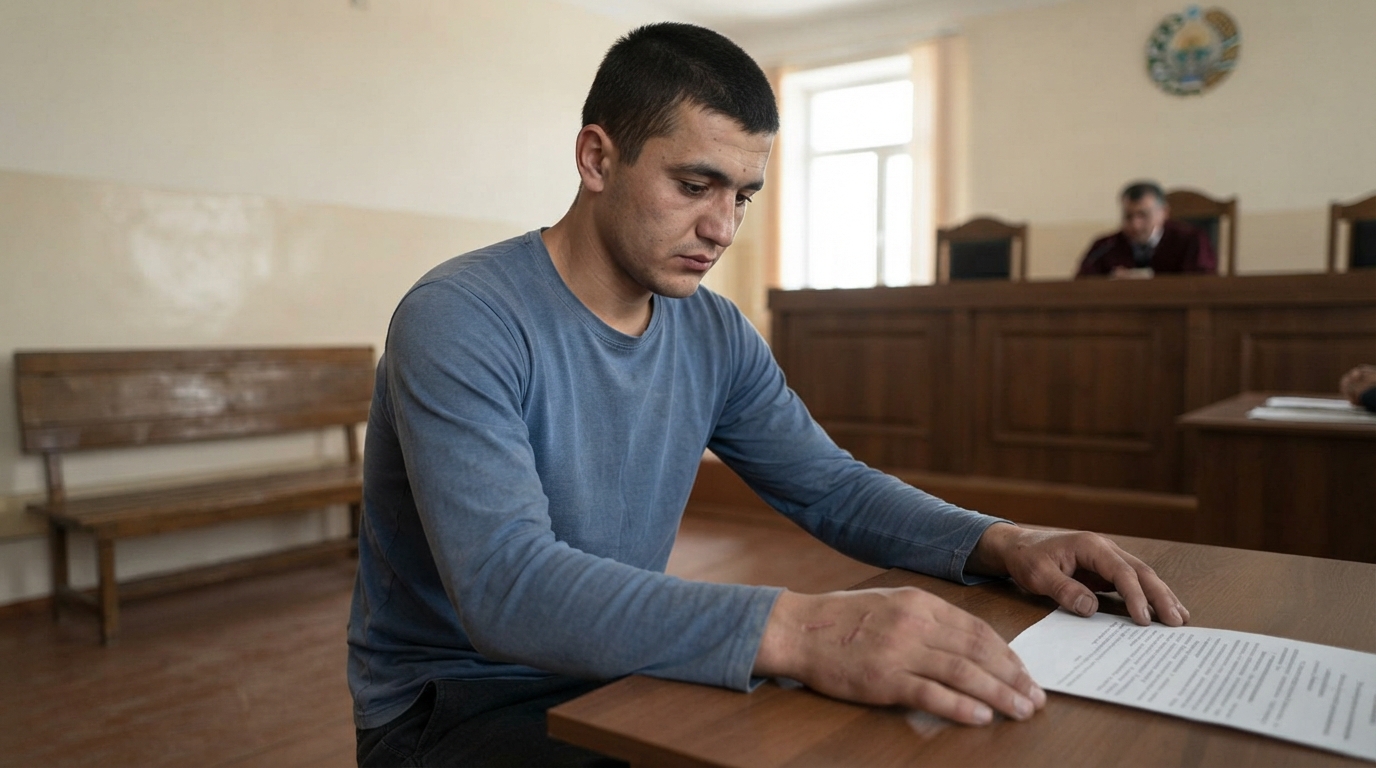
“I wanted to return to my homeland without getting my hands dirty with blood.” The 20-year-old Surkhandarya resident who participated in the Russian-Ukrainian war has had his freedom restricted for 4.5 years.
On July 22, the Muzrabot District Criminal Court of Surkhandarya Region considered the criminal case of a 20-year-old citizen named A.B., who fought on the side of Russia in the Russian-Ukrainian war. Gazeta reported this after reviewing the court document.
According to the court, A.B. traveled to Russia in November 2024, signed a contract with the Russian Armed Forces in November 2025, and was drafted into military service to participate in the fighting in Ukraine. He underwent military training at a training ground in the Donetsk region, and then was sent to fight against Ukrainian soldiers. The court document states that A.B. did not participate directly in the fighting, but was engaged in delivering food to his comrades.
In March 2026, he voluntarily fled the Russian Armed Forces, applied to the Uzbek Embassy in Moscow and received a "Certificate of Return to the Homeland". He returned to Uzbekistan on March 28. Later, when his phone was examined, photos and videos were found in which he was in Russian military uniform and holding an AK-74 assault rifle.
A.B. fully confessed to his guilt in court, saying that he had gone to Russia in November 2024 to earn money. He said that he worked as a courier at the "Union Food" food base in the Moscow region, and then at "Yandex goo".
“I ordered sushi in early October 2025. When I arrived at the address, the Russian police came and asked for my documents. I showed them my identity documents. They asked me to open the bag with the order. I said that orders cannot be opened. The police officers said that they could and opened the bag themselves,” he said.
A.B. said that the police found sushi in the bag and a black bag with an unknown white powdery substance with a pungent odor. After that, he was detained and suspected of drug trafficking.
“I was investigated and charged with drug trafficking under Part 4 of Article 228 of the Russian Criminal Code, and was kept in a pre-trial detention center in Moscow until November 2025,” the defendant said.
“They incited me to participate in the war in Ukraine and used violence”
A.B. stated that while in pre-trial detention, the guards of the institution encouraged him to participate in the Russian-Ukrainian war, and for this he was subjected to mental and physical pressure.
“While in pre-trial detention, the guards of the institution constantly encouraged me to participate in the Russian-Ukrainian war, and subjected me to mental and physical violence. After that, on November 27, 2025, I was forced to conclude a contract with the Armed Forces of the Russian Federation,” he said.
According to the defendant’s testimony, on December 2, he was taken to a base in the city of Rostov along with 50 other prisoners. There, documents were drawn up and he was given a token.
“We underwent military training for about a month”
A.B. later said that they were taken to the Gornoye district of the city of Shakhtyorsk in the Donetsk region under Russian control. There, military training was conducted for about a month.
“During military training, they taught me how to walk in the trenches, shoot, and dodge drones. After the military training was over, I was given an AK-74 rifle, uniforms, and bulletproof vests,” the defendant said.
He said that on February 10, 2026, they were taken to the front line.
“I wanted to return to my homeland without getting blood on my hands”
A.B. said that he and his comrades delivered food and necessary supplies to the soldiers on the front line. He said that after he got there, he planned to leave the area and avoid direct participation in the fighting.
“When I got to the front line, I planned to leave here as soon as possible. I wanted to return to my homeland without getting blood on my hands, and I tried to escape from this area twice,” A.B. said.
According to the defendant's testimony, he was caught during his first escape attempt and held in custody for 10 days. He said that during this time he was deprived of food for four days and subjected to mental and physical torture.
"After 10 days, they took him to a nearby school and locked him in a cold room. At that time, we met people from Tajikistan named Aryol and Zakhar and started looking for a way to escape from there," the defendant said.
"We made a rope and escaped from the second floor of the school"
A.B. stated that he had agreed with Aryol and Zakhar on March 1 and escaped from the school building: "We made a makeshift rope from the second floor of this school building and, having escaped without a vehicle, hid in the destroyed houses around here. We reached the city of Rostov in two and a half days through secret routes."
He said that then, through his father, S.Kh., who was from the Muzrabat district, contacted and took a taxi he found to Moscow.
“I threw away my military uniform and documents”
A.B. said that upon arriving in Moscow, he threw away his military uniform, military ID, and Russian-issued identity document.
After that, he rented a flat in one of the apartment buildings in Moscow and applied to the Uzbek embassy. A.B. said that on March 23, he received a certificate of return to his homeland, and on March 28, he returned to Uzbekistan.
The defendant asked the court to grant him leniency, taking into account his remorse for his actions and family circumstances.
The court found A.B. guilty of committing crimes provided for in Part 1 of Article 154 (Recruitment) and Part 2 of Article 154-1 (Recruitment to the military service, security, police, military justice bodies or other similar bodies of foreign states).
When determining the sentence, the court took into account A.B.'s sincere remorse for his actions, his youth, no previous convictions, the fact that he was the only breadwinner in the family, his family circumstances, the fact that he had received a minor injury that caused a health problem and the need for treatment as mitigating circumstances. It was also noted that there were no aggravating circumstances.
A.B. was sentenced to 4 years of restriction of liberty under Part 1 of Article 154 of the Criminal Code and 3 years of restriction of liberty under Part 2 of Article 154-1 of the Criminal Code. By partially adding the sentences, a sentence of 4 years and 6 months of continuous restriction of liberty was imposed.
A.B. will serve his sentence at his place of residence in Muzrabat district. He was restricted from leaving his place of residence except for the time necessary to go to work or study and return to his home.
He was also ordered not to change his place of residence and not to leave the territory of Surkhandarya region without the consent of the supervisory body.