

"I didn't understand what I was signing." A native of Khorezm was given a four-year prison sentence for mercenarism.
A native of the Khorezm region who had left for Russia to earn money was detained due to document problems. He said he signed a contract with the Russian Ministry of Defense under threat of deportation, but was later able to return home. Taking into account his previous conviction, the court sentenced him to four years of restricted freedom.
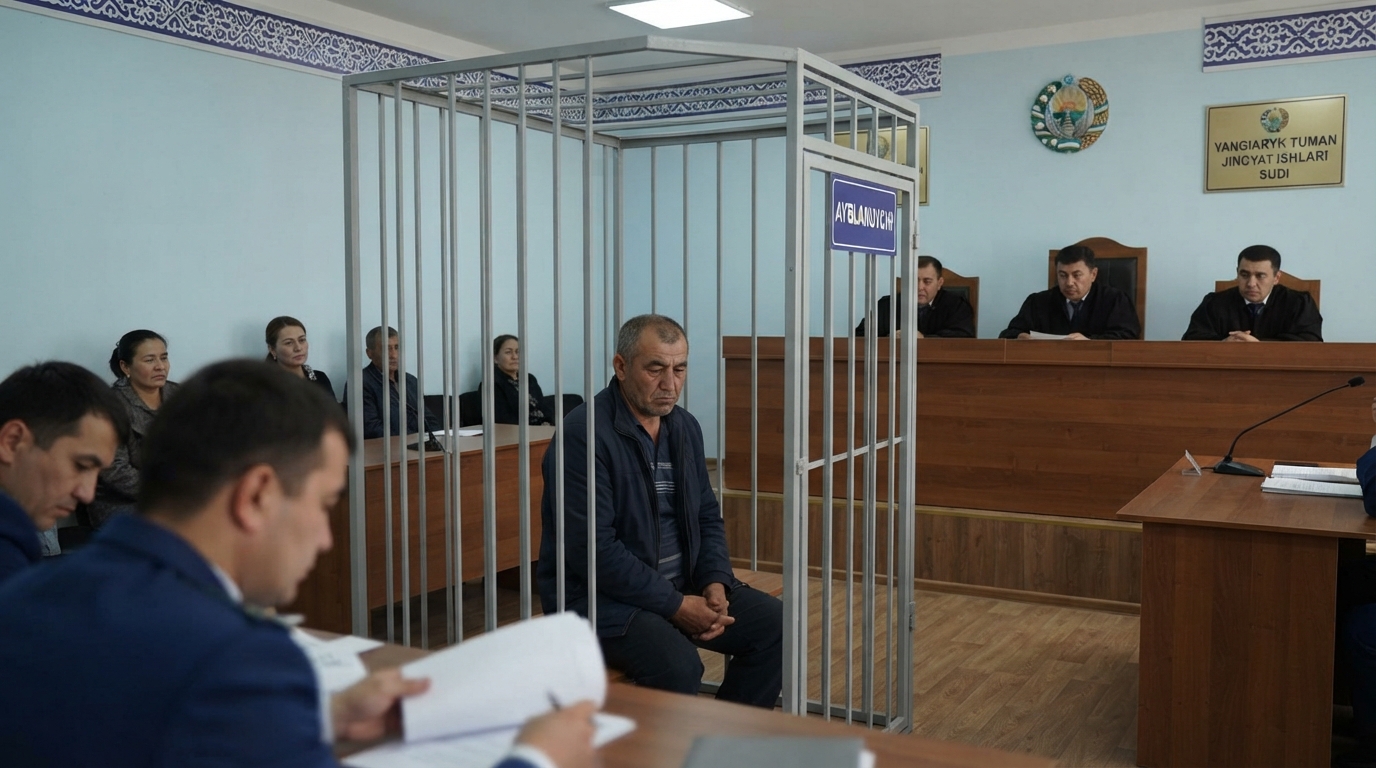
"I didn't understand what I was signing." A Khorezm native was sentenced to four years of restricted freedom for mercenarism.
The Yangiarik District Criminal Court of the Khorezm Region heard the case of citizen D. Ya., who signed a contract with the Russian Armed Forces to fight in the war with Ukraine. Gazeta has reviewed the verdict.
The document states that the defendant was detained by law enforcement agencies for violating the rules of temporary residence in Russia.
He was offered contract military service in the Russian Armed Forces. D. Ya. accepted and reported to a military unit in Simferopol in June 2025.
During a medical examination, he was diagnosed with several illnesses, leading to his return to the military recruitment center in Tver for further examination and treatment.
According to the court's findings, D. Ya. never took part in military action.
In court, D. Ya. pleaded not guilty. He stated that he first left for Russia with his family in 2007 and worked in seasonal construction until 2011. He then returned to Uzbekistan and sold clothing at a market in Khiva.
In the summer of 2023, a fire at the market destroyed all his merchandise, leaving him $45,000 in debt.
To pay off his debts, he returned to Russia in January 2024. He first worked in Moscow, then at a construction site in Tver.
According to him, he was unable to obtain temporary residency documents and was later detained by the police. While in custody, he was approached by a man who introduced himself as a member of the Uzbek diaspora in Russia but did not give his name.
Under threat of deportation, he gave him several documents to sign.
"Since I don't speak Russian, I believed him and signed the papers he gave me," the defendant stated.
He emphasized that he remained in custody after this.
In early June 2025, he and several other detainees were taken to the train station in a paddy wagon. They then traveled two days by train to their destination.
When the soldiers were taken to the military unit, they began a medical examination.
“During the medical examination, a woman asked me, ‘Are you Uzbek?’ I answered, ‘Yes.’ Then she asked, ‘Have you come to fight?’ I said I didn’t know how I ended up here and that I wasn’t planning to fight,” he said.
According to the defendant, the woman returned two hours later.
The man reported that she returned his phone and asked him to photograph all the documents in his personal file with it.
“Then she gave me 1,000 rubles and told me to spend it on food and travel expenses. "She also explained that after leaving the military unit, I should call the Uzbek Embassy in Russia," D. Ya. said.
According to him, after leaving the military unit, he called the Uzbek Embassy. Embassy staff asked him to send copies of his documents via Telegram.
"After I sent the documents, they told me to come to Moscow, where they would help me return to Uzbekistan," the defendant said.
According to D. Ya., with the help of acquaintances, he made his way to Moscow, bought a plane ticket, and returned to Uzbekistan in June 2025. In December 2025, he was summoned to the Khiva Department of Internal Affairs.
D. Ya. declared his innocence and asked the court to acquit him.
The court rejected D. Ya.'s claim that he did not understand he was signing a military contract due to his lack of knowledge of Russian.
The court's decision noted that this testimony did not correspond to the factual circumstances of the case and was given in order to mitigate liability and avoid punishment.
However, the court considered the defendant's family and financial situation, the fact that he had one child, and the reasons for committing the crime as mitigating circumstances.
The court found D. Ya. guilty under Part 1 of Article 154 and Article 25 of the Criminal Code of Uzbekistan (attempted mercenarism).
Applying Article 57 of the Criminal Code (imposing a more lenient sentence), he was sentenced to restricted freedom for a period of 3 years and 6 months.
The court also took into account his previous conviction. The verdict notes that in 2019, D. Ya. was convicted under Part 2 of Article 266 of the Criminal Code (violation of traffic safety regulations or the operation of vehicles resulting in death) to six years' imprisonment. The sentence was subsequently commuted to correctional labor, and in 2022, he was released on parole.
Therefore, the court partially attached the unserved portion of his previous sentence to the new one and finally sentenced D. Ya. to four years of restricted freedom.
The convicted person is obligated not to change his place of residence without the consent of the probation authority and not to leave the Khorezm region.