

“We don't know 90 percent of our rights.” What does not knowing our rights lead to?
Lawyer Jahongir Mutalibov believes that literacy alone is not enough to ensure rights; legal culture is also important in the process. He believes that the state has a greater responsibility. 'Our state must take on a big task,' says the lawyer. Discussion of the topic in the newspaper.
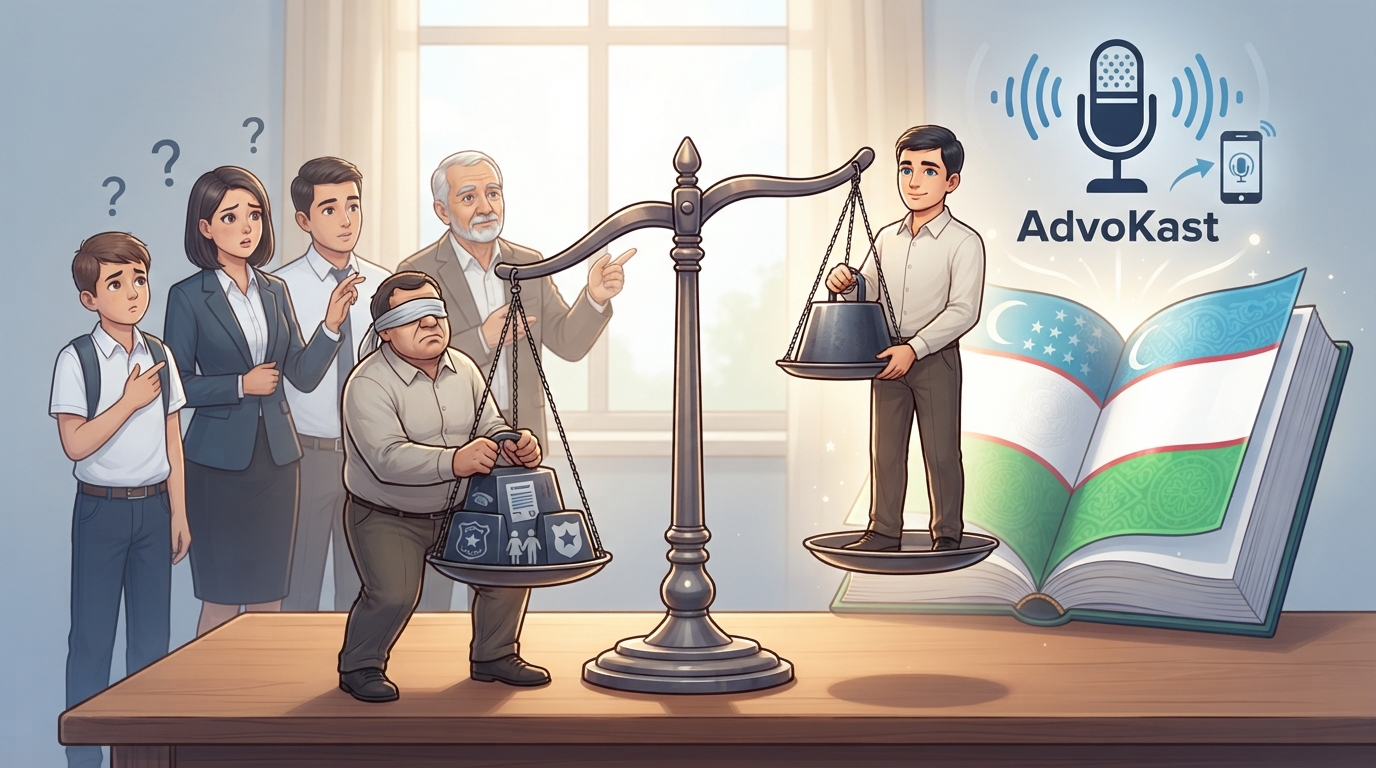
"We don't know 90 percent of our rights." What are the consequences of not knowing our rights?
Two thousand years of human experience show that the importance of fundamental literacy is incomparable. Today, the lack of necessary knowledge can negatively affect a person's ability to make important decisions and fully use their potential.
For example, if an official enters your home under the pretext of a "cleaning raid" and wants to fine you, but you remain silent, something may be going wrong here. Understanding exactly what is wrong begins with having basic legal knowledge.
Therefore, Gazeta has launched a new project - the "AdvoKast" legal podcast - to help people better understand their rights, thereby protecting themselves and living safer and more confidently.
During the podcast, lawyers will be interviewed about the legal assessment of various situations and social relations that arise in our daily lives.
In the first episode of the show, lawyer Jahongir Mutalibov tried to explain the essence of legal literacy and legal culture, the importance of these two concepts, and why a person should know their rights.
— Jahongir, first of all, thank you for agreeing to our proposal. For the introductory part at the beginning of the conversation, can you explain what legal literacy is? Why is it needed?
— Thank you for starting such a good show. The reason is that legal literacy is as necessary for people as water and air, and it will not be wrong to say that. Because from the moment a person is born, although he does not realize it, in addition to moral and material support, legal support is also needed, and it will later become permanent. Today, the rights of citizens are reflected in the Constitution of the country, laws, codes, resolutions of the President or the Cabinet of Ministers, or documents issued by certain bodies for the population. Being aware of these rights is called literacy. That is, the more laws you know, first of all, personal ones, that is, those that concern you, the more you begin to become legally literate. It is not important whether it is sufficient or not, the important thing is to have this knowledge.
Especially in today's 21st century, the world is developing rapidly. We are entering into many relations with foreign countries. If earlier relations were entered into at the level of states or only political institutions, now relations are increasingly being addressed at the level of citizens. Many people are traveling, crossing borders, staying in certain hotels, resting or going to conferences, and there is migration from one region to another within the territory of Uzbekistan itself. In all these processes, the means of self-defense of a person is the law. Therefore, today you cannot carry a weapon with you, it is not such an era. Your weapon is the law. Therefore, even though we live in a peaceful life, legal literacy is as necessary for every person as water and air.
Every person can get into a problematic situation. In this case, you need to know the law in order not to get deeply involved in a conflict. First of all, legal knowledge is needed in order not to violate the boundaries of your rights and not to violate the rights of the person, organization, or enterprise with whom you are entering into a conflict, or vice versa. We also observe this in simple family relations.
The conflict between spouses comes down to the idea that, say, the husband has excessive rights because of the land or because he is the breadwinner of the family. They give out open orders and pressure. Even sometimes women beat and injure their spouses or commit some illegal acts, plots against them, and seize their property. There are cases of children doing things to their parents, and parents doing things to their children. If each family member knows the limits of their rights, they will protect themselves and the other party. Having legal knowledge can prevent a dispute from escalating, and also prevent it from reaching a process such as a court and its expenses, and frustration.
— What problems does ignorance of the law cause?
— Ignorance of the law, first of all, causes you to get into a dispute out of nowhere. Let's say there is a dispute, and you do not have legal knowledge, during a conversation you can unknowingly insult the other party or call them by some nickname. Calling them by a nickname is also considered an insult. For example, if someone has shaved their head, they can send a message saying "you're bald." If someone is short or has a defect in their eyes, they can call them by some name. Saying these things and throwing them in the face is also considered an insult.
Even if you say "Yes, I'm calling you with what you have, I'm not making up something you don't have," it will seem insulting to the other person. All of these are legal boundaries. Why don't we know these boundaries? Because we lack literacy. We don't read literature on this topic, we don't listen to scientific discussions. In the end, we don't know how we ended up in a conflict. If the person who was insulted goes to court tomorrow, it will cause him to be fined several million.
— What types of violations are most common today?
— Conflicts have increased significantly in all types of relationships. Whether it's labor disputes or service sectors, sales relations, consumer rights or lending and borrowing, credit, family relations, there are a lot of them. Their number has reached tens of thousands. The population is also increasing. People are given very little legal knowledge. There is also a shortage of teachers in schools. The number of educational institutions in the legal field is also increasing. But still, more work needs to be done on education.
If we turn to foreign experience, they start education from kindergarten. There, too, they don't give dry lectures, they create situations and explain. For example, they show how a war is going on between parents, they play scenarios with questions such as whether it is right or wrong, whether the boundary of respect between a young child and an adult is right or wrong. Children are taught this.
We need to work on these things. These should be included in educational standards. Then the conflicts may decrease later. There are a lot of conflicts in labor relations. For example, since it is easier for people to see visually, you can make some games, shows on television to show what is possible and what is not. There is no such thing yet. Or you can develop some films, animations, this is also a passive action, easy to remember. To work with these, legal knowledge is also needed. That is why a specialist who teaches in the field of education must be a lawyer.
— In the general context, if we conclude for this part, violations occur due to a lack of legal literacy. That is, when we say which rights people do not know the most, can we say labor relations, rights related to trade, these? Is that so?
— True. But, I think, people probably do not know 90 percent of their rights. Because they didn't study, didn't attend school or didn't understand, maybe they thought that this wasn't necessary for them. So they went back and forth and couldn't get the knowledge on time, but now they need it. Now they don't know where to get it. They don't have the time or patience to read books. Books don't meet the demand either. Fortunately, there is something called artificial intelligence. They can learn by asking, but unfortunately, we don't learn from that either.
— But there is a point of discussion here, Jahongir aka. That is, let's talk about the role of legal culture. Even a person who is only literate may not be able to actively participate in fully ensuring their rights. In this, practice, or rather, legal culture, is more relevant. But many people see legal culture and legal literacy as one concept. Is there a difference between the two? Let's talk about that.
— In my opinion, they are two different things. Legal literacy is the possession of legal knowledge. Legal culture is the application of these acquired knowledge in practice. That is, one is theory, the other is practice. True, if a person who does not know the law at all is polite and cultured, he may not get involved in a particular dispute. It is not because he knows the law that he does not get involved, but because he is cultured, he may stay away from it from the point of view of etiquette, saying, "If I get involved, there will be no conflict, leave it alone." There is also a category of people in this category. But in legal culture, it is impossible not to get involved in some dispute. Otherwise, you will have deviated from humanity. Let's say, not all of us, but many drive a car. There are traffic rules. Many people know the traffic rules. But they knowingly run a red light, they knowingly do not give way to pedestrians. That is, they do it knowingly. So, there is legal literacy, but they lack culture, they do not know how to apply it. We can say that such people are without legal culture.
A certain leader of one of the developed countries in the Middle East went to developing countries like ours, and when he went, he saw that people were driving without following the rules of the road. Then he said, I do not want to make a contract with this country. Why, they do not obey their laws, they do not obey ordinary traffic rules. He said, I do not trust them to fulfill my contract in full tomorrow. You see, what kind of image legal culture creates from the outside. That is why legal culture is so necessary.
If we take ordinary buying and selling relations, now if you go to some stores, they say that the goods sold cannot be returned. However, the law on consumers has conditions for returning each product based on its nomenclature and characteristics. Let's return to legal literacy. For example, if a person buys a product and then wants to return it, but does not receive a receipt, he cannot prove that he bought it from the store. This is where legal literacy is lacking, and then he cannot apply culture. This harms the consumer himself.
— That is, literacy means knowing one's rights, and culture means being able to demand and apply those rights. Okay, how would you assess legal literacy in Uzbekistan?
— I believe that legal literacy in Uzbekistan has increased significantly over the past 20-30 years. Because there is some appropriate education in this regard, and in addition, legal shows are being held on social networks, lawyers are commenting on the law, a digital platform for legislative documents has appeared - the Lex.uz website, Advance.uz, various Telegram bots are working. Thanks to the provision of legal knowledge through these means, a lot of people's knowledge has increased. But this is still not enough. There must also be practice and culture in the process of applying it. We now have a great need to increase our legal knowledge.
— Understandable. Who should a citizen contact when his rights are violated? What is the procedure and what do you recommend in this regard?
— First of all, I recommend using the Internet and artificial intelligence. If you write a problem without a solution and send a question about which rights have been violated, free information will be provided. I would say that it is convenient to get an initial base first of all. If you go to an ordinary lawyer, tell him your situation and ask for advice, you will have to pay him a good amount. Therefore, first of all, I think that you should turn to the tools that are available and free. Artificial intelligence will give you an 80% correct answer, if not 100%. It is enough to ask for reference to the legislation of Uzbekistan when writing an assignment.
After that, you can also ask the AI (artificial intelligence) which body to go to and get advice. In Uzbekistan, the bodies that citizens can apply to are the Ministry of Internal Affairs, the Prosecutor General's Office, and the court. Depending on the jurisdiction of the courts, they can be on civil, administrative, or criminal cases, which needs to be clarified. The administrative court is also divided into two: public and private administrative. That is, public means cases related to relations with the state, and private means cases between citizens. However, in most cases, when citizens apply to the court, they think that they are being censored.
But when they go to court, they need to collect evidence and prove it. There is a separate body that deals with it. Therefore, the court, whether they want to or not, sends the applicant to another body. Because they cannot accept your application directly. They say that the internal affairs bodies or the relevant body will first consider these and then give me the materials. That is, evidence is collected, some cases are proven or not proven, and the court will finally make a final legal conclusion on all of them. Today, the courts also have a lot of work. It is impossible to explain to every citizen who comes.
— Let's finish this point, if you can't get an answer from the court, where should you go and apply?
— The body that controls the implementation of laws in all of Uzbekistan is the prosecutor's office. If you go to the Prosecutor General's Office, they will always accept the citizen, listen to your application, and at least give you instructions on who to go to.
— Who faces problems more often?
— It is impossible to distinguish a specific layer depending on the type of problem, anyone can face it. Now, if you leave here and another car is parked in front of your car, you will start to get nervous. You wouldn't treat the owner of that car like, "Dude, I was in a hurry, you canceled it," would you? Well, who are you, do you have any sense? You start calling him yourself. He doesn't like that treatment either, and then a conflict begins. He says, "Who are you?"
So, as a result of our poor communication culture, conflicts are arising. We lack patience, we are losing understanding of each other. If you go to state authorities, everyone is on edge. Why? Because that's how it works, the tasks given at meetings, the tasks are not completed on time, and shortcomings arise, no one is patient until it is resolved, everyone is shouting at each other, and posting on social media. In the end, it all comes down to our impatience, our lack of legal culture, and our lack of decency in everyday life, which ultimately leads to bad situations.
— It would be really unfair to deny this, I think, but I would like you to pay attention to another point, Jahongir aka. That is, have there been cases of abuse by representatives of state authorities or law enforcement agencies, and could this be the reason for conflicts on both sides?
— We also see cases of abuse on social networks. Yesterday, the deputy khokim made a speech in the sense of "I will show you, I am the state", which is exactly this abuse. The state trusted him and gave him a position, that is, he said that he would participate in easing the problems of the population, but he could not justify it. One person cannot be the state, the state is a large system.
Some kind of intimidation of people, making them do what they say, and if they do not do it, using their powers against them is also abuse. But there is no way to find out about all this, and citizens are discouraged from fighting it. Or they lack legal literacy, wondering who to turn to. In such cases, how many latent (hidden) crimes and violations remain. We cannot fix all this at once. This will take years. But these years should not pass in vain.
We need to develop programs to increase people's legal literacy for 10, 20, 30 years. How do we do it? What is the literacy rate of our general population today, why is this happening - we need to find answers to all the questions and develop planned work. We need to think about this. Because if our legal literacy does not increase, nothing will change even after 50 years. The economy may develop, but maybe not. But if we do not work on legal literacy and culture, no matter how much time passes, we will remain illiterate.
Our state must take on a big task. The reason is that legal literacy is not enough even in families. To begin with, a specific group or commission can be formed by the state, which can develop a procedure for this. In this process, young people who have been educated can be given more responsibility after they reach the age of starting a family.
— What do you see as the three main steps in this process?
— First of all, education should start in kindergarten. Concepts should be at a level that a child can understand. After that, legal literacy classes should be held in schools, and rules of conduct in society should be taught. The next step will be in the family. Adults should first be an example for children, and then we should demand it from young people. Currently, our legal culture is the same as that of adults. We need to look for an answer to the question: what will happen to our people in 20 years, how will they live? It is time for this.
— If there is one thing people should remember to prevent crime or ensure their rights, what would it be in your version?
— Let's say rules, if we talk about the most necessary rules, then of course it is to have legal knowledge. That is, you need to understand that this is a violation of the law. For this, you need knowledge. We understand crime, we say that it is a crime, but there are also attitudes that are not crimes. You need to learn them at least a little bit. You need to read the Constitution little by little, study your personal rights.
Secondly, a certain dispute has arisen, a dispute is taking place. What will protect you in this dispute is evidence. You need to know how to collect evidence. Before you say that so-and-so hit me, cursed me, you need to think about how you will prove it tomorrow. We need to learn to collect evidence with video or audio recordings. You have the right to collect evidence against any aggression against you. The only thing that limits you is not to embarrass someone.
Thirdly, there is a lot of borrowing. There are many conflicts between brothers, sisters, and parents. Some processes are not documented. If they say, "Write a simple receipt" or "Let me write something about this," they say, "Don't you believe me?" So, they say, "The goal is not to write it down." Let's explain it beautifully and write it down, I believe it. But different situations happen, conflicts arise, so it would be better if you write it down, my heart will be at peace, and you will be free from various suspicions tomorrow." For this, we need to learn to reinforce it with evidence. We have very little of this culture. He says, "I trust him, I didn't think it would happen like that."
In addition, you need to familiarize yourself with any document you sign. I'm sure that 99 percent of our people have not read the employment contract. They just signed it. You had a job interview, you liked it, they said that in reality we will pay you such and such a salary, that's it, you're happy, it's a verbal agreement. In a verbal agreement, the details are not agreed upon: what will be the working holidays, what will be the work and rest days, or what will be my salary if I work overtime, no one asks about it. Or the one who asks is ashamed. We get into disputes because we are not vigilant, because we lack legal knowledge.