

"Bring someone sighted!" How a notary's internal instruction trumped the law
Visually impaired people face systematic discrimination when receiving notary services. Notaries refuse to accept legally required facsimile signatures, requiring a representative from the Society for the Blind. Dilmurad Yusupov and Abdullo Abdukhalilov are calling for a change in this system.
"Bring Someone Sighted!": How Notaries' Internal Rules Ignore the Law, Discriminating Against Blind Citizens
Visually impaired people in Uzbekistan face systematic discrimination when seeking notarial services. Citing internal regulations, notaries refuse to accept facsimile signatures from blind individuals, even though such signatures are legally mandated. Dilmurad Yusupov and Abdullo Abdukhalilov analyze how this bureaucratic practice violates citizens' constitutional rights.
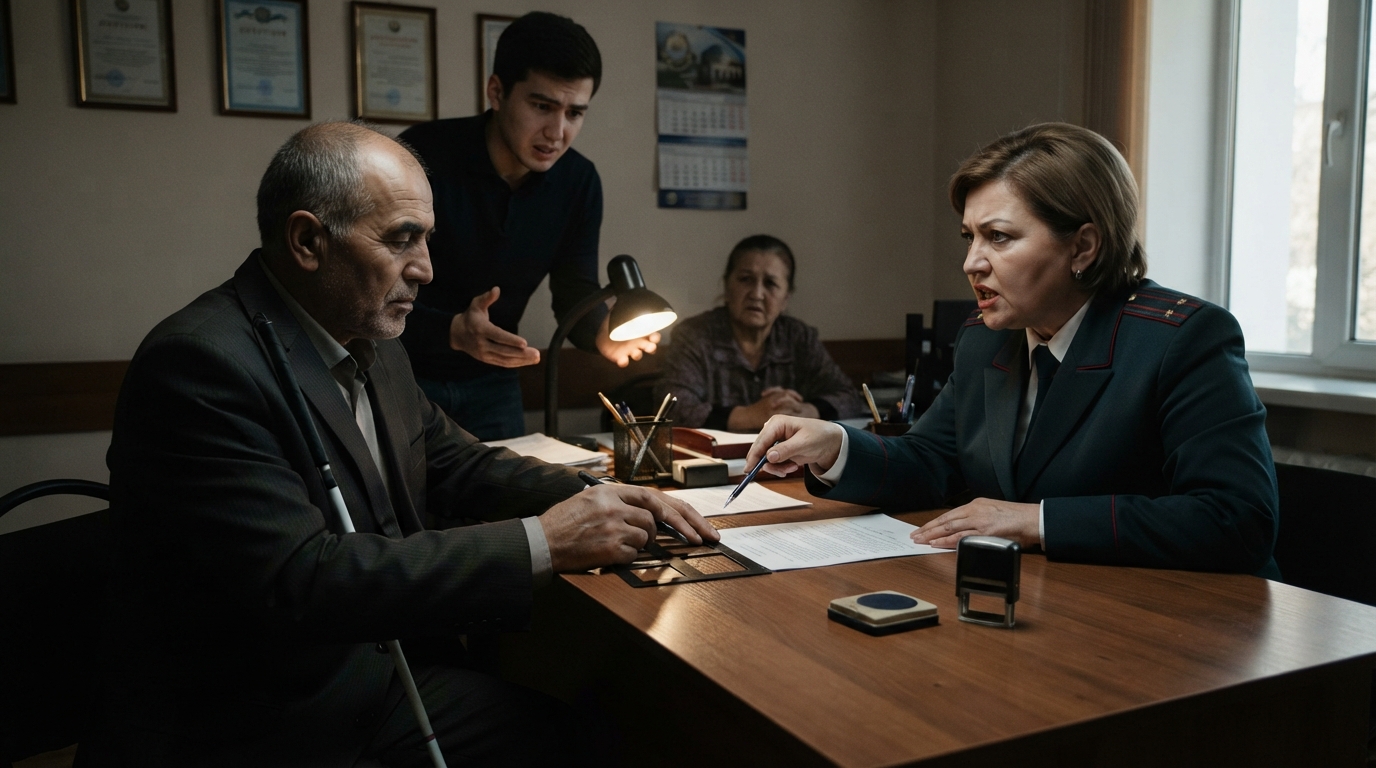
On July 24, Abdullo Abdukhalilov, who has had a Group I visual impairment since birth, visited a notary office in Tashkent's Yashnabad district with his son. He needed to obtain a simple power of attorney to obtain a bank card. However, instead of receiving the service, he encountered bureaucratic obstacles and outright discrimination based on his disability.
The notary refused to process the documents, stating that he needed to bring a representative from the Uzbekistan Society of the Blind. An attempt to resolve the situation on the spot led to even greater absurdity. A Notary Chamber employee, who was called, asked an unethical question: "Are you blind from birth or did you acquire the disability?" Upon learning that Abdullo had been blind since birth, she confirmed the requirement for an intermediary from the Society of the Blind.
This means that if a visual impairment has been acquired, a representative from the Society of the Blind is not required. This illogical instruction makes the situation even more absurd. The authors emphasize that this is not an isolated case, but a systemic problem faced by all visually impaired people. In their opinion, government regulations effectively turn capable citizens into "second-class citizens," depriving them of the right to manage their own lives.
People with visual impairments are full and capable citizens, fully responsible for their actions. For self-signing of documents, a facsimile—a special stamp that replaces a handwritten signature—is used worldwide.
In Uzbekistan, this right is enshrined in Article 29 of the Law "On the Rights of Persons with Disabilities," which explicitly states that a facsimile signature of a person with disabilities is recognized as official and has legal force.
However, in practice, notaries ignore this law, citing an internal departmental instruction (clause 9 of the 2019 Ministry of Justice Instruction on the Procedure for Performing Notarial Acts), which prohibits accepting documents with a facsimile signature.
This creates a serious legal conflict: the ministry's bylaw takes precedence over the law and the Constitution of the Republic of Uzbekistan. According to the Law "On Regulatory Legal Acts," departmental instructions are bylaws and cannot contradict laws.
The Ministry of Justice's internal instruction has no right to override or limit the Law "On the Rights of Persons with Disabilities," which permits the use of facsimile signatures. By applying the instruction instead of the law, notaries violate Article 15 of the Constitution, which recognizes the supremacy of law.
To circumvent its own ban on facsimiles, the notary's instruction (clause 8) offers blind people a humiliating solution: another person (the "guarantor") must sign the document for them in the presence of a notary, with video recording. Moreover, notaries persistently demand that representatives from the Society of the Blind be brought in.
This requirement is illogical. Firstly, most of the Society of the Blind's employees are themselves blind; how can they be "sighted" guarantors? Secondly, not all blind people are members of this organization. Public services should not be dependent on NGO membership, which artificially creates a blind person's dependence on strangers.
The authors ask: Why should the Society of the Blind be the sole intermediary? Which regulations establish this role? Why can only a representative of one specific organization act as a guarantor? A blind person should have the right to choose a trusted person or avoid intermediaries.
Moreover, by forcing the services of a guarantor on a specific organization, notaries violate the Law "On Non-Governmental Non-Commercial Organizations." Part 3 of Article 18 of this law prohibits requiring NGO membership and using it as grounds for restricting rights and freedoms. By refusing to provide services without a representative of the Society of the Blind, notaries illegally restrict the rights of citizens with visual disabilities.
The Tashkent City Department of Justice sent an official response to Abdullo's request to the President's virtual reception office. In a letter signed by Deputy Head of the Department, Zh. Khudoyorov, the department fully justifies the notary's actions.
The Department cites the Administrative Regulations (approved by Cabinet of Ministers Resolution No. 726 of 2020), according to which, when a blind person makes a request, the presence of a "tiflotranslator" is required. Their authority must be confirmed by a power of attorney and an official ID card issued exclusively by the Society of the Blind of Uzbekistan. The response concludes by stating that the notary was "simply explaining the regulations," and the citizen "misunderstood this as discrimination."
This response raises more questions than it answers and exposes the system's incompetence. First, the official profession of "auditory interpreter" doesn't exist in Uzbekistan. There are audio description specialists. Where is a blind citizen supposed to find a specialist in a non-existent profession? Second, the Society of the Blind lacks the legal authority, mechanisms, or educational foundations to train, certify, or issue certificates to "auditory interpreters."
Third, the regulation itself (No. 726), to which officials cite, is written with gross logical errors and lacks an understanding of the specifics of disability.
The document states that a "auditory interpreter" is not required if the notary is skilled in using a certain "device designed for a blind citizen." The specific device in question is not specified. The wording "if the notary knows how to use the device" dooms the regulation to failure, as no notary is trained to use special typhlotechnical aids.
Furthermore, the regulation absurdly links this mythical device to the ability to "communicate," even though blind people have no difficulty with verbal communication. This legal "black hole" gives the notary a legal excuse: since no one knows what this device is or how to use it, notaries simply send all blind people to find non-existent "typhlointerpreters."
The most cynical part of this response is the phrase that the blind person "misunderstood" the situation as discrimination. The authors ask: how can one "correctly" or "incorrectly" feel that one's rights are being violated? Why does a justice department official take it upon himself to decide whether the feelings of a person with a disability are justified?
The answer lies in a conflict of interest: a complaint about discriminatory instructions developed by the Ministry of Justice is being reviewed by an employee of the same agency. The system has risen to the defense of the "esprit de corps" and its own dysfunctional regulations.
The most dangerous consequence of this bureaucracy is the gross violation of fundamental civil and property rights. For example, a blind citizen wants to draw up a will to transfer their home or savings to their children. According to Articles 1127 and 1128 of the Civil Code, every citizen has the unconditional right to the "secrecy of a will."
But the notarial instruction deprives the blind of this right. Since a person cannot simply come and affix their own facsimile stamp, the system forces them to involve a third party—an outsider—to sign for them. This outsider will inevitably learn all the details and secrets of the will. Confidentiality guaranteed by law is completely destroyed. The blind person is deprived of the basic right to freely, independently, and secretly dispose of their property.
The ban on facsimile signatures is usually justified by "security concerns" and fraud protection. But this argument falls apart when looking at the financial sector.
Banks deal with real money, loans, and enormous risks. However, the Central Bank of Uzbekistan has long since resolved this issue. According to official Central Bank instructions (clause 30 of Resolution No. 3420), if a person with a disability is unable to sign in person, banks officially allow the use of facsimile signatures when opening accounts and processing documents. Moreover, banks have introduced priority service for individuals with disabilities and created conditions for signing contracts remotely.
If the strict financial system has been able to adapt, recognize facsimile signatures, and ensure equal rights for clients with disabilities, then why does the notary profession continue to adhere to discriminatory rules?
Blind people are considered fully capable citizens with equal rights and can bear full responsibility for their actions. However, the actions of notaries and the internal rules developed for them render blind citizens legally incompetent. Moreover, a person can only be declared legally incompetent through a court order.
Blind citizens of Uzbekistan do not need leniency or externally imposed "guarantors" to exercise their constitutional rights. They simply need compliance with the law. Uzbekistan ratified the UN Convention on the Rights of Persons with Disabilities in 2021, and its provisions take precedence and are binding on government agencies, including the Ministry of Justice and the Notary Chamber. The Convention prohibits any discrimination based on disability and, to ensure equality, requires the provision of "reasonable accommodations" for people with disabilities.
The use of a facsimile signature is precisely this "reasonable accommodation" for a blind person, allowing them to benefit from services equally with everyone else. The Convention considers denial of this accommodation to be an act of discrimination based on disability.
To quickly address this situation, the Ministry of Justice and the Notary Chamber must urgently review the regulations governing the provision of notarial services to persons with disabilities, taking into account their interests and rights.
The key recommendations include the following measures:
* Recognize paragraph 9 of the Instructions on the Procedure for Performing Notarial Acts, as well as paragraph 18 of the Administrative Regulations (approved by Cabinet of Ministers Resolution No. 726 of November 18, 2020), as discriminatory and inconsistent with the Law "On the Rights of Persons with Disabilities" and the UN Convention on the Rights of Persons with Disabilities.
* Officially permit the use of facsimile signatures by blind citizens when receiving any notarial services, ensuring the direct application of Article 29 of the Law "On the Rights of Persons with Disabilities."
* End the illegal practice of forcing persons with visual impairments to seek representatives exclusively from the Society of the Blind. This requirement flagrantly violates Article 18 of the Law "On Non-Governmental Non-Commercial Organizations." Blind citizens must be granted the unconditional right to independently choose whether or not to engage trusted individuals or legal entities to receive notary services.
* Eliminate from regulatory legal acts unrealistic requirements to engage specialists in non-existent professions ("auditory interpreters"), as well as vague provisions regarding the use of undefined "devices." Documents must be written technically and terminologically correctly, with an understanding of the specifics of various forms of disability, and primarily with the direct participation of representatives of organizations of people with disabilities.
* Make regular training for notary staff on communication ethics and standards for providing services to people with various disabilities mandatory. Organizations of people with disabilities must be directly involved in the development of regulations and the conduct of training, adhering to the fundamental principle of the UN Convention: "Nothing about us without us."
The authors conclude that it's time to stop dividing citizens into those who can manage their own lives independently and those who need to ask favors from people with pens. The right to human dignity must be equal for everyone.
Dilmurad Yusupov is a postdoctoral fellow at the University of Tokyo and holds a PhD in development studies from the Institute of Development Studies at the University of Sussex.
Abdullo Abdukhalilov is an acting professor in the Department of Social Work at the Mirzo Ulugbek National University of Uzbekistan, a doctor of sociological sciences, deputy chair of the Association of Disabled People of Uzbekistan for strategic planning, and an international expert in inclusion and disability.