

"Bring someone who can see!" How did the notaries' internal instructions prevail over the law?
Visually impaired people face systematic discrimination in accessing notary services. Notaries are refusing to accept facsimile signatures as required by law, requiring them to bring a representative from the Society for the Blind. Dilmurod Yusupov and Abdullo Abdukhalilov are calling for a change in the system.
**"Bring a sighted person!": Notaries' internal instructions prevail over the law**
Citizens with visual impairments are constantly faced with discrimination when using notary services. Notaries, using departmental instructions as an excuse, refuse to accept legal facsimile signatures of blind persons.
Dilmurod Yusupov and Abdullo Abdukhalilov analyze how this bureaucratic obstacle violates the constitutional rights of blind citizens.
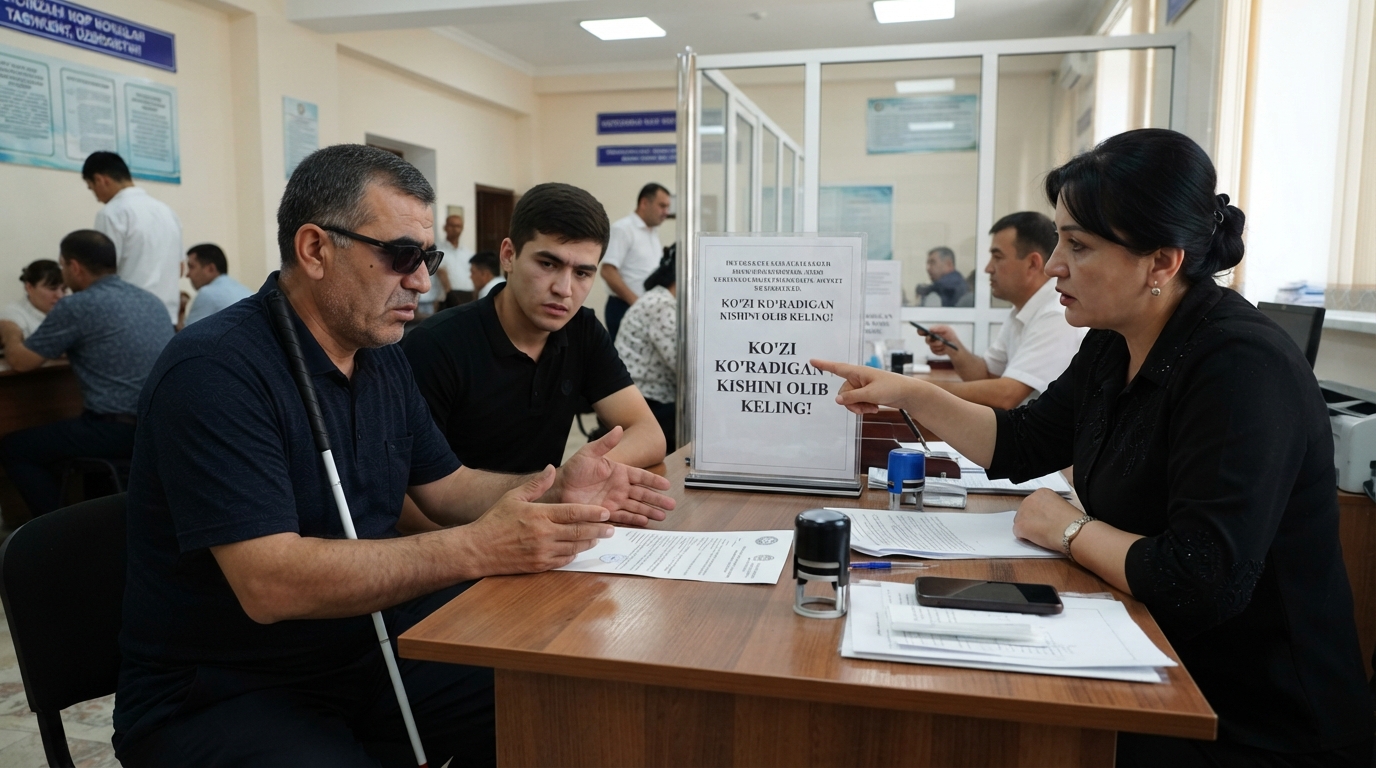
On July 24 of this year, Abdullo, who has a congenital first-group visual disability, went with his son to a notary office in Yashnabad district. He needed to issue a simple power of attorney to obtain a bank card for another person. However, instead of receiving a civil service, he faced a bureaucratic obstacle and open discrimination based on his disability.
The notary refused to formalize the documents, insisting that a representative from the Society of the Blind of Uzbekistan be brought in for this purpose.
Attempts to resolve the situation on the spot led to even greater absurdity. During a phone call to the notary chamber, its employee asked a question that completely did not meet ethical requirements: "Are you blind from birth or did you acquire a disability?" When Abdullo learned that the disability was congenital, he confirmed the previously mentioned requirement to find an intermediary from the Society of the Blind.
So, if the visual impairment was acquired, there is no need to call a representative from the Society of the Blind. This instruction, which does not correspond to any logic, makes the situation even more absurd.
Unfortunately, this situation is not the fault of one notary, but a systemic problem that all visually impaired people face.
Today, state regulations are effectively turning capable, independent citizens into second-class citizens, depriving them of the right to manage their own lives.
People with visual impairments have all the rights and are capable citizens. They are fully responsible for their actions. In order for them to sign documents independently, a facsimile, recognized worldwide, is used - a specially prepared stamp that replaces a person's handwritten signature.
In Uzbekistan, this right is clearly defined in Article 29 of the Law "On the Rights of Persons with Disabilities". The law directly states that a facsimile signature of a person with disabilities is recognized as an official signature and has legal force.
**Screenshot: Article 29 of the Law "On the Rights of Persons with Disabilities"**
However, in practice, notaries ignore this law. They rely on their internal departmental instructions (paragraph 9 of the Instructions of the Ministry of Justice on the Procedure for Performing Notarial Actions in 2019), which strictly prohibit the acceptance of documents with facsimile signatures.
As a result, an extremely gross legal conflict arises: for some reason, a subordinate legal document of a separate ministry is given precedence over the Law and the Constitution of the Republic of Uzbekistan. However, in accordance with the Law "On Normative and Legal Acts", departmental instructions are subordinate legal documents and cannot contradict the laws in any way.
The internal instruction of the Ministry of Justice, which is a sub-legal departmental document, does not have the right to cancel or restrict the operation of the Law "On the Rights of Persons with Disabilities", which allows the use of facsimile.
By using the instruction instead of the law, notaries directly violate Article 15 of the Constitution, which recognizes the unconditional primacy of laws.
To circumvent its own ban on facsimile, the notarial instruction (paragraph 8) offers a discriminatory solution for blind people. For a person with visual impairment, another person ("guarantor") must sign the document under video recording in the presence of the notary. At the same time, for some reason, notaries are insistently demanding that blind people bring representatives from the Society of the Blind.
There is no logic in this requirement.
First, if the majority of employees of the Society of the Blind are themselves blind people, how can they fulfill the role of a sighted guarantor? If a visually impaired representative comes to the notary as a guarantor, will his rights also be violated?
Secondly, not all visually impaired persons are members of this organization. Civil service should not depend on whether a person is a member of a non-governmental non-profit organization (NGO) or not. This creates an artificial dependence of a blind person on strangers.
Why should the Uzbekistan Society of the Blind be the only intermediary between notaries and blind citizens? In what regulatory and legal documents is this role of the Society of the Blind enshrined? And why can a blind person's guarantor be a representative of only one specific organization? After all, a person with visual impairment should have the right to choose his or her authorized representative, regardless of whether it is a legal entity or an individual. Or should he or she be able to do business without any intermediaries at all when receiving notarial services. All these questions remain open...
In addition, by forcibly requiring the guarantor services of a specific organization, notaries directly violate the Law of the Republic of Uzbekistan "On Non-Governmental Non-Profit Organizations". Part 3 of Article 18 of this Law clearly states: "It is not allowed to require in official documents to indicate membership in a particular non-governmental non-profit organization or participation in its activities. The fact that citizens belong or do not belong to a non-governmental non-profit organization cannot be a basis for restricting their rights and freedoms."
Therefore, by refusing to provide services without a representative of the Society of the Blind, the notary is illegally restricting the rights of citizens with visual disabilities.
The Tashkent City Department of Justice sent an official response to Abdullo's appeal to the President's virtual reception on this matter. In the letter, signed by the Deputy Head of the Department, J. Khudoyorov, the department fully justifies the notary's actions.
In its response, the department refers to the Administrative Regulation (approved by Resolution No. 726 of the Cabinet of Ministers of 2020). According to the document, when a blind person applies, his powers are required only by a "translator", whose powers must be confirmed by a power of attorney and a service certificate issued by the Society of the Blind of Uzbekistan. The response letter ends with the words that the notary simply explained the regulation, and the citizen "misunderstood it as discrimination."
Instead of clarifying, this answer raises more questions and reveals the astonishing incompetence of the system.
First, there is no official profession of "typhoid interpreter" in Uzbekistan. There are typhoid interpreters (specialists who describe visual images for the blind). Where is a blind citizen supposed to find a profession that does not exist?
Second, there are no legal powers, mechanisms, or educational bases in the Blind Society to train, certify, or issue certificates to any "typhoid interpreters."
Third, the regulation (No. 726) on which officials rely is itself written with extremely gross logical errors and without the slightest understanding of the specifics of disability.
**Screenshot: Chapter 5 of the Cabinet of Ministers' resolution of November 18, 2020.**
The document states that if a notary can work with some kind of "device intended for a blind citizen", then a "typhlo-interpreter" is not needed. It is not specified what kind of device is being discussed. Is it a braille display? A screen reader (JAWS, NVDA)? A dictaphone? The phrase "a notary can work with a device" undermines this norm from the very beginning. Not a single notary in the country has received training in working with special typhlo-technical devices.
In addition, the regulation absurdly associates this mythical device with the ability to "communicate", although blind people have no problems with verbal communication. This legal "black hole" gives the notary a legal excuse: since no one knows what this device is and how to work with it, notaries simply send all blind people to look for "typhotranslators" who do not exist.
But the most ridiculous thing in this answer is that the blind person is said to have "misunderstood" the situation as discrimination.
A logical question arises: how can one feel "right" or "wrong" about the violation of one's rights? Why would an official of the Department of Justice take it upon himself to decide whether the feelings of a disabled person who has encountered an obstacle are justified or not?
The answer is hidden in the conflict of interest.
The complaint about the discriminatory instructions developed and implemented by the Ministry of Justice is being considered by an employee of this very justice department. Instead of objectively analyzing the problem and protecting human rights, the system has simply switched to protecting the honor of a state body and its own ineffective regulations.
The most dangerous consequence of this bureaucracy is the extremely gross violation of fundamental civil and property rights.
Imagine that a blind citizen wants to draw up a will to leave his house or savings to his children. According to Articles 1127 and 1128 of the Civil Code, every citizen has the unconditional right to the "secret of the will". No one should know about its contents until a certain time.
But a notarial instruction takes away this right from the blind. Since a person cannot simply come and put his facsimile stamp, the system forces him to involve a third party - a stranger who will sign in his place. This stranger will inevitably learn all the details and secrets of the will.
The confidentiality guaranteed by law is completely destroyed. A blind person is deprived of the fundamental right to freely, independently and secretly dispose of his personal property.
Usually, the ban on facsimile by notaries is justified by "security considerations" and protection against fraud. But if you look at the financial sector, this reasoning becomes more and more absurd.
Banks work with money, loans and huge risks. Nevertheless, the Central Bank of Uzbekistan solved this problem long ago. According to the official instructions of the Central Bank (in particular, paragraph 30 of Resolution No. 3420), if a person with disabilities cannot sign a document with his own hand, banks officially allow the use of a facsimile signature when opening accounts and executing documents.
In addition, banks have introduced non-stop service for persons with disabilities and created conditions for signing contracts remotely.
If a rigid and conservative financial system has been able to adapt, recognize facsimile and ensure equal rights for clients with disabilities, why does the notary continue to cling to discriminatory rules?
Blind people are considered equal, fully capable citizens and can take full responsibility for their actions. However, the actions of notaries and the internal regulations developed for them are rendering blind citizens incompetent. However, a person can only be declared incompetent in court.
Blind citizens of Uzbekistan do not need concessions or "guarantors" forced from outside to exercise their constitutional rights. They simply need to comply with the law. Uzbekistan ratified the UN Convention on the Rights of Persons with Disabilities in 2021, and its norms have priority and are mandatory for state bodies, including the Ministry of Justice and the Notary Chamber. The Convention prohibits any discrimination on the basis of disability and makes it mandatory to provide "reasonable accommodation" to persons with disabilities to ensure equality.
The use of a facsimile signature is the same "reasonable accommodation" for a blind person to use services on an equal basis with everyone. The Convention considers the refusal of this accommodation to be an act of discrimination on the basis of disability.
To eliminate this situation as soon as possible, the Ministry of Justice of Uzbekistan and the Notary Chamber should review the standards for providing notarial services to persons with disabilities, taking into account their interests and rights.
Our main recommendations include the following measures:
* To declare paragraph 9 of the Instructions on the Procedure for Performing Notarial Actions, as well as paragraph 18 of the Administrative Regulations (approved by Resolution of the Cabinet of Ministers No. 726 dated 18.11.2020) discriminatory and contrary to the Law "On the Rights of Persons with Disabilities" and the UN Convention on the Rights of Persons with Disabilities.
* Officially allow blind citizens to use a facsimile signature when receiving any notarial services, ensuring the proper functioning of Article 29 of the Law "On the Rights of Persons with Disabilities".
* Stop the illegal practice of forcing visually impaired persons to seek representatives only from the Society of the Blind. This requirement grossly violates Article 18 of the Law "On Non-Governmental Non-Profit Organizations". Blind citizens should be provided with the unconditional right to independently choose whether or not to involve authorized representatives (individuals or any legal entities) to receive notarial services.
* Remove from regulatory legal acts unfulfillable requirements for the involvement of non-existent professionals ("typhoid interpreters"), as well as abstract norms for the use of vague "devices". Documents should be written technically and terminologically correct, with an understanding of the specifics of various forms of disability and, first of all, with the direct participation of representatives of organizations of persons with disabilities.
* Make it mandatory for notary employees to undergo regular training on the ethics of communication with people with various forms of disability and standards of service.
* It is necessary to directly involve organizations of persons with disabilities in the development of regulations and conducting training sessions, in accordance with the basic principle of the UN Convention "Nothing about us without us."
It is time to stop dividing citizens into those who can independently manage their lives and those who have to rely on people with a pen for this. The right to human dignity should be equal for all.
The opinions of the authors may not coincide with the opinions of the editorial board.
**Dilmurod Yusupov** — Postdoctoral fellow at the University of Tokyo, Doctor of Philosophy at the Institute of Development Studies, University of Sussex.
**Abdullo Abdukhalilov** — Acting Professor of the Department of Social Work at the National University of Uzbekistan named after Mirzo Ulugbek, Doctor of Sociology, Deputy Chairman of the Uzbekistan Association of Disabled Persons for Strategic Planning, international expert in the field of inclusion and disability.