

We are — dark, we are — host
By 2100, half of the population of Central Asia will consist of Uzbeks
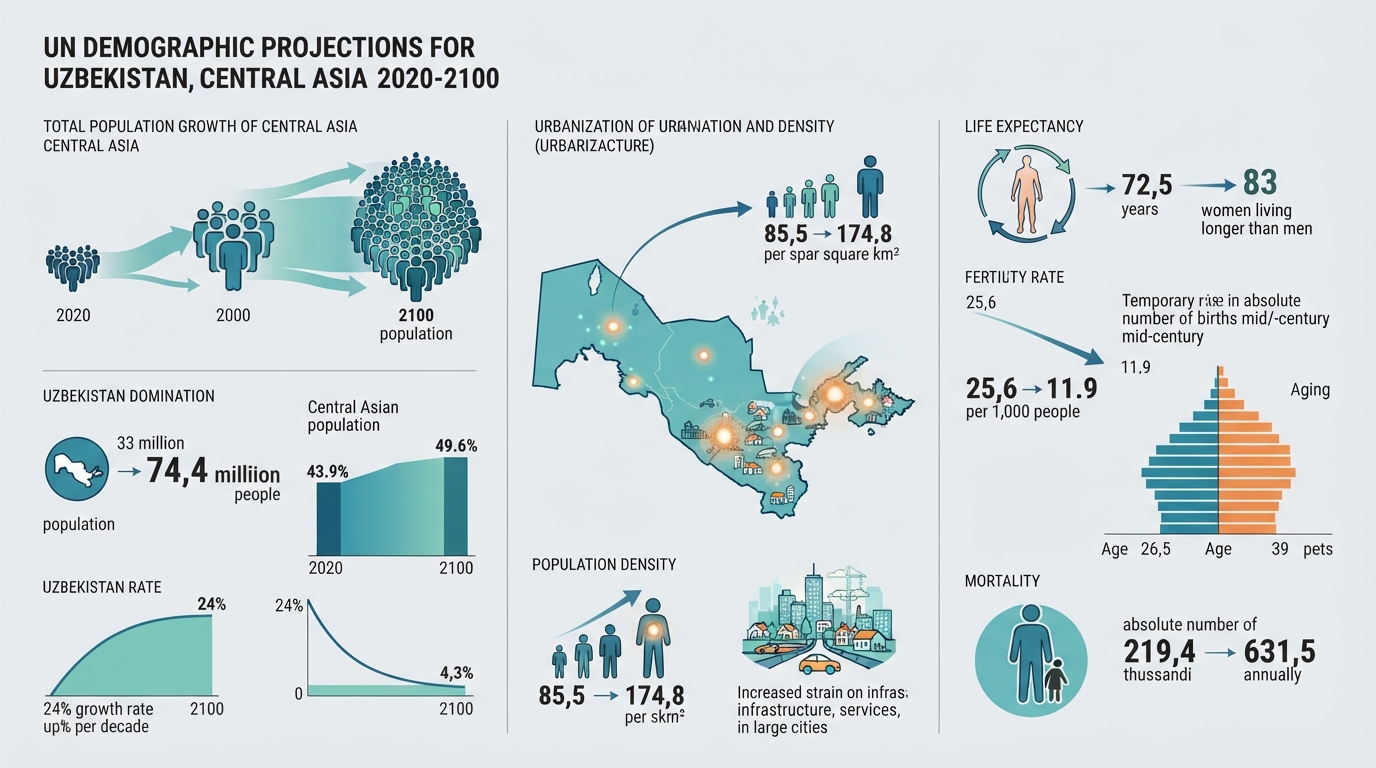
We Are Legion, We Are Hosts
Experts from the UN Population Division have updated their forecast for world demographic development up to 2100. The document presents several scenarios. When analyzing the indicators for Central Asian countries, we relied only on the baseline scenario. It does not foresee sharp jumps, such as pandemics, but reflects future values while maintaining current trends and factors.
According to UN calculations, the total population of the Central Asian region will almost double from 2020 to 2100 — from 75 million to 149.9 million people. The highest growth rates are expected precisely in the first decade: by 2030, the population will increase by 21.5%. Then, in each subsequent decade, the 10-year growth will decline and reach 2.8% by 2100.
Country data provided in the source allow us to conclude that Uzbekistan will remain the demographically largest state in the region. While in 2020 the actual share of residents of the Republic of Uzbekistan in the total population of Central Asia was 43.9%, by 2100 it will reach 49.6%. At the same time, the number of Uzbek citizens in such a long-term dynamic will increase 2.3 times — to 74.4 million compared to 33 million people in 2020. The highest growth rates will also be observed until 2040 — up to 24% per 10 years, then over several decades the country's demographic development will proceed at a moderate pace — 5%–7% per 10 years, and by 2100 the indicator will decline to 4.3% per 10 years.
Kazakhstan, Tajikistan, and Kyrgyzstan will also show positive population dynamics, although the growth rates in these countries will be lower. By 2100, the figures are projected at 33.7 million, 20.2 million, and 11.7 million people, respectively. In Kazakhstan, the total number of citizens will increase by 75.3% compared to 2020, in Kyrgyzstan — by 72.4%, in Turkmenistan — by 53.2%, and in Tajikistan — 2 times.
Why are demographic forecasts made for such a long period? There are several reasons. Understanding how the population size will change allows a country's government to lay the foundation for long-term socio-economic planning. This affects literally all areas of the economy — the capacity of goods and services markets, the necessary minimum level of production, the capacity of healthcare and education systems, housing construction, and the development of transport infrastructure.
The UN forecast for Uzbekistan looks like an extensive version of demographic development. A doubling of the population over a relatively short historical period represents not only an important stage of development, but also risks. For example, with such growth, the population density of the Republic of Uzbekistan will grow rapidly. While in 2024 it was 85.5 people per sq. km, by 2040 the figure will reach 108.2, and by 2100 — 174.8. In this situation, the internal regional factor and the level of urbanization will play a key role. If population growth across regions is uneven, as is most often the case, this will lead to an increased infrastructure load on the country's major cities.
Another extremely important factor in developing long-term development strategies is life expectancy. Good news for Uzbekistan: this social indicator will gradually increase. While in 2024 it stood at 72.5 years, by 2100 it could reach 83 years. According to UN estimates, women in the Republic of Uzbekistan will live to an average of 85 years, and men — up to 81 years. This forecast should serve as a benchmark for healthcare and pension development programs.
The detailed UN forecast allows for a close examination of many demographic indicators affecting the overall picture. One of them is birth rate.
According to experts' calculations, the annual number of newborns in Uzbekistan will gradually decrease from 2024 to 2033: from 929.3 thousand to 850.8 thousand people. Then, up until 2050, the indicator is expected to grow to 996.6 thousand people, after which a decline will begin again.
At the same time, the crude birth rate will steadily decline across the entire forecast horizon: from 25.6 per 1,000 people in 2024 to 11.9 in 2100. This reflects a long-term trend toward a decrease in childbearing intensity, even against the background of a temporary increase in the absolute number of births.
Why might events develop in this way? Data on the average age of Uzbekistan's population provide part of the answer. From 2030, it will begin to rise, going from 26.5 years to reach 39 years by 2100. And given that the average age at which women give birth to children in the Republic of Uzbekistan is 27–29 years, the decline in the birth rate will merely be the result of general changes in the age structure of the population. There will be fewer young people capable of giving birth.
The age and sex structure of Uzbekistan's population will also affect the growth of mortality. The crude death rate, reflecting mortality intensity per 1,000 people, will increase from 6 in 2024 to 8.5 by 2100.
Under this scenario, the absolute number of deaths will only grow. According to UN forecast data, the annual indicator will increase from 219.4 thousand people in 2024 to 631.5 thousand people by 2100. These dynamics are explained by the growth of the total population and its aging. Even with relatively moderate crude death rate values, an increase in the proportion of older age groups elevates the total number of deaths.