

Water tariffs: why do prices differ by region?
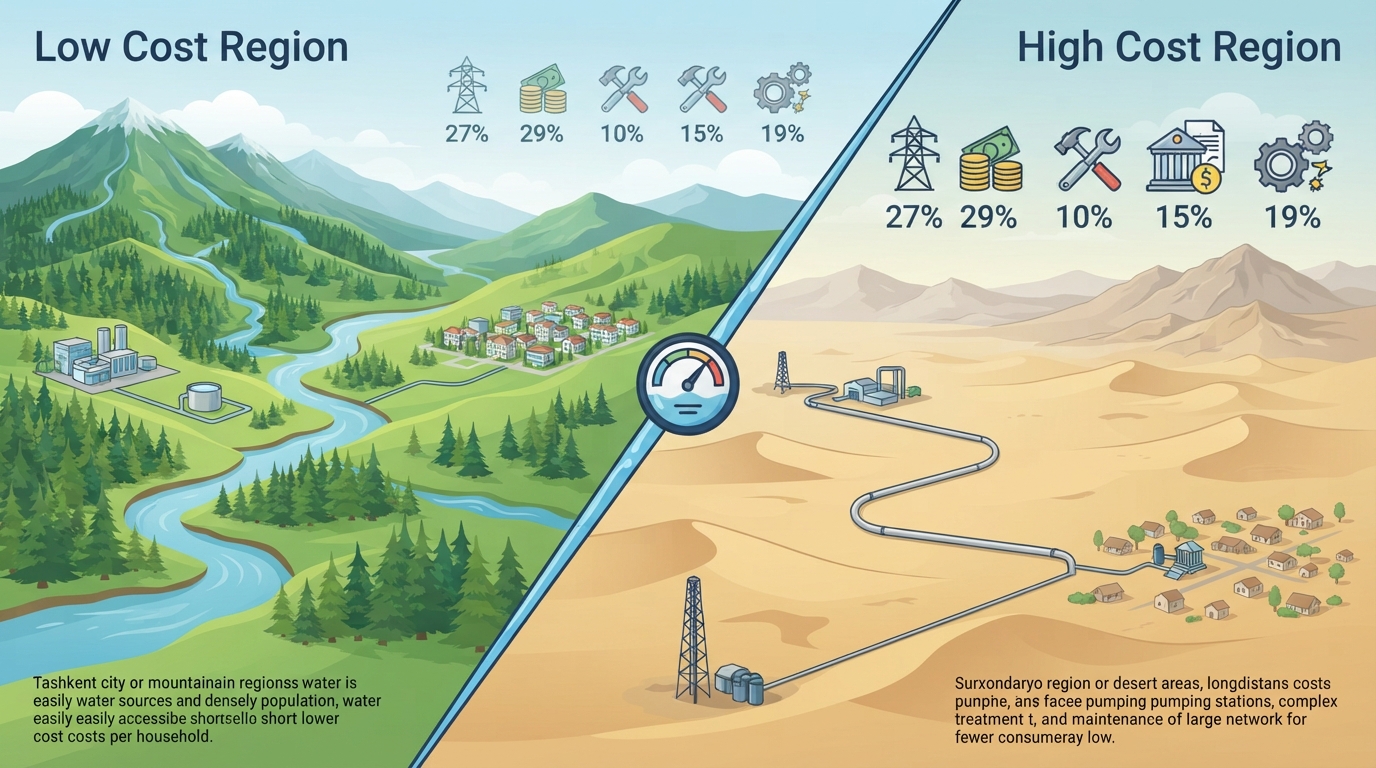
The difference between tariffs primarily depends on the natural and geographical conditions of the regions, the location of water sources, population density, and the delivery of water.
Water tariffs: why do prices vary by region?
It is noted that the sustainability of drinking water supply and wastewater services directly depends on tariffs. Because if the tariff does not cover the cost of the service, enterprises will not have sufficient funds to repair, renew, and modernize networks.
Why are tariffs different in regions?
The difference between tariffs is explained, first of all, by the natural and geographical conditions of the regions, the location of water sources, population density, and the costs incurred for water delivery.
For example, in foothill regions, since water sources are close, the costs of obtaining and purifying it are relatively low. In desert regions, however, local water sources are scarce and often saline. Population density also affects the cost of water. While one kilometer of pipe serves hundreds of households in cities, this indicator is significantly lower in villages. For this reason, the costs of maintaining and repairing long pipelines and delivering water through pumps increase.
It is reported that in the cost of one cubic meter of drinking water, electricity costs account for 27 percent, wages 29 percent, major and current repairs 10 percent, repayment of loans received from foreign financial organizations 15 percent, and depreciation and other expenses 19 percent.
Current tariffs and reasons for their increase
Across the republic, the average tariff of drinking water for the population is 3,765 sum per cubic meter (4,217 sum with VAT), and the tariff for wastewater services is 2,008 sum.
The lowest drinking water tariff is in the city of Tashkent — 1,400 sum. This tariff has not changed since December 2023. The highest tariff is in the Surkhandarya region, amounting to 6,800 sum.
The need to revise tariffs was also noted at the press conference. In recent years, the gap between the cost of water and current tariffs has widened. This is mainly caused by the increase in electricity prices, rising costs of repairing outdated networks, and obligations on loans received from international financial institutions.
Debt has reached 542.6 billion sum
The issue of payment discipline of consumers was also raised at the conference. As of October 2026, the total debt in the system of "Uzsuvtaminot" JSC amounted to 542.6 billion sum.
It was also announced that changes will be made to the debt collection procedure starting January 1, 2027. According to it, if the debt is up to one thousand times the basic calculation amount, it will be collected through a notary, and if it exceeds that, through judicial proceedings. Only if the debt is not eliminated in the established manner, the consumer's ability to make payments for electricity may be restricted. This procedure does not apply to families included in the Single Registry of Social Protection.
The procedure for approving tariffs will change from 2027
Information about prospective plans in the field was also provided at the press conference.
In accordance with Decree No. UP-140 of the President of the Republic of Uzbekistan, from January 1, 2027, the authority to approve tariffs for drinking water supply and wastewater services will be transferred to the Interdepartmental Tariff Commission under the Cabinet of Ministers.
According to the new procedure, tariffs will be reviewed based on uniform and economically justified criteria, rather than separately in each region. Starting April 1, 2027, it is planned to introduce a unified tariff for budget organizations.