

Water on Ration
Water scarcity is becoming one of the main risks for Uzbekistan's economy. The country's authorities are revising water management rules and studying foreign experience in its conservation. However, the scale of required changes is determined not only by water shortages, but also by the state of infrastructure, high water intensity of agriculture, and growing pressure from the population.
In September, a delegation of Uzbek water management specialists visited Israel. The trip participants learned about modern approaches to water conservation, irrigation, monitoring, and water reuse. Uzbek delegations dispatched to Egypt and Poland with similar tasks.
The increased attention of Uzbekistan's leadership to the water sector was reflected in the new Water Code, which came into force on October 31, 2025. The document provides for the implementation of public-private partnerships, a transition from an administrative-territorial to a hydrographic principle of water resources management, as well as mandatory water metering at all points of its withdrawal.
Participants of the V Tashkent International Investment Forum, held on June 16–18, 2026, spoke about the cost of delay. According to presented expert estimates, if current trends in the water sector persist, Uzbekistan's economy risks becoming paralyzed within the next 15 years. Experts at Boston Consulting Group (BCG), in particular, predict that under the worst-case scenario, the annual water deficit will reach 22 cubic kilometers by 2040.
The social consequences could be equally severe. If current trends continue, about 5 million displaced persons are expected to emerge by 2050, who may be granted the status of "climate migrants." This is comparable to the combined population of the Republic of Karakalpakstan, Jizzakh, Navoiy, and Syrdarya regions, or 14% of Uzbekistan's population.
The basis of the republic's water resources consists of transboundary rivers, primarily the three largest — the Amu Darya, Syr Darya, and Zeravshan. The overall structure also includes temporary watercourses and groundwater. With an average annual volume of used water resources of 51–55 cubic kilometers, about 80–85% comes from the Amu Darya and Syr Darya. Approximately 70 artificial reservoirs are intended mainly for irrigation.
Consumers receive water from several sources. The combined water supply system integrates surface water, operational groundwater reserves, and the reuse of drainage water. However, the combined contribution of the last two sources remains small: it does not exceed 2–2.5 cubic kilometers per year.
Potential natural reserves of fresh and brackish groundwater are estimated at 27.6–31.2 cubic kilometers per year. At the same time, they are distributed extremely unevenly across the territory of Uzbekistan. At least 40% of the total groundwater reserves are concentrated in Tashkent and Samarkand regions, and according to some estimates, their share approaches 50%.
The situation is exacerbated by climate change. Melting glaciers and reduced snow cover affect the replenishment of water resources. Since the Central Asian states gained independence, the area of glaciers in the region has decreased by at least 25%. The reduction has also affected the small glaciers of Surkhandarya and Kashkadarya.
Meanwhile, inefficient water use remains one of the key problems of the sector. On average, agriculture accounts for about 90% of water consumption. Specific consumption per hectare in Uzbekistan is 2–2.5 times higher than in technologically developed countries.
Remaining the largest consumer of water in Central Asia, Uzbekistan traditionally ranks among the countries with the most acute water deficit both in the region and in the world. Continued population growth creates a risk of increasing the load on the water infrastructure to a critical level. For the authorities, this makes the issue of modernizing facilities, networks, and operating equipment — upon whose condition consumer supply depends — particularly acute.
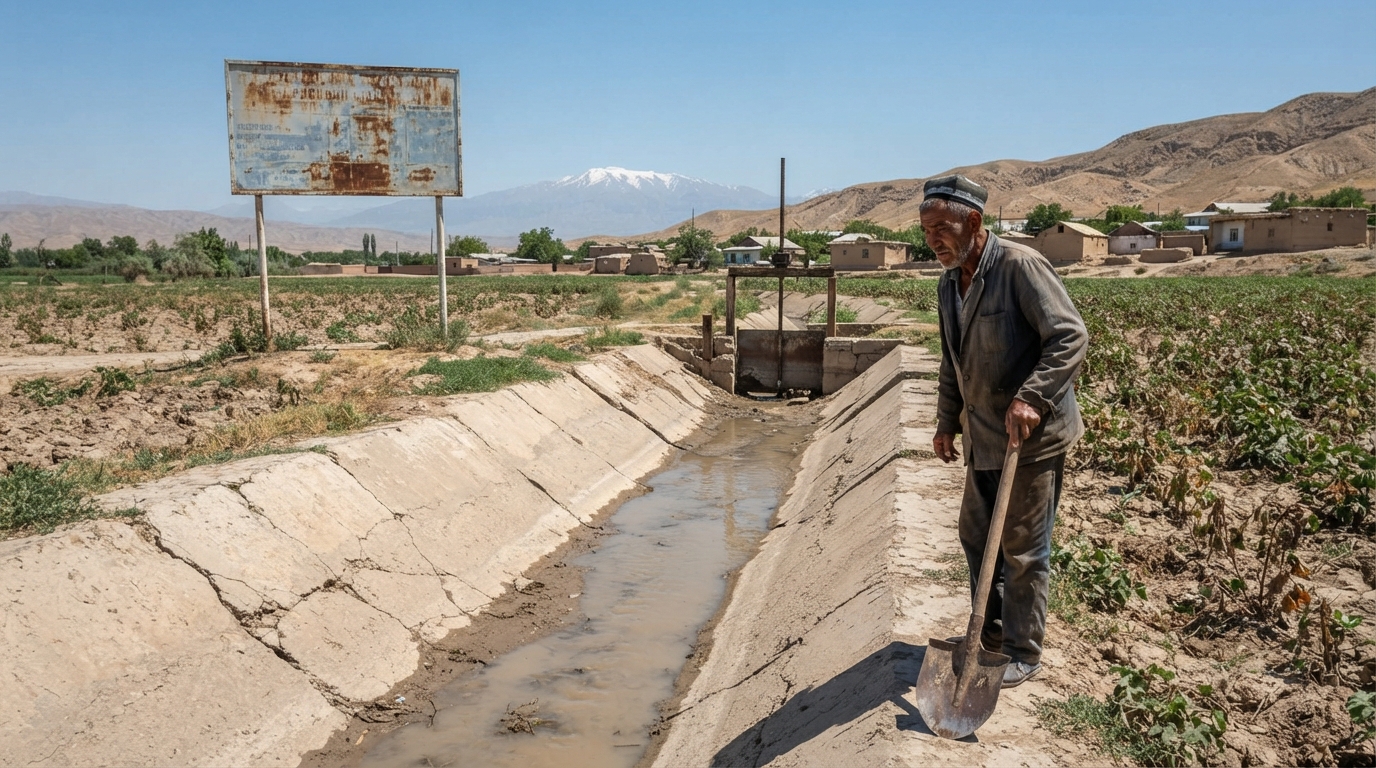
Underfunding of the water sector development program has led to the wear and tear of municipal equipment and utility lines. About 40% of water supply facilities, 32% of water conduits, and 36% of water distribution networks require repair or complete replacement. In the wastewater system, updating is required for 25% of sewer networks and 31% of main sewer lines.
The total investment needed to modernize Uzbekistan's water infrastructure is estimated at approximately $40 billion. At the same time, there is no clarity yet as to who will provide such funding and from what resources. Analysts estimate the annual financial losses from inefficient water use at $5 billion. Against the backdrop of these losses, finding investment sources becomes one of the main practical issues of Tashkent's water policy.