

The race for leadership
Uzbekistan is catching up with Kazakhstan: Tashkent aims for economic leadership
**The Race for Leadership**
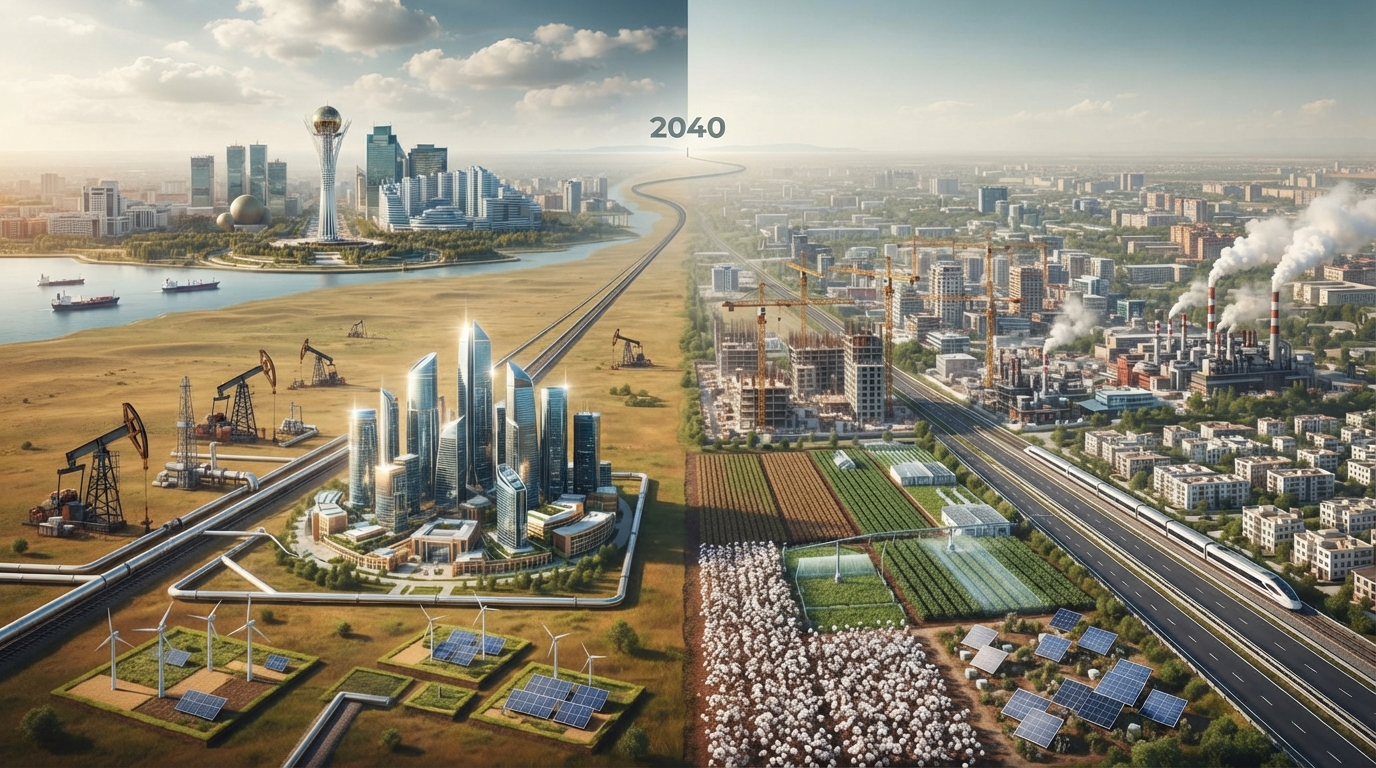
In 2040, Kazakhstan and Uzbekistan will approach the half-century mark of their modern independence. For decades, Astana has maintained undisputed economic primacy in Central Asia. But Tashkent is consistently raising the bar for its goals. Today, President Mirziyoyev speaks directly of his intention to bring GDP to $300 billion. Will Uzbekistan be able to strip Kazakhstan of its status as the region's largest economy by this symbolic date?
In a recent interview with Exclusive.kz, Uzbekistani economist Yuliy Yusupov explained in detail why the rivalry between Astana and Tashkent benefits both countries. In his opinion, when neighboring states simultaneously improve conditions for business, the entire region wins, as international investors need a capacious and understandable market. But in addition to integration intentions, all countries also have internal economic policies, and, by all appearances, the familiar balance of power in this area is already beginning to change.
Eight years ago, at the end of 2018, Kazakhstan's GDP stood at about $179.3 billion, while Uzbekistan's figure was in the range of $55-60 billion. The gap between the economies reached 3.2 times, and Astana's position as the region's permanent leader seemed unshakable. However, already by the end of 2026, the Kazakhstani economy is expected to establish itself at the level of $360 billion, while the Uzbekistani economy will exceed the $180 billion mark. The distance between the two countries is rapidly shrinking.
Such a rapid leap was the result of regular revisions of targets by the government of Uzbekistan. In July 2023, Shavkat Mirziyoyev set the task of doubling the economy from a baseline of $80.4 billion in 2022 to $160 billion by 2030. But real indicators quickly surpassed calculations, so the bar was first raised to 200 billion in 2024, then to 240 billion at the end of 2025, and now, in August of this year, the President of Uzbekistan officially set a new goal — to reach $300 billion by 2030.
To go from the current $180 billion to the declared $300 billion by the end of the current decade, Uzbekistan's economy must grow by approximately 13-15% annually in dollar terms. For this, real production within the country must grow by 8.5-9% per year. Such a pace is entirely achievable: according to the Statistics Agency of Uzbekistan, in the first half of 2026 alone, the country's real gross product growth had already reached 8.5%, whereas at the end of 2025 it was 7.7%.
The most remarkable thing about this acceleration is that Uzbekistan is managing without a rich oil cushion. Kazakhstan has about 30 billion barrels of proven hydrocarbon reserves underground, ensuring a constant influx of foreign currency. Uzbekistan's reserves are 50 times smaller — just 0.6 billion. And due to rapid population growth and the launch of new factories, the country has now turned from an exporter of natural gas into a buyer of it from its neighbors.
Previously, the main source of budget support for Tashkent was gold, but today the country is trying to reduce its dependence on precious metals. In the first seven months of 2026, the share of gold in the total export sales basket fell to 14.1%. At the same time, exports of finished goods, excluding gold, grew by almost 28%, and sales of clothing and fabrics alone abroad reached $1.9 billion over the same period, indicating real development in processing.
The Uzbekistani authorities are laying a tangible financial foundation for these tasks. A plan to attract $450 billion in foreign direct investment and create 2 million new jobs in industrial enterprises is envisioned for the coming decade. The goal of the reforms is to defeat poverty — according to official data, it has already decreased to 4% today compared to 35% in 2017 — and to raise the average income per person above $10,000.
The main engines of Uzbekistan's growth are the service sector, large-scale construction, and processing plants, which are growing at rates of more than 15% per year.
This is supported by the domestic demand of the 39-million population and regular remittances from labor migrants, who send home over $14 billion annually, and at the end of 2025, remittances amounted to $18.9 billion. This sector contributes 2.2 percentage points to overall economic growth.
The second key engine is the manufacturing industry, which adds another 2.2 percentage points to gross product growth.
The production of electrical and household appliances is growing rapidly in the country: a 20.4% growth was recorded in this area thanks to the development of the Artel brand and joint ventures. In the automotive industry, instead of a monopoly, the assembly of BYD, Chery, Kia, and Chevrolet cars has emerged — we recall that Kazakhstani billionaire Nurlan Smagulov, in particular, is investing in this — while the production of building materials is growing by 14% per year. In addition, since 2022, cotton is no longer sent abroad as raw material but is fully processed within the country; just under ten years ago, Uzbekistan processed only 40%.
The third powerful driver is the construction sector, which adds 1.3 percentage points to economic expansion and is growing at 14.2% per year.
The construction of the large "New Tashkent" district, satellite cities around Samarkand and Namangan, as well as toll highways, generate high domestic demand. All these projects force cement plants, metallurgical combines, and cable factories across the country to work at full capacity.
At the same time, the state's development relies on several already established industrial and service hubs. Tashkent and the Tashkent Region generate almost a third of the country's total GDP, acting as the main financial, trade, and technological center.
Another important pole is the densely populated Fergana Valley, which encompasses the Namangan, Andijan, and Fergana regions. Namangan has become a center of light industry and deep textile processing, while Andijan retains its status as the main automotive cluster. The high population density in this region provides newly launched enterprises with a constant and relatively inexpensive influx of labor.
The Navoiy and Samarkand regions form the third supporting zone of the Uzbekistani economy. Heavy industry, non-ferrous metallurgy, and chemical production based on the Navoiy Mining and Metallurgical Combine are concentrated in Navoiy. Samarkand, meanwhile, is currently being transformed into a major tourism, cultural, and transport-logistics hub, welcoming millions of guests and ensuring the transit of goods.
The noticeable difference in the growth rates of the two countries is explained by the difference in economic approaches. Shavkat Mirziyoyev acts as an active developer, focused on the fastest possible growth from a low base. To achieve this, Uzbekistan reduced VAT to 12%, introduced tax incentives for factories, and keeps the Central Bank rate at 13.5% with inflation at 7.3%, making commercial loans more accessible to entrepreneurs.
Kassym-Jomart Tokayev chooses a more cautious course, where the main priority is curbing prices, de-monopolization, and protecting accumulated reserves. The National Bank of Kazakhstan, fighting inflation, keeps a fairly high base rate, although it has recently begun to gradually lower it, which is why loans for Kazakhstani enterprises remain expensive. Largely thanks to such a conservative policy, the country recently received a BBB international rating for the first time in 10 years.
At the same time, one gets the impression that it was precisely the successful experience of Uzbekistan that prompted Tokayev to announce a course toward turning Kazakhstan into a major construction site, instead of the previously declared course of saving state funds and accumulating resources in the National Fund. In turn, Tashkent, in response to remarks by foreign entrepreneurs about the imperfection of the courts, also switched to directly copying Astana's successful institutions.
Earlier, Exclusive.kz reported in detail on the Tashkent Financial Center, which is being created under a special Constitutional Law. This project is conceived essentially as a direct competitor to the Astana International Financial Centre in the struggle for international capital. As we noted earlier, Uzbekistan is repeating all the key decisions of its neighbor: the new financial center is introducing English common law, creating an independent court with foreign arbitrators, and exempting participants from corporate income and dividend taxes for 50 years. Tashkent expects to attract $25 billion through this platform in its first years of operation.
Kazakhstan, however, retains a serious advantage over Uzbekistan in the development of the financial sector and accumulated capital. The assets of Kazakhstani banks exceed $120 billion compared to $58 billion in Uzbekistan, and the AIFC exchange, unlike the newly created TFC, is already directly integrated with global platforms. The Kazakhstani financial system is capable of lending to individual large-scale projects, even if not all, from domestic sources, whereas Tashkent still has to turn to foreign funds for every major loan.
In addition, compared to Uzbekistan, Kazakhstan is in a more favorable geographical position, acting as a natural transit hub. Although both countries have no direct access to the World Ocean, Kazakhstan possesses a key advantage — a developed port infrastructure on the Caspian Sea, namely the ports of Aktau and Kuryk, as well as a direct land border with Russia. Uzbekistan, on the other hand, is among the "doubly landlocked" states, being surrounded by neighbors who also have no access to the open sea.
On the other hand, to reduce logistical risks, Uzbekistan, together with Kyrgyzstan, began building a railway to China bypassing Kazakhstan and started working on the Trans-Afghan route to the ports of Pakistan.
However, firstly, these projects require years of construction and large capital investments, meaning they do not remove Kazakhstan's high influence in the near term. Secondly, even after their completion, Uzbekistan's dependence on other countries will remain in any case, although the control center will be transferred to other territories. But be that as it may, in the global perspective, the implementation of these projects will definitely affect the race between the two economies, and not in Kazakhstan's favor.
In addition, Kazakhstan is noticeably inferior to its neighbor in terms of cheap labor and demographic resources, which is good for social policy but bad for economic policy. The average salary in Uzbekistan is still only $350-400 compared to $700-900 in Kazakhstan, and half a million young people enter the labor market there every year. Therefore, for investors building factories with a large number of workers, particularly textile, footwear, or assembly plants, it is much more profitable to open them in Uzbekistan than in Kazakhstan.
At the same time, despite the rapid industrial leap, Uzbekistan still faces serious natural constraints. The growing deficit of water resources is becoming the main barrier. According to international statistics, by 2040, the shortage of fresh water in Uzbekistan could reach 15 billion cubic meters per year, which will threaten traditional agriculture.
The economic consequences of such a deficit could be very significant. According to UN estimates, Uzbekistan's losses due to inefficient water resource management and the state of irrigation infrastructure could amount to up to 8% of GDP. The vulnerability is primarily explained by the large role of agriculture: according to the World Bank, it forms about a quarter of the country's economy and employment and consumes around 90% of all water, with a significant portion of agricultural production depending on an outdated irrigation network with high losses.
For Kazakhstan, however, the water crisis does not pose such a direct threat to the structure of national GDP. The Kazakhstani agricultural sector forms only about 4-5% of the economy, and the main grain fields in the north of the country are irrigated by natural precipitation. Of course, the water deficit is also a huge problem for Kazakhstan and could inevitably cause damage primarily to the southern regions of the country, in particular the main financial center of Almaty, but it is not capable of stopping the operation of key industrial, mining, and oil-producing centers, at least not as rapidly as in the neighboring country.
The second acute problem for Tashkent has been the energy deficit. Uzbekistan's traditional thermal power plants run 75% on gas, the production of which is declining in old fields. Due to fuel shortages in winter, the authorities are forced to limit the supply of gas and electricity to industrial enterprises, which leads to factory downtime and reduces investment attractiveness.
Tashkent is trying to close resource gaps through large-scale modernization programs. The country has begun concreting more than 5,000 kilometers of irrigation canals and transitioning to drip irrigation. In the energy sector, investors from Saudi Arabia and the UAE have been attracted to build solar and wind power plants, and an agreement has been signed for the construction of a small-scale nuclear power plant.
If resource and infrastructural problems are not resolved in the coming years, they will inevitably reduce Uzbekistan's GDP growth rates. As a result, instead of the desired 8-9% per year, the economy could slow down to 4-5%.
By 2040, Kazakhstan and Uzbekistan will approach the 50th anniversary of their state independence. This historical date will sum up the results of the development of two different economic models. If Uzbekistan maintains the current gap in growth rates at the level of 3.5-4% in its favor, the volume points of the two economies will intersect in the corridor of 2042-2048 — right around this anniversary.
The probability that Uzbekistan will become the region's largest economy by gross output by this point is quite high, though not absolute. The main driver of this process is demography: by 2040, Uzbekistan's population is projected to exceed 45-48 million people, while in Kazakhstan it will remain at around 22-24 million. This will give Tashkent an advantage due to the capacity of the domestic market.
However, leadership in terms of total gross product does not mean seizing primacy in terms of living standards and citizens' incomes. In the matter of individual well-being, Kazakhstan will retain a confident advantage that will last for a very long time. The gap in population incomes between the two countries will remain very significant.
Today, GDP per capita in Kazakhstan is about $14.7 thousand, while in Uzbekistan it is at the level of $4 thousand. That is, the difference in the well-being of citizens still exceeds 3.7 times. Due to high population growth, Uzbekistan needs to produce several times more goods just to maintain the achieved level of payments per person.
To catch up with Kazakhstan in terms of income per resident by 2050, Uzbekistan, with a population of 55 million, will need to form an economy worth over $1.3-1.5 trillion. For this, the country needs a deep technological leap and a complete transition from light industry and assembly to the production of microelectronics, robotics, and pharmaceuticals with high added value.
Thus, with a high probability, by the 50th anniversary of its independence, Central Asia will arrive at a model of division of roles resembling the relationship between China and Singapore. Due to demography and factories, Uzbekistan will become the main industrial engine and the largest consumer market in the region. Kazakhstan, meanwhile, will retain its role as its richest, capital-intensive, and high-tech financial center.