

The World Bank has raised its economic growth forecast for Uzbekistan for 2026 by 1.5 percentage points, to 7.9%
The World Bank has raised its GDP growth forecast for Uzbekistan for 2026 from 6.4% to 7.9%, and for 2027 from 6.7% to 7.5%. The economic upturn is supported by wage and employment growth, remittances, and investments, the bank's new report notes.
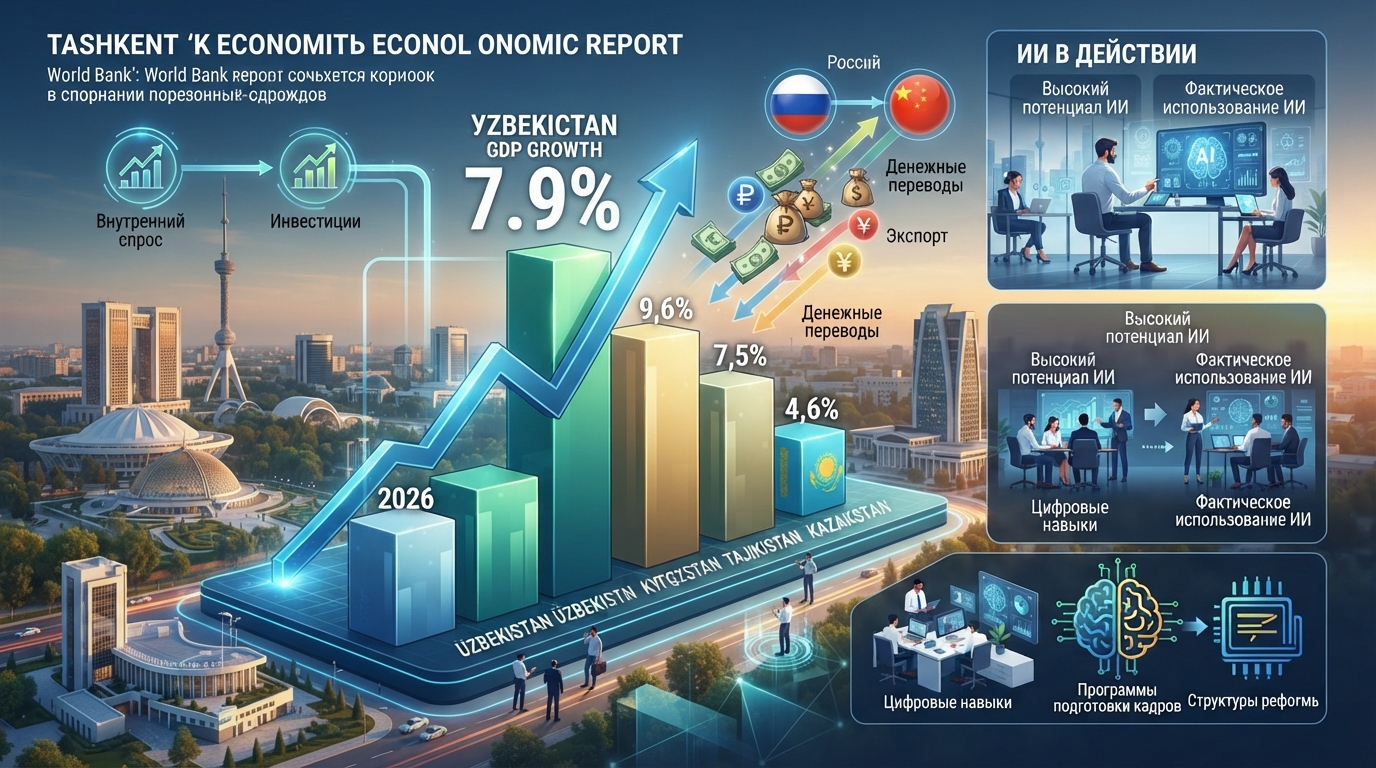
The World Bank has upgraded its economic growth forecast for Uzbekistan for 2026 by 1.5 percentage points to 7.9%
The World Bank has revised upward its GDP growth forecast for Uzbekistan for 2026: it now stands at 7.9% instead of 6.4%, which is 1.5 percentage points higher than the April estimate.
The updated data is contained in the Europe and Central Asia Economic Update report, "Artificial Intelligence in Action: Jobs, Firms, and Productivity," published on October 6.
The forecast for 2027 has also increased — from 6.7% to 7.5%, or by 0.8 percentage points. In 2028, the bank expects Uzbekistan's economy to grow by 7.1%.
According to the table in the report, in 2026 Uzbekistan will rank second in terms of growth rate among the emerging and developing economies of Europe and Central Asia (ECA) under consideration. A higher figure is expected only for Kyrgyzstan — 9.6%. In 2027, according to the WB forecast, Uzbekistan will take first place with a growth of 7.5%.
The WB attributes the economic upturn in Uzbekistan to robust domestic demand, supported by real wage growth, rising employment, remittances, and investments in infrastructure, energy, and housing. The bank also points to the role of ongoing structural reforms.
The volume of remittances to the country in the first half of 2026 grew by 13% to a record $9.2 billion for this period. About 70% of the inflows came from Russia.
Uzbekistan's non-gold exports increased by nearly 30% due to expanded shipments to China and neighboring Central Asian countries. At the same time, total exports declined due to a reduction in gold shipments, the report says.
Uzbekistan also continues to attract significant foreign direct investment, including in major projects in energy, digital infrastructure, and industry. According to the WB, investments from foreign sources, including direct investments and loans, already account for more than 70% of all investments in the country.
The fiscal deficit in 2026, according to the bank's forecast, will remain almost unchanged at 2.2% of GDP. The growth in social and investment spending will be offset by reductions in energy subsidies and targeted lending to state-owned enterprises, as well as an increase in budget revenues, experts believe.
At the same time, in Uzbekistan, Kyrgyzstan, and Tajikistan, more than 60% of private sector employment remains informal. Over the past five years, this figure has barely changed.
"Growth is currently not creating enough productive, formal jobs for the growing working-age population," the authors note, referring to Central Asia.
Central Asia remains the fastest-growing subregion of ECA. According to the World Bank's estimate, growth here was 7.1% in 2025, and is expected to slow to 5.8% in 2026. The economy will continue to be supported by robust domestic demand and public investment in transport and energy.
In 2026, the three highest growth rates among ECA's emerging economies are again expected in Central Asian countries: Kyrgyzstan — 9.6%, Uzbekistan — 7.9%, and Tajikistan — 7.5%. Kazakhstan's economic growth is projected at 4.6%.
In 2027, subregional GDP growth is expected to slow to 5.4%, and in 2028 — to 5.1%.
Economic activity in Central Asia is supported by domestic demand and public investment in transport and energy. Among the major projects, the report names the China-Kyrgyzstan-Uzbekistan railway, the Trans-Caspian Transport Corridor, and the Rogun HPP.
Overall, in the emerging and developing economies of Europe and Central Asia, growth will slow from 2.6% in 2025 to 2.2% in 2026. The bank attributes this to high energy prices, geopolitical uncertainty, and weakening growth among major trading partners. Russia is expected to grow by 0.8%, while the region excluding Russia is projected to grow by 3%.
Among the risks, the WB highlights further trade disruptions, the ongoing war in Ukraine, rising costs of energy, transport, and fertilizers, tightening financing conditions, and extreme weather events.
A separate section of the report is dedicated to how artificial intelligence can boost productivity and help the region's countries cope with a shrinking working-age population.
Approximately one in five workers in the region is employed in a position whose tasks are highly exposed to the impact of AI. At the same time, less than one in 10 companies use it, mostly for basic tasks.
In Uzbekistan, the highest exposure to AI is observed among clerks performing administrative and support tasks.
According to the March 2026 round of the "Listening to Uzbekistan" survey, AI is used at work by 48% of professionals and 43% of managers. Among office clerks — the group with the highest share of tasks that can be automated with AI — this figure is 27%.
At the same time, AI is also used by representatives of professions where the potential for task automation using AI is estimated as practically zero. For example, 16% of elementary workers reported this.
The authors point to a lack of basic digital skills as one possible explanation for the gap between automation potential and actual AI use. In one of the subsequent survey rounds, about 39% of employed respondents reported that they could not copy or move a file on a phone or computer without assistance.
The WB recommends that countries develop basic, digital, and managerial skills, expand access to computing power, and prepare worker support programs. Uzbekistan is named among the countries already implementing sector-specific advanced training programs for working with AI.